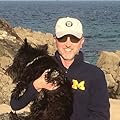
Introducing Robert
Robert Adams accidentally emigrated from the United States when, pursuing a career opportunity in London, he met his future wife almost immediately. Half a lifetime later, as retirement hit him like the psychological equivalent of a diver resurfacing too quickly, he attended a Dutch psychedelic retreat. Encouraged to journal, he began writing about the experience and other unusual daily encounters, reframing each positively and humorously.
Notes from My Psychedelic Years is his first book. To protect privacy, he has altered the identities of eight locations, four organisations, three occupations, one film, and the names of more than one hundred people, including himself, in these stories. Everything else is completely factual.
An Interview with the Author:
Can you describe the book in 10 words?
A comedic memoir of a man in search of himself.
Why all the name changes?
I have a friend who is a rather famous actor but prefers a quiet life. When he saw that he makes a brief appearance late in the book, he asked me if I could disguise him. To make his hidden identity more secure, I realised that I would have to disguise others as well. This began a cascade of name changes, including my own.
How did you choose your pen name and would you be able to tell us your real name?
In 2024, I asked an editor to read my draft and tell me honestly whether the book had any merit. Much to my surprise, he said yes. He encouraged me to accentuate the comedy even more, saying that the entertainment value of the book provided a very readable way of imparting its gentle lessons. When we became good friends, I decided to adopt his surname (Adams) as my own. My real name is Robert Bloom. There are so many disguised identities in the book that I don't believe there's any danger of other characters being discovered as a result of revealing my own name.
Why did you choose to write this book?
I didn't. It just seemed to happen. Encouraged to journal as part of my first psychedelic retreat, I discovered afterwards that by re-reading my own notes, I was able to keep the experience fresh in my mind and embed lessons I had learned during what we call the integration process. Struck on occasion by how day-to-day occurrences could be as strange as those in psychedelic journeys, I began capturing them, too, in writing. Over time, I saw a progression in my writing towards acceptance, healing, and gratitude, and I began to wonder if there was a story to tell. And that's why it took seven years from start to finish, because I didn't realise I was writing a book for at least four of those years.
How did you arrive at the format of the book?
I wanted to tell a story in the form of first-last-middle-aftermath, but also make it more interesting by adding asynchronous events where they fit, either to provide context or sometimes just for comic relief. I used my three psychedelic retreats to anchor a book written in four sections. In each of the first three sections, a chronological story is told about one of the retreats. In the opening section, there's the initial experience, which is profound but not quite deep enough. Then, in the second section, there's the final experience and the realisation of now being, largely and for lack of a better word, healed. After that, there's the long third section about the middle and most significant of the retreats, which reveals more than the other ones do. The fourth and final section of the book comprises stories that reflect the character's growth afterwards.
Who are your writing influences and how would you characterise your own style?
I can't cite any one author. Also, I'm not sure I've seen anyone write quite like this before. More seriously, though, during the process I noticed a style developing in my writing and I chose to lean into it. We have a first-person, semi-omniscient narrator, writing in the present tense, for immediacy, even when the events are in the past. He is occasionally aware of what is going to happen next, though he sometimes states that he cannot do anything about this because he is, after all, living in the present tense. Comedy is created by extensive use of asides that show us a narrator who recognises the absurdity in certain situations, but takes pains to pretend that all is normal. He is the quintessential willing outsider.
The book references some serious issues including identity, depression, aging parents, death, and personal isolation, but never lingers long on them. Why?
I suppose I felt that even though these issues are universal, they are also quite personal. So, rather than over-reveal, I thought it would be better if I could, to some extent, let it be the reader's own story. Also, I wanted to keep it light, to entertain both the reader and myself. As for not lingering on serious issues, I think that sometimes the best way to inform is to do it without the reader even noticing it's happening.
Many who have undertaken a therapeutic, high-dose psychedelic journey have described it as the single most significant experience of their lives. Where do you stand on this?
It's close! I'm going to place it fourth. In first place is a Wednesday evening in August 1992 at the Campden Hill Lawn Tennis Club, in Kensington (London). I never intended to stay in England beyond my initial two-year work permit. Meeting my future wife that night changed everything. She was, and is, exactly what I needed, and my life has been so much fuller as a result. In second place is a phone call I received in December 1976. It began with "Congratulations," to which I responded, "What did I do?" My acceptance to Yale University, which took a shy teenager out of a small town and placed him into a learning environment of boundless possibilities, gave me the courage to dream and the willingness to endlessly experiment and take chances in my life. In third place is the whole period from 1996 to 2000 when I overcame my paralysing fear of public speaking and repeatedly challenged myself to become someone I could be proud of. Finally, in fourth place, there would be the psychedelic journeys, particularly the ones in November 2018. I haven't really experienced depression since. And I'm no longer even sure it was depression.
What would you tell people about psychedelics and mental health?
I can really only speak about psilocybin – that is, magic mushrooms or magic truffles – though my understanding is that the other classic psychedelics work quite similarly. Psilocybin has now been studied extensively, producing positive results in the treatment of depression, addiction, OCD, and various anxiety-related conditions. I personally have witnessed this. Still, there are caveats. For one, it is illegal in most jurisdictions. Also, the therapeutic high-dose experience – which is marked by wearing eyeshades, listening to a curated playlist, and facilitated by experienced sitters in a safe environment – is not recreational. The dose can be much greater, the experience is primarily an inward one – which can be beautiful, terrifying, or both – and the nature of the setting is conducive to more profound outcomes. Finally, since psilocybin produces short-term cognitive entropy, it may be dangerous for those who have a family history of psychosis, and this is one of the reasons why retreat organisations work hard in pre-screening participants. On the whole, though, I believe that psychedelic experience, in a safe setting, can be profoundly positive for our cognitive health.
Before writing and before the endless hobbies, what did you do for a career?
I graduated from Yale in 1981 and Harvard in 1983, studying applied mathematics, biostatistics, and epidemiology. In my early career, I worked in cancer clinical trials at the Dana-Farber Cancer Institute and then in new drug trials at Johnson & Johnson. I migrated to Wall Street in the late 1980s during an era of bringing in quantitative expertise, working first in mortgage-backed securities research, then in trading mortgage-backed securities and bond options, at Merrill Lynch, Franklin Savings Association, and Kidder Peabody. I moved to London to start a European bond options trading desk at S.G. Warburg Securities. By 1995, I was married with a first child on the way and looking for a house, so I wanted a less stressful career. Mistakenly, I thought that would be management consulting! Working at the former Coopers & Lybrand, then its successor firm PwC, I grew my skill set tremendously, but discovered a whole new level of stress. Following that, I was global head of foreign exchange risk management at Citigroup, where I worked for 3 years. That led to my joining an investment manager, Record Currency Management, where I worked for 7 years, heading portfolio management and product development, and helping them to list on the London Stock Exchange by codifying and writing the firm's suite of policies for its numerous investment products and corporate practices. I finished my career back in consulting, at EY. If I have regrets, they're twofold. First, in not finding a career more people-oriented. And second, in losing touch with so many extraordinary colleagues. In retirement, I've worked for a disabilities charity, acquired a degree in psychometrics, and become a Highlands Ability Battery consultant, helping young people with educational and career choices.
Read more
Read less