

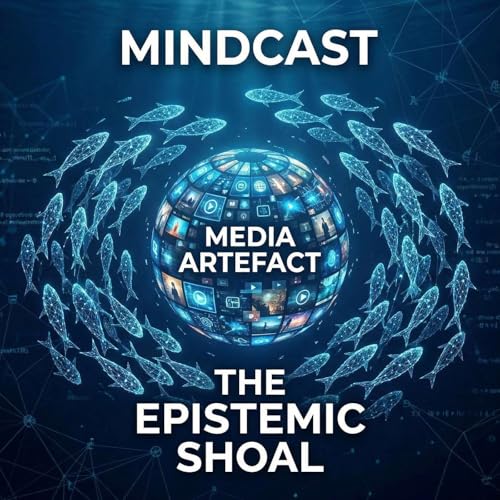
The Epistemic Shoal | Algorithmic Swarming, Participatory Bait Balls, and the Restructuring of Social Knowledge in the Post-Broadcast Era
Failed to add items
Add to cart failed.
Add to wishlist failed.
Remove from wishlist failed.
Follow podcast failed
Unfollow podcast failed

The Epistemic Shoal | Algorithmic Swarming, Participatory Bait Balls, and the Restructuring of Social Knowledge in the Post-Broadcast Era
-
Narrated by:
-
Written by:
About this listen
Send us a text
The history of media is often recounted as a history of technologies—the printing press, the radio tower, the television set, and the server farm. However, a more profound history lies in the evolution of the audience itself, the shifting topology of human attention and collective consciousness. Central to this query posits a striking and biologically resonant metaphor for the contemporary digital condition: the YouTube audience not as a static "mass" or a seated "crowd," but as a shoal of fish, swarming from content to content, associated not by species (demographics) but by interest (psychographics). In this model, the media artefact functions as a "bait ball" a sphere of topical, enthralling content that triggers a feeding frenzy of interaction before the shoal disperses into the digital deep, relegating the video to the sediment of social media history.
This podcast validates and rigorously expands upon this metaphor, arguing that it perfectly encapsulates the ontological shift from solid modernity characterised by stable institutions, centralised gatekeepers, and linear information flow to liquid modernity, defined by fluidity, algorithmic currents, and ephemeral swarming. The transition is not merely functional but structural and epistemic. We have moved from the "Broadcast Era," where knowledge was a finished product delivered to a passive recipient, to the "Networked Era," where knowledge is a negotiated process occurring within the friction of the swarm.
To understand this paradigm, we must synthesize the media theory of Byung-Chul Han, who distinguishes the "digital swarm" from the traditional "mass"; the pedagogical framework of Connectivism proposed by George Siemens, which re-imagines learning as network formation; and the technical realities of deep reinforcement learning algorithms that govern the hydrodynamics of these digital oceans. The "bait ball" in nature, a defensive mechanism adopted by prey becomes in the digital ecosystem a mechanism of attraction and capture, an algorithmic construct designed to concentrate attention for monetisation before the inevitable decay of novelty disperses the shoal.
This analysis explores the anatomy of this new paradigm. We examine the decline of the "Broadcast Era" and its gatekeepers, the rise of the "Networked Era" and its gatewatchers, and the specific mechanics of the YouTube algorithm that creates these "interest shoals." We evaluate the implications for learning contrasting the deep, linear literacy of the book with the associative, rhizomatic literacy of the video link and finally, assess the epistemic consequences of a society where truth is increasingly negotiated through viral consensus rather than authoritative verification.