

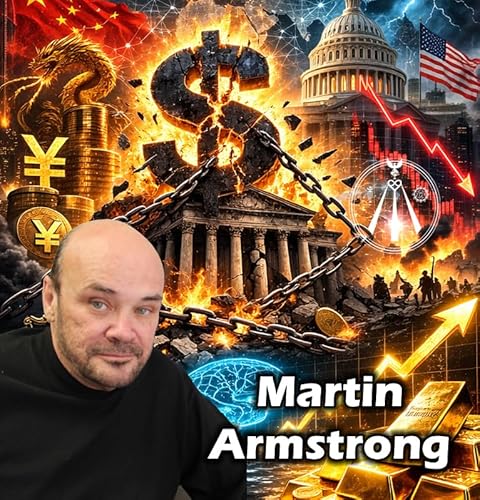
The Multipolar Collapse and the Illusion of AI with Martin Armstrong
Failed to add items
Add to cart failed.
Add to wishlist failed.
Remove from wishlist failed.
Follow podcast failed
Unfollow podcast failed

The Multipolar Collapse and the Illusion of AI with Martin Armstrong
-
Narrated by:
-
Written by:
About this listen
Legendary forecaster Martin Armstrong warns that the world is entering a new phase of distributed global conflict, not World War III in the traditional sense, but simultaneous regional tensions (Iran-Israel, China-Taiwan, Russia-Europe, North Korea-South Korea) that reflect resurfacing historical grudges. Armstrong attributes this partly to geopolitical miscalculation by neoconservatives, particularly regarding Ukraine, where he claims deliberate provocation destabilized the region. He argues that Europe's economic stagnation and leadership (specifically Macron) are driving the continent toward military adventurism as a distraction from systemic collapse. Meanwhile, capital will continue to flow strategically, currently favoring the U.S. market over a weakened Europe, with China poised to eventually replace the dollar's reserve status, though not until after 2032.
On AI, Armstrong directly challenges the hype: artificial intelligence excels at pattern recognition and synthesis but cannot create original ideas, a critical limitation that dooms most AI applications to failure in dynamic fields like trading and forecasting. He also addresses the accelerating debt crisis (now $38 trillion), central bank digital currencies as an end-run around constitutional protections, and gold's trajectory toward $5,000+ as capital preservation. His core thesis remains unchanged: the entire Western system faces mathematical insolvency within the decade, with governments deliberately manufacturing external enemies to delay the reckoning.
Martin Armstrong forecasting, World War III predictions, dollar reserve currency, central bank digital currency, economic collapse 2032, Ukraine geopolitics, AI limitations trading, gold price $5000, China replaces dollar, Western debt crisis