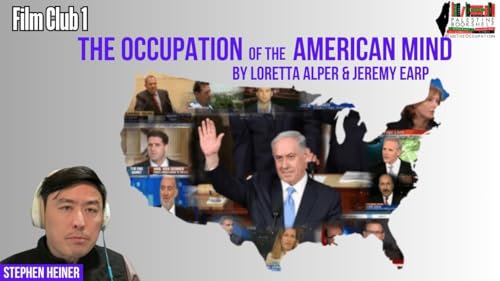
The Occupation of the American Mind: Israel's Public Relations War in the United States by Loretta Alper & Jeremy Earp cover art

The Occupation of the American Mind: Israel's Public Relations War in the United States by Loretta Alper & Jeremy Earp

The Occupation of the American Mind: Israel's Public Relations War in the United States by Loretta Alper & Jeremy Earp

Listen for free

View show details

About this listen

also viewable on Substack: https://open.substack.com/pub/palestinebookshelf/p/the-occupation-of-the-american-mind Copy of the summary: https://docs.google.com/document/d/1KiBSLYqj5qd2TXU4cE9pLfRGg3Pdis7rd5fwQxwx-Tw/edit?tab=t.ji3qeguq19vq OVERVIEW This livestream focuses on the film's examination of how pro-Israel public relations strategies shape U.S. media coverage and public opinion to sustain support for Israel's policies toward Palestinians. The host praises the film's concise structure (discussing the 49-minute version), effective use of news footage for historical context, and its exposure of scripted propaganda tactics. MAIN THESIS The film and the presenter's commentary argue that American support for Israel is not organic or based on shared values but manufactured through sophisticated, coordinated public relations efforts that dominate media discourse, frame Israel as the perpetual victim seeking peace, demonize Palestinians (especially Hamas), and suppress dissenting views on occupation, settlements, and self-determination. The host contrasts views on power dynamics (e.g., Chomsky's U.S.-leads-Israel vs. Mearsheimer's Israel-leads-U.S.), siding with the latter due to observed policy alignment, and frames the PR apparatus as a tool to override facts, international law, and growing public awareness of Palestinian realities. HISTORICAL CONTEXT The discussion connects to long-standing U.S.-Israel ties and media bias in covering the conflict, referencing events like Israel's 2005 Gaza disengagement (portrayed in PR as a peace gesture met with "rockets"), the 1967 borders as a potential basis for resolution, and the origins of Hamas (allegedly supported by Israel to fragment Palestinian unity). It critiques a circa-2009 pro-Israel PR directive (likely from The Israel Project) for scripting responses during the Obama era, and ties this to current realities where opposition to two-state solutions has intensified in Israel, student protests face heavy suppression, and narrative enforcement grows more forceful amid Gaza events. The host situates it within the broader "war on the Palestinians since 1917" and one-way "awakening" to pro-Palestinian perspectives. KEY IDEAS PR scripting and media echo chambers: The directive provides verbatim talking points (e.g., "Israel gave up Gaza with hopes of peace and only got rockets," "peace is Israel's trump card") that pundits repeat to deflect criticism and isolate Hamas. Narrative control and suppression: Anti-Israel views (e.g., student encampments, silent prayer) face disproportionate crackdowns compared to other protests, signaling intolerance for challenges to the dominant frame. Power imbalance and awakening: Awareness of Palestinian suffering is growing irreversibly due to direct exposure (books, visits, recent events), with no parallel shift toward pro-Israel narratives. Propaganda tactics: Emphasis on "peace first, boundaries second" ignores feasibility of 1967 lines; dismissal of Hamas ignores its contextual roots and Arab/Palestinian condemnations influenced by U.S. leverage. Film strengths: Tight editing, historical news clips, and demonstration of U.S. ability (but unwillingness) to impose boundaries or policy changes. EVIDENCE AND RESEARCH The presenter draws from direct readings of the pro-Israel PR directive, film's content including news footage and expert commentary, polls showing low Israeli support for two-state solutions, and references to scholars like Mearsheimer. The host cites personal experiences (visiting Palestine, reading histories) and current observations (protest suppressions, policy shifts post-2023). The film's free availability and use of real media examples are highlighted as accessible evidence. RECEPTION The host positions the film as highly recommended for its clarity and impact, especially for newcomers, and notes positive viewer comments praising its exposure of "lies" and urging wider viewing. It faces no direct controversy in the stream but is contextualized amid broader barriers to Palestine-related narratives (e.g., threats, suppression). IMPACT AND LEGACY The presenter sees the film as a vital tool for understanding how U.S. public opinion is shaped to enable ongoing occupation and conflict, contributing to "cracks" in propaganda and growing awareness. It strengthens advocacy by arming viewers with facts to counter dominant narratives. Find other summaries like this at Palestine Bookshelf: www.palestinebookshelf.org #EndTheOccupation
No reviews yet