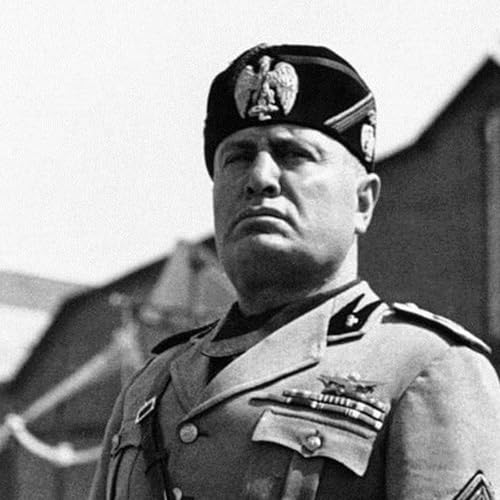
27 - Fascist Italy. Mussolini in power. cover art

27 - Fascist Italy. Mussolini in power.

27 - Fascist Italy. Mussolini in power.

Listen for free

View show details

About this listen

Fascist Italy. Mussolini in power. Upon being appointed Prime Minister of Italy, Mussolini had to form a coalition government because the fascists did not have control over the Italian parliament. Mussolini's coalition government initially pursued economically liberal policies under the direction of liberal finance minister Alberto De Stefani, a member of the Center Party, including balancing the budget through deep cuts to the civil service. Initially, little drastic change in government policy had occurred and repressive police actions were limited. The fascists began their attempt to entrench fascism in Italy with the Acerbo Law, which guaranteed a plurality of the seats in parliament to any party or coalition list in an election that received 25% or more of the vote. Through considerable fascist violence and intimidation, the list won a majority of the vote, allowing many seats to go to the fascists. In the aftermath of the election, a crisis and political scandal erupted after Socialist Party deputy Giacomo Matteotti was kidnapped and murdered by a Fascist. The liberals and the leftist minority in parliament walked out in protest in what became known as the Aventine Secession. On 3 January 1925, Mussolini addressed the Fascist-dominated Italian parliament and declared that he was personally responsible for what happened, but insisted that he had done nothing wrong. Mussolini proclaimed himself dictator of Italy, assuming full responsibility over the government and announcing the dismissal of parliament. From 1925 to 1929, fascism steadily became entrenched in power: opposition deputies were denied access to parliament, censorship was introduced and a December 1925 decree made Mussolini solely responsible to the King. Catholic Church. In 1929, the fascist regime briefly gained what was in effect a blessing of the Catholic Church after the regime signed a concordat with the Church, known as the Lateran Treaty, which gave the papacy state sovereignty and financial compensation for the seizure of Church lands by the liberal state in the 19th century, but within two years the Church had renounced fascism in the Encyclical Non Abbiamo Bisogno as a "pagan idolatry of the state" which teaches "hatred, violence and irreverence". Not long after signing the agreement, by Mussolini's own confession, the Church had threatened to have him "excommunicated", in part because of his intractable nature, but also because he had "confiscated more issues of Catholic newspapers in the next three months than in the previous seven years". By the late 1930s, Mussolini became more vocal in his anti-clerical rhetoric, repeatedly denouncing the Catholic Church and discussing ways to depose the pope. He took the position that the "papacy was a malignant tumor in the body of Italy and must 'be rooted out once and for all,' because there was no room in Rome for both the Pope and himself." In her 1974 book, Mussolini's widow Rachele stated that her husband had always been an atheist until near the end of his life, writing that her husband was "basically irreligious until the later years of his life". The Nazis in Germany employed similar anti-clerical policies. The Gestapo confiscated hundreds of monasteries in Austria and Germany, evicted clergymen and laymen alike and often replaced crosses with swastikas. Referring to the swastika as "the Devil's Cross", church leaders found their youth organizations banned, their meetings limited and various Catholic periodicals censored or banned. Government officials eventually found it necessary to place "Nazis into editorial positions in the Catholic press". Up to 2,720 clerics, mostly Catholics, were arrested by the Gestapo and imprisoned inside of Germany's Dachau concentration camp, resulting in over 1,000 deaths. Corporatist economic system. The fascist regime created a corporatist economic system in 1925 with creation of the Palazzo Vidoni Pact, in which the Italian employers' association Confindustria and fascist trade unions agreed to recognize each other as the sole representatives of Italy's employers and employees, excluding non-fascist trade unions. The Fascist regime first created a Ministry of Corporations that organized the Italian economy into 22 sectoral corporations, banned workers' strikes and lock-outs and in 1927 created the Charter of Labour, which established workers' rights and duties and created labour tribunals to arbitrate employer-employee disputes. In practice, the sectoral corporations exercised little independence and were largely controlled by the regime, and the employee organizations were rarely led by employees themselves, but instead by appointed Fascist party members. Aggressive colonial and foreign policies. In the 1920s, Fascist Italy pursued an aggressive foreign policy that included ambitions to expand Italian territory. In response to revolt in the Italian colony of Libya, Fascist Italy abandoned previous liberal-era ...
No reviews yet