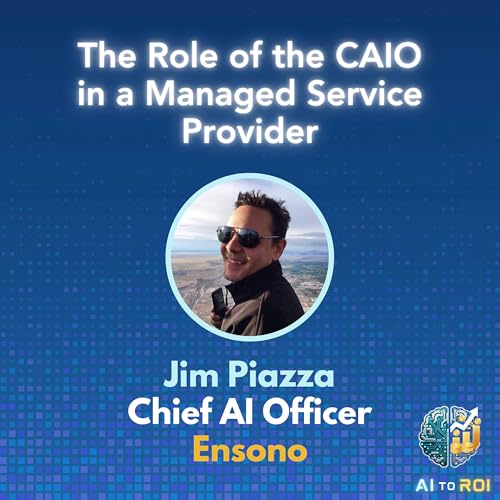
The Role of the CAIO in a Managed Service Provider - with Jim Piazza, CAIO Ensono cover art

The Role of the CAIO in a Managed Service Provider - with Jim Piazza, CAIO Ensono

The Role of the CAIO in a Managed Service Provider - with Jim Piazza, CAIO Ensono

Listen for free

View show details

About this listen

Ray Rike sits down with Jim Piazza, Chief AI Officer at Ensono, a managed services provider scaling AI across both its internal operations and customer environments. Jim brings a rare combination of deep infrastructure experience, nearly a decade at Meta scaling data center operations with machine learning, and a rigorous framework for connecting AI investments to business outcomes that executive operators can actually measure.Key Topics:Defining the Chief AI Officer Role in an MSP: Jim describes the CAIO role as a blend of CDO, CIO, and CTO with an AI lens, but with a critical distinction: the job is not to ask what AI can do. It is to identify where AI improves service delivery, customer outcomes, and financial performance. At Ensono, that meant starting small as VP of Predictive Systems, demonstrating results, and earning the mandate to expand. Prioritization, not ideation, is the core skill.Building AI Tools That Drive Internal Operational ROI: Ensono developed three production AI systems for internal use. Envision Predictive Engine analyzes telemetry data across systems to predict failures before they cause business impact, including one case where a problem was detected 144 minutes before it would have affected a major logistics customer outside Ensono's own scope of responsibility. Diagnose Now puts the right diagnostic data in front of engineers at the right moment and has delivered up to a 66% reduction in mean time to repair in A/B testing. ChangeGuardian assesses risk scores for the 8,000-plus changes Ensono executes monthly, auto-generating methods and procedures from a decade of historical change data to reduce both risk and manual effort.Structuring AI Governance: The Three Musketeers Model: Jim, the CTO, and the CIO operate as a deliberate leadership triad. The CTO owns the platforms. The CIO owns data quality and structure. The CAIO owns the build-versus-buy decision and solution development. Shared accountability, not siloed ownership, drives alignment. Each business unit also contributes one to two subject matter experts through a formal value stream mapping process to identify where AI should focus first.Measuring AI ROI Before Writing a Line of Code Jim's most consistent lesson: define your value metrics before touching the technology. AI use cases must tie back to core business metrics such as mean time to repair, customer satisfaction, SLA risk reduction, and gross margin improvement. Business unit leaders own the outcome measurement. The CAIO owns the budget and the technology. That separation of responsibility keeps AI programs anchored to results rather than activity.The CAIO and CIO Relationship: Where the Lines Get Drawn: For companies bringing in a Chief AI Officer alongside an existing CIO, Jim offers a practical delineation. The CIO owns data infrastructure and quality. The CAIO is a consumer and a builder who depends on that foundation. Without clean, accessible data, AI programs stall regardless of the use case. The CAIO's job is to surface missing or insufficient data and partner with the CIO to close the gap.Lessons Learned and Career Advice for the AI Era: Jim's framework for AI program success: start with one or two high-probability use cases where data is already in good shape, build credibility through results, then expand. Avoid the ten-pilot trap. Kill weak use cases early. For early-career professionals, his advice is equally direct: learn to work with AI, not compete with it. Build problem framing, critical thinking, and business judgment. Technical fluency matters, but business judgment is what separates the people AI replaces from the ones AI makes more valuable.This episode is essential listening for technology and operations executives navigating the practical reality of AI deployment inside complex enterprise environments. If you are a CIO, CTO, COO, or Chief AI Officer trying to figure out how to structure governance, measure impact, and build internal credibility for AI programs, Jim Piazza gives you a real-world operating model, not theory. For managed services leaders and enterprise buyers evaluating MSP capabilities, the Ensono case studies show what it looks like when an MSP moves from reactive service delivery to predictive, AI-driven outcomes. And for executives still debating whether to hire a Chief AI Officer, this conversation makes a direct case for what the role should own, how it should partner, and what success looks like when it is done right.See Privacy Policy at https://art19.com/privacy and California Privacy Notice at https://art19.com/privacy#do-not-sell-my-info.
No reviews yet