How to lead people through change when your decisions hurt them cover art

How to lead people through change when your decisions hurt them

How to lead people through change when your decisions hurt them

Listen for free

View show details

About this listen

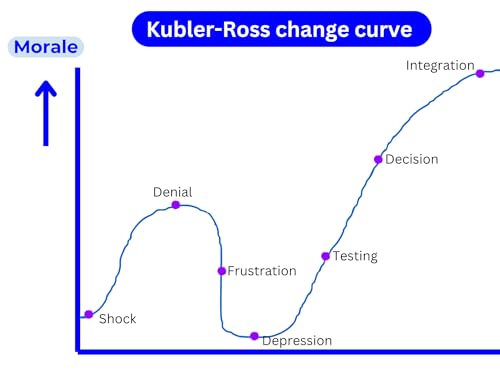
Leadership often gets framed as strategy.Markets. Growth. Performance.But some of the most important decisions you’ll ever make have nothing to do with spreadsheets.They’re the ones that affect people.And sometimes, those decisions are painful.There are moments in every business where doing the right thing for the organisation means negative consequences for individuals.Restructures.Redundancies.Role changes.No leader enjoys making those calls.But avoiding them isn’t leadership.It’s avoidance.The real responsibility is twofold:* Make the right decision for the business* Support people through the impact of that decision“The right thing isn’t to duck the decision, it’s to support people through it.”This is where many leaders struggle.Not with the decision itself.But with what comes next.Because once the decision is made, people don’t respond logically.They respond emotionally.And those emotions follow a pattern.This model, often referred to as the Kübler-Ross Change Curve, provides a useful lens.It doesn’t remove the difficulty.But it helps you understand what people are going through.And how to support them effectively.At first, there’s denial.“This can’t be happening.”“There must be a mistake.”Then frustration.“Why me?”“This isn’t fair.”And then the most difficult stage:Depression.The point where uncertainty and fear peak.This is the moment that matters most.Because it’s where support is critical.Not just managerial support but real, human support.Understanding.Guidance.And, where necessary, professional help.Over time, something shifts.People begin to test possibilities.They start asking:“What now?”“What could I do next?”And from there, they move toward decision.Choosing a path forward.And eventually, integrating that change into their lives.Here’s what we’ll explore next:* How to recognise each stage of the change curve* What support looks like at different points* How to lead with clarity and empathy at the same time* How to handle difficult decisions without avoiding themHow to Support Your Team Through Difficult ChangeStart by accepting the emotional journey.When people are affected by negative change, their reactions are not random.They move through stages:* Denial* Frustration* Depression* Exploration* Decision* IntegrationUnderstanding this helps you respond appropriately.Recognise where individuals are.Not everyone moves at the same pace.Some may still be in denial while others are already exploring options.Your role is to:* Listen carefully* Observe behaviour and language* Tailor your support accordinglyProvide the right support at the right time.In early stages:* Be clear and consistent with communication* Avoid overloading with detail* Allow space for reactionIn the most difficult stage (depression):* Increase support* Offer practical help* Consider professional support where neededEncourage forward movement without forcing it.As people begin to explore:* Help them consider options* Support retraining or reskilling* Provide guidance where possibleThis is where momentum returns.Accept what you can’t control.As individuals move forward, they will make their own decisions.Some may leave.Some may find better opportunities elsewhere.That outcome is not fully within your control.What is within your control is how you lead them through the transition.Leadership isn’t just about making the right decision.It’s about taking responsibility for the human impact of that decision.That’s what defines strong leadership.The toughest moments are where leadership is most visible.Handle them well and people remember.Handle them poorly and they remember that too.Play your business leadership cards right by Bob Bradley is a reader-supported publication. To receive new posts and support my work, consider becoming a free or paid subscriber.They’re written for those responsible for leading organisations and making decisions where the answers are rarely straightforward.I also work with leadership teams through workshops, talks, and one-to-one conversations.You can find out more or get in touch here:WebsiteLinkedIn This is a public episode. If you'd like to discuss this with other subscribers or get access to bonus episodes, visit bobonbusiness.substack.com/subscribe
No reviews yet