

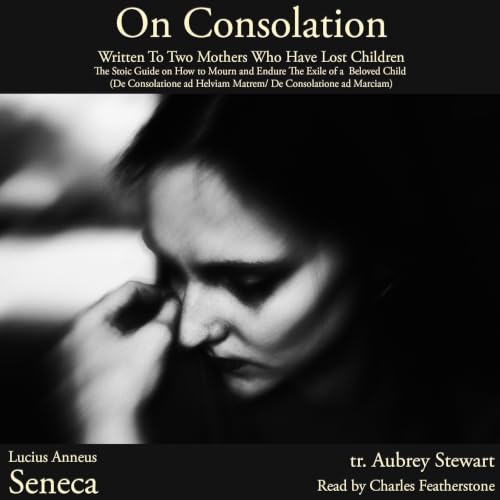
On Consolation: Written To Two Mothers Who Have Lost Children
The Stoic Guide on How to Mourn and Endure The Exile of a Beloved Child (De Consolatione ad Helviam Matrem/ De Consolatione ad Marciam)
Failed to add items
Sorry, we are unable to add the item because your shopping basket is already at capacity.
Add to cart failed.
Please try again later
Add to wishlist failed.
Please try again later
Remove from wishlist failed.
Please try again later
Follow podcast failed
Unfollow podcast failed
 New to Audible Prime Member exclusive:
 2 credits with free trial
1 credit a month to use on any title to download and keep
Listen to anything from the Plus Catalogue—thousands of Audible Originals, podcasts and audiobooks
Download titles to your library and listen offline
₹199.00 per month after 30-day trial. Cancel anytime.

On Consolation: Written To Two Mothers Who Have Lost Children
Narrated by:
Charles Featherstone
Buy Now for ₹187.00
-
Narrated by:
-
Charles Featherstone
-
Written by:
-
Lucius Anneus Seneca
-
Aubrey Stewart
The two most personal letters that Seneca wrote were to his mother, after he had been exiled to Corsica, and to Marcia, who had just lost her son. In both, he consoles a mother who is overwhelmed by grief. No parent should ever lose a child, or have them taken so far away that they may never see them again.
To Marcia, he gives a bracing, almost fierce call to break grief’s stranglehold. He tells her not by denying pain, but also recognise that the dead are beyond suffering, given the release nature grants all things, and that endless mourning dishonours the life she loved.
To his mother Helvia, torn apart by her son’s absence and public disgrace, Seneca consoles her with the fact that exile is no great burden, and she has always been a model of virtue and strength; that his two brothers are still there, and his adopted child needs her.
Written with his classic style, but a strong dose of pathos and sympathy that is often missing from his more abstract ruminations, these are letters from a son, a friend, a fellow sufferer, who is determined to heal wounds he knows firsthand. They overflow with a mix of grit and tenderness, as Seneca shows that grief, when met with reason and love, can transform into a deep, unshakeable memory, and that even the most crushing loss can become the ground on which a sturdier self is built.
adbl_web_anon_alc_button_suppression_t1
No reviews yet