

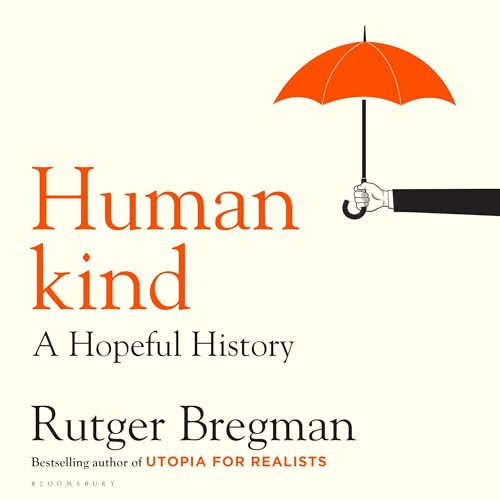
Humankind
A Hopeful History
Failed to add items
Sorry, we are unable to add the item because your shopping basket is already at capacity.
Add to cart failed.
Please try again later
Add to wishlist failed.
Please try again later
Remove from wishlist failed.
Please try again later
Follow podcast failed
Unfollow podcast failed
Listen with Audible free trial
 New to Audible Prime Member exclusive:
 2 credits with free trial
1 credit a month to use on any title to download and keep
Listen to anything from the Plus Catalogue—thousands of Audible Originals, podcasts and audiobooks
Download titles to your library and listen offline
₹199.00 per month after 30-day trial. Cancel anytime.

Humankind
Narrated by:
Rutger Bregman, Thomas Judd
Buy Now for ₹667.71
-
Narrated by:
-
Rutger Bregman
-
Thomas Judd
-
Written by:
-
Rutger Bregman
THE SUNDAY TIMES AND NEW YORK TIMES BESTSELLER
A Guardian, Daily Telegraph, New Statesman and Daily Express Book of the Year
‘Hugely, highly and happily recommended’
Stephen Fry
‘You should read Humankind. You’ll learn a lot (I did) and you’ll have good reason to feel better about the human race’
Tim Harford
‘The book we need right now’
Daily Telegraph
'Made me see humanity from a fresh perspective'
Yuval Noah Harari
It’s a belief that unites the left and right, psychologists and philosophers, writers and historians. It drives the headlines that surround us and the laws that touch our lives. From Machiavelli to Hobbes, Freud to Dawkins, the roots of this belief have sunk deep into Western thought. Human beings, we’re taught, are by nature selfish and governed by self-interest.
Humankind makes a new argument: that it is realistic, as well as revolutionary, to assume that people are good. The instinct to cooperate rather than compete, trust rather than distrust, has an evolutionary basis going right back to the beginning of Homo sapiens. By thinking the worst of others, we bring out the worst in our politics and economics too.
In this major book, internationally bestselling author Rutger Bregman takes some of the world’s most famous studies and events and reframes them, providing a new perspective on the last 200,000 years of human history. From the real-life Lord of the Flies to the Blitz, a Siberian fox farm to an infamous New York murder, Stanley Milgram’s Yale shock machine to the Stanford prison experiment, Bregman shows how believing in human kindness and altruism can be a new way to think – and act as the foundation for achieving true change in our society.
It is time for a new view of human nature.©2020 Rutger Bregman (P)2020 Bloomsbury Publishing PLC
adbl_web_anon_alc_button_suppression_t1
Critic Reviews
An optimistic historian sifts through the past in his mission to prove that mankind might not be so bad . . . A superb read - brisk, accessible and full of great stories
This is the book we need right now . . . Entertaining, uplifting . . . If Bregman is right, this book might just make the world a kinder place
Here, we visit the blitz, Lord of the Flies – both the novel and a very different real-life version – a Siberian fox farm, an infamous New York murder and a host of discredited psychological studies . . . There’s a great deal of reassuring human decency to be taken from this bold and thought-provoking book . . . It makes a welcome change to read such a sustained and enjoyable tribute to our better natures
Filled with compelling tales of human goodness . . . Bregman’s book is a thrilling read and it represents a necessary correction
Humankind displays [Bregman's] gift for synthesising libraries full of academic research into spellbinding reads. I whizzed through Humankind’s 480 pages, engrossed
The notion that we already have the capacity to radically improve the world is both an exhilarating and a daunting one
Bregman argues convincingly that what we teach and report about ourselves, we become . . . Bold, entertaining and uplifting
Bregman’s book is something of a beacon at the moment, when many are looking for values to profess in our traumatised and altered society . . . People have started to talk about this book: perhaps the moment of this entirely positive, heartening message is about to come (Alexander McCall Smith)
Lively and illuminating . . . Even a few months ago, [the idea that most people behave well in most circumstances] might have seemed, as Bregman claims, “a radical idea”. The coronavirus crisis has made it blindingly obvious
This book must be read by as many people as possible - only when people change their view of human nature will they begin to believe in the possibility of building a better world (Grace Blakeley)
One of the most powerful books I have read for a long time, and a book I have absolutely no hesitation about saying everyone needs to read, and that it will change your life if you do so (Matthew Taylor, RSA)
Rutger Bregman’s extraordinary new book is a revelation . . . Humankind is masterful in its grasp of history, both ancient and modern (Susan Cain, author of 'Quiet')
Cynicism is a theory of everything, but, as Rutger Bregman brilliantly shows, an elective one. This necessary book widens the aperture of possibility for a better future, and radically (David Wallace-Wells, author of 'The Uninhabitable Earth')
This important book is almost preternatural in its timing and argument. Rutger Bregman is poetic in his rejection of a Hobbesian view of our true natures. The gigantic upheavals of 2020 have proved him right. Reading this during lockdown changed the way I think about our humanity. We are good (Dan Snow)
Just what you need to read to cleanse your soul
Something went wrong. Please try again in a few minutes.
A must read!
Perspective - Outcome - Reality
Something went wrong. Please try again in a few minutes.
The most optimistic book I've ever read
Something went wrong. Please try again in a few minutes.
Highly recommended!
A healthy diet for the cynic in you!
Something went wrong. Please try again in a few minutes.
A new perspective to life
Something went wrong. Please try again in a few minutes.