

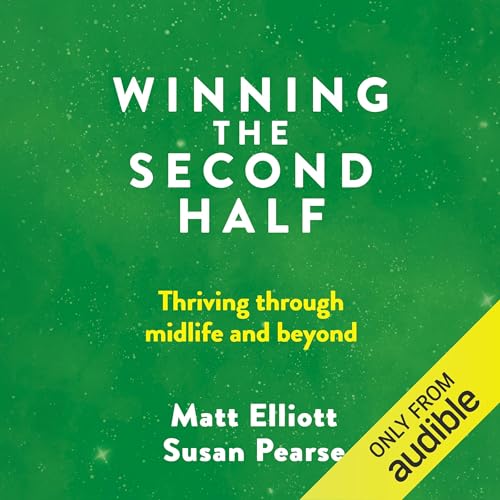
Winning the Second Half
Thriving through midlife and beyond
Failed to add items
Sorry, we are unable to add the item because your shopping basket is already at capacity.
Add to cart failed.
Please try again later
Add to wishlist failed.
Please try again later
Remove from wishlist failed.
Please try again later
Follow podcast failed
Unfollow podcast failed
Listen with Audible free trial
 New to Audible Prime Member exclusive:
 2 credits with free trial
1 credit a month to use on any title to download and keep
Listen to anything from the Plus Catalogue—thousands of Audible Originals, podcasts and audiobooks
Download titles to your library and listen offline
₹199.00 per month after 30-day trial. Cancel anytime.

Winning the Second Half
Narrated by:
Matthew Elliott, Susan Pearse
Buy Now for ₹671.06
-
Narrated by:
-
Matthew Elliott
-
Susan Pearse
-
Written by:
-
Matthew Elliott
-
Susan Pearse
Winning the Second Half is a powerful, relatable conversation between a man and a woman facing the realities of midlife head-on. With honesty, humour, and hard-won wisdom, they tackle everything from mindset shifts to emotional growth, reigniting passion to redefining success. This isn't just a book-it's a wake-up call to embrace the next chapter with clarity, confidence, and excitement. If you're ready to thrive-not just survive-in the second half of life, this is your guide.
©2026 Matthew Elliot and Susan Pearse (P)2026 Audible Australia Pty Ltd
adbl_web_anon_alc_button_suppression_t1
That said, I would like to credit the authors for their treatment of spirituality in the concluding chapters. Their approach was refreshingly sensible, nuanced, and distinct from the often repetitive discussions found in similar works. Those sections were among the strongest parts of the book.
One aspect I found disappointing was the frequent and, in my view, unnecessary use of profane language, including words such as "f**k," "s**t," and similar expressions. While "reprehensible" may seem too strong a term, I cannot help feeling that such language detracted from the overall quality of the work. Authors seeking a global readership should remain mindful that attitudes toward such expressions vary widely across cultures. In many societies, their use in civil and cultured discourse is considered inappropriate and unacceptable. While such language may be commonplace in certain Western contexts, particularly in contemporary American culture, that is not representative of much of the world. Personally, I found it unnecessary and distracting.
A further observation concerns the narration. The authors chose to read the audiobook themselves, which undoubtedly adds authenticity and may reduce production costs. However, both narrators have strong Australian accents, and I frequently found it difficult to understand certain words and phrases. On several occasions, I had to replay sections or listen with heightened concentration. While native accents certainly deserve representation, publishers aiming for a truly international audience may wish to consider professional narrators whose accents are more universally familiar to global English listeners. For many non-native English speakers, neutral international, British, or American accents are generally easier to follow and enhance the listening experience.
Overall, the audiobook contains worthwhile insights and some genuinely thought-provoking sections, particularly toward the end. Nevertheless, the excessive use of profanity and the challenging narration somewhat diminished my enjoyment of an otherwise promising work.
Worth Listening To, But Not Without Reservations
Something went wrong. Please try again in a few minutes.