• Alexander Hamilton, Aaron Burr, and the body in the well
    Jul 23 2026
    In January 1800, Elma Sands's dead body was found in a New York City well. The case has captivated people ever since, not least because in the resulting trial, defendant Levi Weeks was represented by Alexander Hamilton, Aaron Burr, and a future Supreme Court justice. The Girl from Greenwich Street: A Novel of Hamilton, Burr and America's First Murder Trial is a historical fiction novel by Lauren Willig. On this episode of the Modern Law Library, she explains how four years before their fatal duel, Hamilton and Burr came to be co-counsels on a murder case. "The New York Bar was perishingly small in 1800. And in fact, Burr and Hamilton were co-counsel on a complex commercial litigation at the exact time," says Willig. "So people were constantly–it's like swing your partners, do-si-do. They were always working together, working against each other. It was just the way the bar worked in 1800." The defendant, Levi Weeks, lived in the same boarding house as Sands, a hatmaker whose cousin owned the house. The prosecution contended that Weeks had seduced Sands with a promise of marriage, then dumped her body in the Manhattan Well. His trial was the first murder trial in America to have a court transcript, thanks to a clerk who'd recently learned shorthand. This transcript gave Willig a wealth of witness testimony to draw on when fleshing out her characters. "One of the things that drove me nuts when I was researching this case was how little attention has been expended over the years in trying to figure out anything about Elma Sands, the murdered woman," Willig tells Rawles. "There are some big personalities and really big names involved in the trial itself. And people are so eager to get into the courtroom with Hamilton and Burr that they just trample over Elma. And she gets flattened into one of two archetypes. Either she's the innocent young maiden who's been seduced and betrayed, which is how the prosecution portrays her in the trial, or she's a melancholy laudanum-addicted nymphomaniac, which is how the defense tries to portray her." "And I think the reality of Elma was a lot more complicated than those flat depictions would have us believe." Willig and Rawles also discuss her time at Harvard Law, where she signed a contract to write her popular Pink Carnation series as a 1L, and then her time at Cravath, Swain & Moore, trying to balance being a published romance writer and lawyer. "I had to make a choice, try to continue to juggle or go all in on being an author. And I left Cravath and my partner mentor came up to me and said, 'Well, what took you so long? I would've left sooner.' "
    Show More Show Less
    57 mins
  • 'Lessons for a Warming Planet' offers hope and cautions
    Jun 17 2026
    Environmental law in the United States can be a double-edged sword. "I think that when people think about environmental law, very frequently what they mean is environmental protection, and what that misses is the other side of the coin, that there is a whole lot of law that is meant to exploit the environment," says law professor Brig Daniels. When Daniels and his writing partner Alejandro Camacho looked at the literature available on the development of environmental law in the United States, they found it lacking. "Most sort of focus only on environmental protection laws emerging from the 1970s or possibly the progressive era, missing frankly centuries of legal history that drove exploitation," says Camacho. They hope to remedy this with their new book, Lessons for a Warming Planet: A Vital History of US Environmental Law. From colonial expansion that deprived Native Americans of their ancestral lands to modern day battles over the Clean Air Act, Lessons for a Warming Planet offers a broad history of how environmental law has been developed. Change can happen gradually, or all at once. Camacho and Daniels have identified five different eras with dominant ideologies, some pushing towards protection and others towards exploitation. But in all eras, there were elements of both, the authors say. "It isn't just a black and white sort of binary of any of these eras," Camacho tells host Lee Rawles in this episode of the Modern Law Library. "And of course, what often happened is that an undercurrent in any given era becomes the dominant era in a subsequent era." The latest era of environmental law is one of contention, without a dominant force yet emerging. Lessons for a Warming Planet warns that either exploitation or protection could hold sway in the next era. "The thing that I hope that people understand is that looking back, one of the things that is so prevalent is that we didn't get the history that we had due to luck," says Daniels. "A big chunk of way we got our history was due to effort." In this episode of the Modern Law Library, Camacho, Daniels and Rawles discuss the Homestead Act, Cuyahoga River fires, and what Nixon really thought of pesky environmentalists.
    Show More Show Less
    56 mins
  • 'Unlikely insider' critiques how law school thinking can reinforce injustices
    May 27 2026
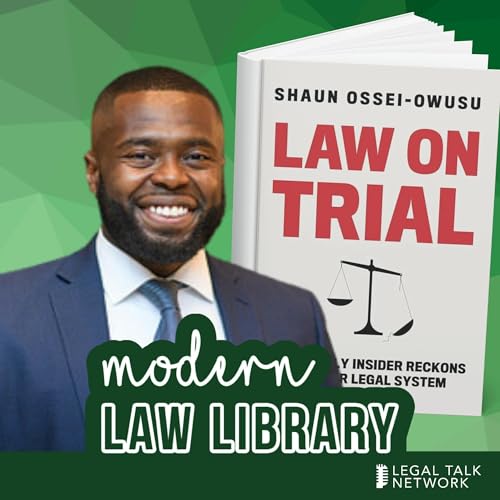
    When Shaun Ossei-Owusu looked around at his classmates at UC Berkeley School of Law, there were many upper middle class children of lawyers who were coming straight from their undergraduate degrees. There were not many people like him, a child of Ghanaian immigrants who grew up in an impoverished South Bronx community and was now finishing his PhD as a returning student. That background and his academic training gave him a different perspective on the law school curriculum. For example, his Property Law class was mostly focused on the ins and outs of titles and transfers. "It was strange to me, particularly being going to school at Berkeley, how little the class said about homelessness," Ossei-Owusu tells host Lee Rawles in this episode of the Modern Law Library. "We have about 750,000 people in this country who are unhoused in any given night. And this is the course, Property Law, that's most directly concerned with how we organize access space and shelter. And the course doesn't say much about homelessness. And so I felt that that was strange, but I didn't want to be the student in class saying, 'Well, why aren't we talking about this?' " Ossei-Owusu went on to practice healthcare enforcement law at Sidley Austin, and worked for the Legal Aid Society of the District of Columbia. His time as a litigator and public interest lawyer gave him a look at how law school principles fared in real world situations. "Lawyers are implicated in many of the hot-button issues of the day, and much of that is tied to the ways that we train lawyers in law school to distance legal reasoning from social and moral consequences–and the ways they bring that habit into legal practice, whether it be BigLaw, public interest lawyering, or government lawyering," Ossei-Owusu says. It's something he now thinks deeply about as a professor at the University of Pennsylvania Law School who focuses on criminal justice, social welfare and professional responsibility. In Law on Trial: An Unlikely Insider Reckons with Our Legal System, he calls out the ways this early training can result in further injustice and inequality for society. "Professional ethics say your job is to primarily serve clients, which creates an inevitable distance between what lawyers do and who pays the price," writes Ossei-Owusu in Law on Trial. "The result is a system that trains smart people to engineer brilliant solutions while staying disconnected from the human wreckage they may leave behind." In this episode of the podcast, Ossei-Owusu and Rawles talk about the hard truths of public interest legal work, how regulatory work can sometimes have more impact than litigation, and and how good intentions alone cannot erase harm.
    Show More Show Less
    49 mins
  • How we deploy the military domestically, and why
    May 6 2026
    The Third Amendment to the Constitution forbids the quartering of troops in Americans' houses. It's a reminder of how uneasy the people of the country have been about the domestic deployment of our soldiers. There are robust rules about how the military can be used on American soil, but how did those rules come about? It's a question that National Guard officer Jonathan Bratten hoped to help answer in Forging the Framework: Evolving Law, Policy, and Doctrine for the US Military's Domestic Response, which he edited and contributed to as one of the authors. "It was really cool to see the way that the roots of our processes are built into the colonial era, just as the roots of a lot of our frictions are built into the colonial era," Bratten tells Modern Law Library host Lee Rawles. Forging the Framework, which is available for free from the Army University Press, looks at how different periods of American history shaped how the military operates on American soil today. As a country that has not faced many invasions, the bulk of domestic military operations have been to respond either to civil unrest or to natural disasters. "When you look at how this affects those who serve, I just think about the number of people who got called off of the COVID-19 mission, where [you were] helping your community members to go deploy, to protect, go into support of law enforcement during the George Floyd protests," says Bratten. "There's just that weird duality that exists in the Guard and these experiences sort of ripple through." In this episode of the Modern Law Library, Bratten and Rawles dive deep into the Pullman Strike, Posse Comitatus, slave revolts, the rewards of disaster response and the difficulty of convincing militiamen to confront their rioting relatives. Download Jonathan's book here.
    Show More Show Less
    1 hr and 7 mins
  • Sherry Thomas's sleuthing librarians and gender-bent Sherlock
    Apr 16 2026
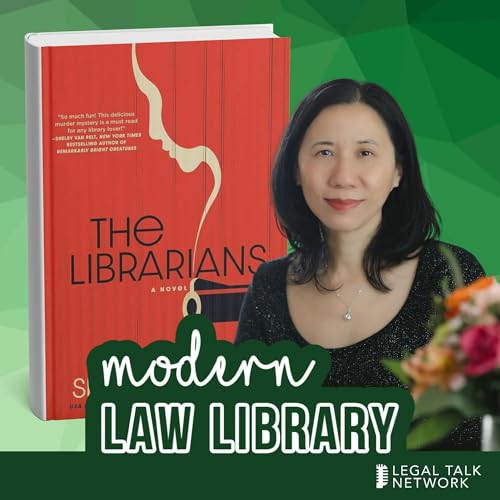
    Coming across the right book at the right time can make all the difference, says Sherry Thomas, author of the popular Lady Sherlock series. In her case, picking up a historical romance from the library led to her writing career. "Two years into my career as stay-at-home mom, I grabbed a historical romance, which I devoured growing up," Thomas tells the Modern Law Library's Lee Rawles. "I grabbed a historical romance from the library, took it home and was going to spend my son's nap time enjoying it. But it turned out that I did not enjoy that book at all. In fact, I was kind of furious at it because I didn't enjoy it at all. And I spent the entirety of my available time that day on that and did not get any pleasure in return. So very seldom does this ever happen to me. But on that day, I was kind of angry. And by the time my husband returned home from work, I said to him, 'I am going to write historical romances.'" Thomas did successfully publish several historical romances, then shifted genres to historical mysteries, publishing eight books in her best-selling Lady Sherlock series. The ninth will be released in the fall. Her newest release is a contemporary mystery, The Librarians, prompted by a suggestion by her publishers. "They specifically said, 'We want this to be The Thursday Murder Club, but with librarians,' " says Thomas. In this episode of the Modern Law Library, Thomas shares more about her writing journey, how she came up with her Charlotte Holmes character, her love of libraries and her tips for other would-be mystery writers.
    Show More Show Less
    44 mins
  • Book Club: The Brethren introduces Tricky Dick's chief justice
    Apr 1 2026
    It's time for the first official meeting of the Modern Law Library Book Club, and Lee has invited on her friend (and go-to Nixon expert) Victor Li to talk about his experience reading the 1979 bestseller The Brethren: Inside the Supreme Court. As both a lawyer and journalist, Victor gives his thoughts on how Woodward and Armstrong were able to pierce the secrecy of the Supreme Court and show the behind-the-scenes wrangling as Nixon's newly-appointed chief justice, Warren Burger, took over from famed liberal Chief Justice Earl Warren. Up next, we'll be discussing Chapter 1, the 1969 Term, and we want to hear from you! Email your comments or a voice message to modernlawlibrary@legaltalknetwork.com to appear on a future episode. Check out our discussion group on Goodreads: https://www.goodreads.com/group/show/1285340-modern-law-library Purchase your copy of The Brethren: Inside the Supreme Court: https://amzn.to/4cRQivF
    Show More Show Less
    39 mins
  • Your household devices are tracking you—but who else is watching?
    Mar 18 2026
    Your smartwatch tracks your heart rate and counts your calories. Your Ring camera lets you know when a package has been delivered. The GPS in your car smoothly directs you to a restaurant you've never been to before. We've grown used to getting a technological assist for everything from finding our keys to checking where our children are at curfew. But the consumer electronics which can make our lives easier can also be used by the government to track and prosecute us–and Fourth Amendment protections haven't been keeping up. Prof. Andrew Ferguson of George Washington University Law School has long been an advocate for digital privacy, and in his new book, Your Data Will Be Used Against You: Policing in the Age of Self-Surveillance, he hopes to kick off a movement to protect Americans from government intrusion. In this episode of the Modern Law Library, Ferguson and host Lee Rawles talk about cases where people's device data wound up being used against them, how personal information is being sold by data brokers, and how the Wiretap Act could point the way forward for future data privacy protections. Ferguson also shares tips on how to sabotage your data and explains the Tyrant Test.
    Show More Show Less
    49 mins
  • Introducing the Modern Law Library Book Club
    Mar 4 2026
    For more than a decade, the Modern Law Library has been chatting with authors about their books. But there haven't been many opportunities to talk directly with our listeners, and we want that to change. We are so excited to announce that we are launching a monthly book club series, which will appear in your normal podcast feed. This year, we are going to be diving into The Brethren: Inside the Supreme Court, by Bob Woodward and Scott Armstrong. This book made waves when it was released in 1979, giving readers an unprecedented look into the U.S. Supreme Court chambers. Covering the 1969 to 1975 terms, The Brethren exposed the internal debates over matters like the Pentagon Papers and Roe v. Wade. Each month, we will be reading a section of the book and inviting on a guest to discuss the issues raised. To be ready for the first book club meeting at the end of March, read the introduction and prologue! We are hoping to hear from you, so if you have a comment about the book or want to share your experiences with it, email us a written message, video or audio recording to modernlawlibrary@legaltalknetwork.com. You can purchase a copy here and join in the discussion in our Goodreads group athttps://www.goodreads.com/group/show/1285340-modern-law-library
    Show More Show Less
    10 mins