• Two Deep, Low‑Risk AI Automations Small Businesses Can Deploy in 30 Days (with scripts & checklist)
    Jan 12 2026
    This 15-minute episode trades breadth for actionable depth: instead of skimming three ideas, we walk through two automations a small business can deploy within 30 days with low disruption. First: customer-response triage that keeps humans in the loop and aims to cut average first-response time from hours to under 1 hour within 30 days. Second: invoice & expense intake that targets reducing monthly admin time by 50–80% using OCR + lightweight workflows. For each automation you get: a 20–25 second micro case audio (real result, anonymized), three vetted integration-first tool options, a short setup checklist, one sample prompt or rule to copy, and a clear KPI to measure success at 30 days. The episode finishes with common failure modes and exact mitigation steps so listeners leave with a playbook, not theory. Downloadable checklist and prompt templates mentioned in the episode notes.
    Show More Show Less
    9 mins
  • Local Ad Blitz: Build Personalized, Small-Budget Campaigns in a Weekend with AI
    Feb 2 2026
    Anchor with a 45-second micro-story: Miguel, a neighborhood plumber, turns a $50 weekend ad test into three booked calls by switching from a generic ad to three localized, persona-targeted creatives. In this episode I walk through a practical, no-agency weekend plan to produce, launch, and learn from small-budget AI-powered local ad campaigns. You get copy-and-run artifacts: a prompt library for headlines and local voice, short image prompts for quick asset creation, a 6-variation ad matrix for A/B testing, and a one-page tracking sheet to measure cost per lead. I cover targeting choices that map to real customer personas, budget and pacing rules to avoid overspend, and human-in-the-loop checkpoints to preserve brand voice and platform compliance. Finish with a clear 48–72 hour checklist you can run this weekend and a template to show measurable lift. Visit the show website to download the checklist, prompt pack, and tracking sheet.
    Show More Show Less
    8 mins
  • Loyalty Pilot in 14 Days
    Mar 11 2026
    Rosa, a single-location deli owner, stopped blanket discounts and ran a two-week, people-first loyalty pilot that increased core repeat visits without adding staff stress. This episode hands small-business owners a practical, nontechnical playbook they can run in 14 days. By episode end listeners will be able to: (1) calculate a one-line 'Staff Burden Score' to judge operational cost versus reward value; (2) pick and build one margin-safe mechanic—we test a low-cost 'mini-upgrade' live on the show that nudges frequency without cutting price; (3) run a short pilot with clear stop/go rules, a privacy-first opt-in script, and measurement templates. Hosts and panelists (an owner who ran the pilot, an operations advisor, and a retention marketer) model short roleplays, a 60-second daily standup cadence, and one quick listener reflection. Downloadable assets: segmentation checklist, reward matrix, staff scripts, 14-day pilot checklist, and a ready-to-read opt-in phrase for on-air use.
    Show More Show Less
    8 mins
  • Swap Smart: A Human‑First Shift Swap Pilot That Protects Schedules and Staff Wellbeing
    Mar 12 2026
    Leah, a two‑location café owner, beat last‑minute coverage gaps and rising staff frustration by running a 10–14 day, human‑in‑the‑loop shift‑swap pilot. This episode gives a tight, nontechnical playbook you can set up in 60–90 minutes: a minimal tech stack (roster CSV → Google Sheets, one shared SMS/email template, an optional Twilio shortcut), explicit consent language, a fairness checklist, and an audit log template. We walk signals to collect (availability windows, max weekly hours, consecutive‑shift caps), a conservative match + manager‑gate workflow, empathetic swap messages, and simple KPIs with targets (manager triage time: baseline → target −50%; swap fill rate: target ≥80% within 24 hours; staff pulse +10% satisfaction). Panelists (owner, ops advisor, frontline employee) roleplay approvals and one mid‑pilot fix. Downloadable assets on the show page let listeners run the pilot immediately and preserve human oversight while reducing scheduling friction.
    Show More Show Less
    9 mins
  • Cut the Fat: A 7‑Day Human‑First Spend Audit to Reclaim Hidden Cash
    Mar 16 2026
    Anchor with a micro‑story: Dana, a salon owner, found three redundant subscriptions and a mischarged utility line that together freed $1,200/year after a one‑week human‑led audit. This episode gives small business owners a tight, nontechnical playbook to run a 7‑day spend audit that balances AI speed with human judgment. We show how to collect minimal signals (bank/card statements, recent invoices, vendor list), run privacy‑first AI summarization and clustering locally or with redacted prompts to identify low‑value recurring charges, and prioritize actions that are high‑impact and low‑risk. Panelists (owner, ops advisor, finance-savvy co‑host) roleplay a cancellation call and a supplier renegotiation, and share a simple measurement rubric (monthly savings identified vs. enacted, rework hours). Downloadable assets include a redaction checklist, prompt templates, cancellation & negotiation scripts, and a 7‑day audit checklist so listeners can reclaim cash while keeping human control.
    Show More Show Less
    9 mins
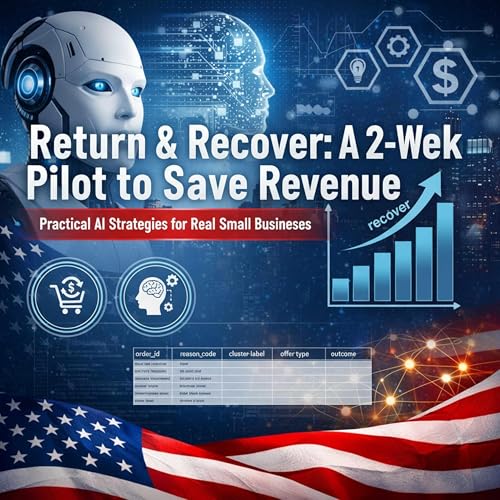
  • Return & Recover: A 2‑Week Pilot to Save Revenue
    Mar 17 2026
    Start with a 45‑second micro‑story: Naomi, a boutique owner, turned a return spike into repeat business by offering timely, margin‑safe alternatives and a $10 goodwill credit—recovering 50% of potential lost revenue in two weeks. This episode gives U.S. small sellers a step‑by‑step, low‑tech playbook to run a 10–14 day pilot that protects margins and relationships. You’ll get concrete KPIs (target recovery rate 30–60%, pilot worst‑case margin impact modeled at ≤10%), a sample spreadsheet layout (order_id, days_since_purchase, margin_tier, reason_code, cluster_label, offer_type, offer_value, staff_notes, outcome, days_to_resolution), two short sample staff lines to use immediately, and a privacy‑safe redaction prompt example for local or privacy‑forward AI. We roleplay one difficult case, show approval gates (staff cap $50; manager sign‑off above), and explain how to measure recovery rate and repeat‑customer lift. Download the 2‑week pilot kit and submit your pilot summary to be featured on the show page.
    Show More Show Less
    10 mins
  • Pop‑Up Playbook: Launch a Profitable Weekend Pop‑Up with Human‑First AI
    Apr 6 2026
    Anchor with a tight micro‑story: a florist turned an empty storefront into a two‑day Valentine’s pop‑up and netted a week’s worth of revenue in a single weekend after running a conservative, human‑first test. This panel episode gives U.S. small business owners a practical weekend pop‑up playbook you can execute with low spend and human oversight. We cover how to pick and vet sites with minimal public signals, draft privacy‑safe permit and pop‑up host messages, size starter inventory and conservative pricing, and create POS, staffing, and simple reopening rules that protect margins and team wellbeing. The episode includes exact AI prompt patterns used only on sanitized public data (venue descriptions, foot‑traffic proxies), a manager approval gate for every public message and sale rule, a printable one‑page checklist, and roleplays showing how to handle unexpected queues and partner asks. Visit the show website to download the pop‑up checklist, permit template, signage pack, and the weekend pilot tracker so you can run your first pop‑up this month.
    Show More Show Less
    10 mins
  • Window Lab: Human‑First AI to Test Storefront Displays That Drive Foot Traffic
    Apr 7 2026
    Anchor with a short micro‑story: a small bookshop swapped a handwritten chalkboard for two concise, AI‑drafted window concepts and saw a measurable uptick in weekday foot traffic within a weekend. This panel episode gives U.S. small business owners a practical, privacy‑safe Window Lab playbook to design, test, and measure two competing storefront displays in 72 hours. We cover how to pick one clear hypothesis (curiosity vs. value), collect minimal signals that matter (sightlines, passerby demographics, peak hours), and use AI to draft three short sign options and simple visual mock descriptions that a local printer or manager can produce overnight. The episode includes a conservative human‑approval checklist (accuracy, accessibility, brand fit), an inline 72‑hour test plan with caps and KPIs (foot traffic lift, linger time proxy, conversion to sale), and real roleplays showing how staff should rehearse on‑floor prompts. Visit the show website to download the Window Lab checklist, three ready‑to‑print sign templates, a measurement sheet, and a weekend pilot tracker so you can run the experiment next weekend. Use AI to support people — not replace them.
    Show More Show Less
    10 mins