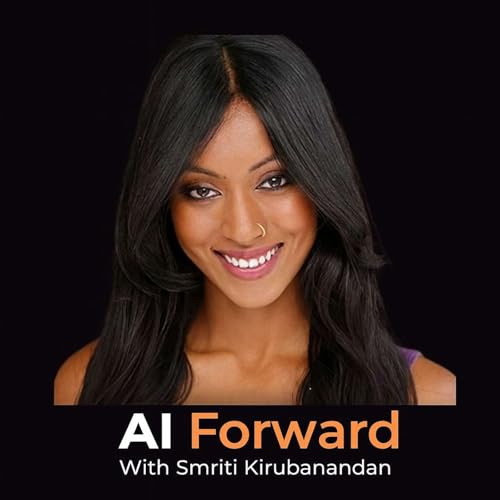
AI Forward cover art

AI Forward

AI Forward

Written by: Smriti Kirubanandan
Listen for free

About this listen

AI Forward — the podcast where we break down the world of artificial intelligence, one conversation at a time. I’m your host, Smriti Kirubanandan, and in each episode, we’ll explore the ideas, technologies, and people shaping the future of AI.


Artificial Intelligence isn’t just one thing — it’s a collection of technologies working together to transform how we live, work, and connect. From machine learning that helps systems improve with data, to natural language processing that enables computers to understand us, to computer vision, robotics, and generative AI — each piece is building towards something bigger: intelligence that augments human potential.


Think of AI as a spectrum. On one end, it powers everyday conveniences — like recommendation engines, voice assistants, and smart devices. On the other hand, it drives breakthroughs in medicine, climate science, creativity, and even space exploration. AI is already here, woven into the background of our lives — but its true impact is only just beginning.


In this show, we’ll dive into how AI works, what it means for industries, and the ethical questions we must face as we move forward. Whether you’re an innovator, a curious learner, or someone who just wants to understand what’s next — you’re in the right place.


Let’s move beyond the buzzwords, cut through the hype, and take a thoughtful, forward-looking journey into the world of artificial intelligence. This is AI Forward.


Simi (Host) + AI Powered

© 2026 AI Forward
Economics Leadership Management Management & Leadership
Episodes
  • The Inference Economy- Simi (Human) & NotebookLM (AI)
    Apr 21 2026

    As AI moves from its centralised, expensive early phase into mass diffusion, I see enterprises facing a structural reckoning: processing millions of inference calls against frontier large language models is no longer just a technology choice — it is a capital allocation decision with material consequences for margins and business model sustainability. I argue that Small Language Models are the efficient market response. A model fine-tuned on a narrow domain will consistently outperform a generalist model on that specific task while cutting inference costs by 80–95%, improving latency, satisfying data residency requirements, and eliminating vendor concentration risk. The key insight I draw on is that comparative advantage belongs not to the broadest capability set, but to the system most precisely matched to the task — the same principle that explains why specialisation creates value throughout economic history.

    The theoretical gains of SLMs, however, only materialise through what I call "harness engineering" — the surrounding infrastructure of evaluation pipelines, automated testing, production monitoring, and deployment tooling that converts a model's potential into reliable business output. Without it, SLMs fail not because the models are inadequate, but because the organisational systems governing them are. More importantly, I find that this discipline generates compounding returns over time: because SLMs are lightweight and fast to retrain, production signal feeds directly back into improved models, with each iteration enriching the evaluation dataset and refining the deployment playbook. Organisations that build this stack are not merely reducing AI costs — they are accumulating proprietary cognitive infrastructure that appreciates with use, insulated from frontier model pricing volatility, and positioned to treat intelligence as an owned organisational capability rather than a vendor relationship.

    Show More Show Less
    20 mins
  • Rosie’s Prophecy: How The Jetsons Imagined Our AI Future
    Nov 22 2025

    In the early 1960s, when humanity still looked up at the stars with unfiltered wonder, Hanna-Barbera dreamed a world suspended between magic and machinery—The Jetsons. Born from the spark of a space-age imagination, the show stitched together flying cars, talking screens, and automated everything, long before such things seemed possible. It didn’t just guess at the future; it cast a spell over it, whispering ideas of artificial intelligence and digital companions into the collective imagination. Little did its creators know that their cartoon prophecies would echo into our world, guiding inventions and inspiring dreamers who grew up believing tomorrow could hum, blink, and speak back.

    And at the center of that prophecy rolled Rosie the Robot, the whirring heart of the Jetson home—part housekeeper, part guardian, part accidental oracle. With her metallic apron and warm sass, she embodied what we now call AI: responsive, aware, and uncannily tuned to the humans she served. Today, as our world fills with smart assistants, robotic helpers, and learning machines that study the rhythms of our lives, Rosie feels less like fiction and more like a blueprint. We’re not soaring through skyways just yet—but each voice command, each autonomous robot, each algorithmic moment brings us one step closer to the shimmering future The Jetsons once imagined.

    Show More Show Less
    7 mins
  • Mirror, Mirror on the Wall: Who Holds the Future, After All? Story of AlphaGo Vs Lee Sedol
    Oct 20 2025

    In 2016, the world watched in awe as AlphaGo, an artificial intelligence program developed by Google DeepMind, defeated Lee Sedol, one of the greatest Go players in history. Go, a game of seemingly infinite complexity, had always been a bastion of human intuition and creativity — the one arena machines were thought unable to conquer. Yet in just five games, AlphaGo did more than win; it revealed a new kind of intelligence. Its now-legendary move 37 stunned experts not because it was logical, but because it was profoundly original. That moment marked a turning point: machines could not only calculate but also surprise, innovate, and teach us to see differently.

    Nearly a decade later, we stand in front of our own metaphorical mirror, asking, “Who is the most productive of all?” The answer, more often than not, is AI. From writing and art to medicine and logistics, machines are surpassing us in speed, scale, and sometimes even creativity. This leaves us in an existential predicament: if AI can do what we once thought defined us, then what is left for humanity? Like Go players reimagining their strategies after AlphaGo, we too must reimagine our purpose — shifting from competing with machines to rediscovering meaning, identity, and value in the uniquely human dimensions of empathy, imagination, and purpose.

    Show More Show Less
    7 mins
adbl_web_anon_alc_button_suppression_c
No reviews yet