Episodes

  • Building a Quantum Workforce in Illinois: Why Business Leaders Should Pay Attention Now
    Feb 19 2026

    In this episode we talk to Harley Johnson, CEO of the Illinois Quantum and Microelectronics Park.

    Most business leaders have quantum computing filed away in the "maybe in 10–15 years" folder. After sitting down with Harley Johnson, the CEO of the Illinois Quantum and Microelectronics Park (IQMP), for the latest episode of the AI in Chicago Podcast, I'm convinced that timeline needs to be moved up. Significantly.

    Timed to the federal CHIPS and Science Act, a group of state and institutional leaders developed a deliberate strategy: take the basic science excellence Illinois had been building for a decade and translate it into economic development. The result is IQMP — a state-backed technology park being built on a former steel mill site on Chicago's South Side, designed to take quantum technology from lab breakthroughs to real-world scale.

    Show More Show Less
    46 mins
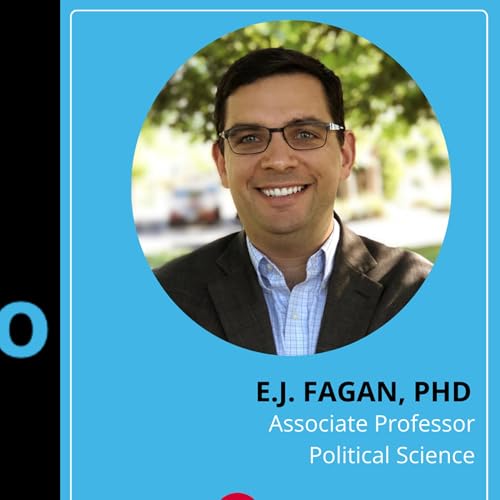
  • The Information War: How Think Tanks Fractured American Democracy (with Prof. E.J. Fagan)
    Feb 4 2026

    Why do Republicans and Democrats live in different factual universes? The answer traces back to 1973 and three conservative staffers who transformed how America makes policy.

    Professor E.J. Fagan, author of "The Thinkers," explains how partisan think tanks replaced neutral expertise with competing knowledge regimes—and why smart, educated people are actually easier to fool than everyone else.

    In this conversation, we explore:

    • Why the Heritage Foundation was founded and how it changed American politics

    • How the 2009 stimulus bill demonstrates the cost of ideological capture

    • Why it's easier to fool intelligent, motivated people than those who are less informed

    • The difference between think tanks in the US versus other democracies

    • Why Project 2025 may be less influential than people think

    • Organizations like the Niskanen Center and R Street Institute that are getting it right

    Professor Fagan argues the solution isn't neutral centrism;' it's politically engaged organizations with epistemic integrity.

    As we face decisions about AI deployment, climate adaptation, and economic transformation, we need information infrastructure that serves democracy.

    Key insight: "Don't try to take the politics out of information, but try to get it right."


    Guest: Professor E.J. Fagan, Associate Professor of Political Science at the University of Illinois Chicago and author of "The Thinkers: The Rise of Partisan Think Tanks and the Polarization of American Politics" (Oxford University Press)

    Show More Show Less
    1 hr and 4 mins
  • Downtown Isn't Dying; It's Evolving | Michael Edwards, CEO of the Chicago Loop Alliance
    Jan 29 2026

    Michael Edwards has spent 35 years leading downtown organizations across America. In his final months as CEO of the Chicago Loop Alliance, he joins the podcast to discuss downtown narratives in the age of AI with Khullani Abdullahi.

    He challenges the dominant narrative about urban decline. The data tells a different story: 1.2 million people visited the Loop for arts and culture in Q4 2025, spending $512 million.

    Weekend foot traffic now exceeds pre-pandemic levels. We discuss the shift from office occupancy as the defining metric, why Chicago's arts patrons visit five times more often than the national average, and how 145,000 Loop residents are reshaping the economic calculus of downtown living.

    Show More Show Less
    42 mins
  • From Steel City to the Chicago Urban League: In Conversation With Karen Freeman-Wilson
    Jan 19 2026

    In an era where artificial intelligence is reshaping industries, labor markets, and communities at an unprecedented pace, the question of who benefits—and who gets left behind—has never been more urgent.

    At the forefront of this challenge stands Karen Freeman-Wilson, President and CEO of the Chicago Urban League, who brings a unique combination of legal expertise, executive experience, and deep community roots to the mission of ensuring AI becomes a force for equity rather than exclusion.

    Show More Show Less
    44 mins
  • People Don’t Resist Technology — They Resist Ambiguity | NielsenIQ's Elena Vekilov on Enterprise AI & Privacy
    Jan 9 2026

    On the latest episode of the AI in Chicago Podcast, I had the privilege of speaking with Elena Vekilov, Chief Privacy Officer and Global General Counsel for Data Security, Product, and AI at NielsenIQ. With responsibility for privacy governance across more than 90 markets, Elena sits at an intersection few executives occupy: where data protection, product innovation, and AI governance collide at a global scale.

    Our conversation crystallized an insight that every leader racing to implement AI should absorb: People don't resist technology. They resist ambiguity.


    Elena reserves particular passion for redefining legal's role in AI adoption. "If your legal team is known as the Department of No, you're doing something wrong," she states bluntly.

    The alternative is embedding legal into the product development process from the start – not as a final rubber stamp but as a navigation tool. "Think of legal not as a roadblock, but as a GPS: helping the organization reach its goals without unexpected detours or collisions."

    Show More Show Less
    56 mins
  • Illinois's AI Mental Health Law with State Representative Bob Morgan, Assistant Majority Leader and Floor Whip' within the IL House Chamber
    Sep 29 2025

    Illinois just made history. In August 2025, Governor Pritzker signed the Wellness and Oversight for Psychological Resources Act, and the first law in the nation (possibly the world) to regulate AI in mental healthcare.

    In this episode, we sit down with State Representative Bob Morgan, Assistant Majority Leader and Floor Whip' within the IL House Chamber, the architect of the Wellness and Oversight for Psychological Resources Act to understand how Illinois moved from concept to law in just nine months, what the legislation actually does (and doesn't do), and why this matters far beyond state borders.

    Rep. Morgan brings a unique perspective as both a healthcare attorney with decades of experience and a state legislator navigating the complex intersection of innovation, safety, and regulation. From his work implementing the Affordable Care Act to managing Illinois's Ebola response, he's seen firsthand how technology and healthcare policy collide.

    In this conversation, you'll learn:

    • What prompted the urgent need for AI mental health regulation
    • How the law protects patients without stifling healthcare innovation
    • Why licensed professionals can still use AI to augment their practice
    • The political dynamics of passing first-in-the-nation tech legislation
    • What other states are learning from Illinois's model
    • Where AI regulation is headed next

    Whether you're a healthcare provider, tech builder, policy professional, or simply concerned about AI's role in mental health, this conversation offers rare insight into how thoughtful regulation is actually developed.


    Guest: Rep. Bob Morgan, Illinois State Representative (58th District), Partner at Benishlaw, former General Counsel for Illinois Department of Public Health

    Host: Khullani Abdullahi, Founder of Techne AI

    Listen now to understand the policy framework that may shape AI healthcare regulation across America.

    Show More Show Less
    42 mins
  • Breaking Through Healthcare's Innovation Desert: How Prenosis Built the First FDA-Authorized AI Tool for Sepsis Diagnosis
    Sep 25 2025

    Join AI in Chicago host Khullani Abdullahi for this eye-opening conversation with Bobby Reddy Jr., CEO and co-founder of Prenosis, as he shares the remarkable 10-year journey of developing the first FDA-authorized AI tool for sepsis diagnosis.

    In this episode, Bobby reveals why acute care has remained an "innovation desert" for 30 years, the critical shift from product-first to problem-first thinking, and how his team built AI that actually demands better data rather than working around missing information.

    We dive deep into the unique challenges of healthcare AI, including perverse financial incentives, biological complexity, and the importance of developing transparent systems that clinicians can trust.

    Bobby also shares his vision for revolutionizing clinical trials in acute care and why Chicago's grounded culture provides the perfect environment for tackling healthcare's most intractable problems.

    Key Topics:

    • Why acute care innovation has stagnated despite representing 10x oncology spending
    • The power of problem-first vs. product-first entrepreneurship
    • Building AI systems that refuse to operate with incomplete data
    • The 5-year path to FDA authorization and why it matters
    • Transforming clinical trials through precision medicine approaches
    • Chicago's emerging role as a healthcare AI hub


    Whether you're a healthcare professional, AI developer, or entrepreneur, this episode offers invaluable insights into solving complex problems that truly matter.

    Show More Show Less
    46 mins
  • Effective and Responsible Use @ Scale Aligned to Firm Strategy, Director of AI Richard Robbins at Reed Smith
    Sep 9 2025

    AI in Chicago: Transforming Legal Practice with Richard Robbins of Reed Smith

    Join host Khullani Abdullahi as she sits down with Richard Robbins, Director of Applied AI at Reed Smith, for an illuminating conversation about how artificial intelligence is revolutionizing the legal profession at unprecedented speed.

    With over 40 years at the intersection of law and technology, Richard brings a unique perspective on why this AI moment feels different from previous tech waves. From his academic background at MIT, theUniversity of Chicago, and Berkeley to his experience as partner, general counsel, and now technology strategist, Richard has witnessed the legal industry's evolution firsthand.

    In this episode, discover:

    • Why law firms have compressed a decade of change into mere months
    • The four pillars of successful AI implementation: effective use, responsible governance, scale, and strategic alignment
    • How senior lawyers, not junior associates, are getting the most value from AI tools
    • The shift from measuring clicks to measuring client outcomes
    • Why the "trough of disillusionment" is coming and how firms can prepare
    • Strategies for preserving institutional wisdom before it retires with senior partners


    Richard shares candid insights on moving beyond efficiency gains to true transformation, the governance imperative that separates leaders from followers, and why generative AI demands active experimentation rather than passive observation.

    Whether you're a legal professional, tech enthusiast, or business leader navigating AI adoption, this conversation offers practical frameworks for turning AI enthusiasm into sustained competitive advantage.

    AI in Chicago explores how artificial intelligence is reshaping industries across the Midwest, featuring conversations with innovators, entrepreneurs, and thought leaders driving change in the heartland.

    Show More Show Less
    1 hr and 41 mins