• They Say We Descend From… — Is It True?
    Jul 11 2026

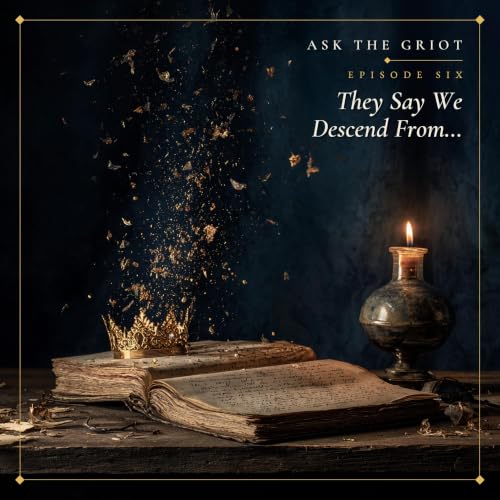
    Every family carries a story: that we descend from a king, from royalty, from someone the world remembers. Nia brings back the legend she mentioned weeks ago — and asks the elder, at last, if it's true. Jeliba won't answer true or false. He teaches her to weigh it: where did the story come from, and what kind of knowing is it? A tale can be false without a single liar in the chain — memory grows in the direction of dignity, and for a people whose names were taken, "we come from kings" was not vanity but armor. Then the reframe: kings are cheap in a story; to trace a real ancestor, by name, from a real record, is the harder and greater thing. One is a wish; the other is a resurrection. And a second story handled with more care still — the claim of Native ancestry — because a nation is not gone, and belonging is the nation's to grant, by their rolls and their rules, not a DNA estimate's. Honor why we carry these stories. Test what they claim. Don't crown yourself until the evidence does.

    Resources for this episode:

    • Record the story first. Before testing a family legend, capture it fully — who tells it, and how far back it goes. Free interview guides: StoryCorps (storycorps.org).
    • Test oral tradition against the record using the databases from earlier episodes: FamilySearch (free, familysearch.org), the National Archives (free, archives.gov), and Ancestry (often free at your library).
    • On Native ancestry — start with the nation, not a DNA test. Belonging is determined by tribal governments. Learn the difference between ancestry and citizenship through the National Congress of American Indians (ncai.org) and each nation's own enrollment office.
    • On DNA and tribal claims: a percentage or a haplogroup cannot make you a citizen of a nation, and cannot name a specific tribe. Use it as a compass, and let each nation's rules stand.
    Show More Show Less
    10 mins
  • What Are the Freedmen's Bureau Records?
    Jul 10 2026

    After freedom came, for a brief and precious time, someone wrote our names down. The Bureau of Refugees, Freedmen, and Abandoned Lands kept labor contracts, marriage and cohabitation records, ration rolls, letters, and school registers — and in them, people who had been invisible in the old records appear at last as themselves. In this sitting I show you what the Bureau left behind, where it survives today, and how to read it. These records are uneven, scattered, incomplete — the work of overwhelmed clerks in a hard season. But for many seekers, they are the bridge across 1870, and the first time an ancestor is called by name.

    Resources for this episode:

    • National Archives (free) — archives.gov — Freedmen's Bureau records, Record Group 105.
    • FamilySearch (free) — familysearch.org — digitized and searchable Bureau records.
    • Smithsonian NMAAHC — nmaahc.si.edu — the Freedmen's Bureau transcription and search project.
    • Ancestry (subscription; often free through your public library) — ancestry.com.
    • Tip: search by place, not just name — start with the state and the field office that served your ancestor's county, since much of the Bureau's paper isn't name-indexed.

    Show More Show Less
    11 mins
  • Who Was the Greatest Griot?
    Jul 10 2026

    Who was the greatest griot who ever lived? Jeliba names Balla Fasséké Kouyaté, griot to Sundiata Keita and the one from whom the office descends — and honors Toumani Diabaté, who carried seventy-one remembered generations of kora players. Then he declines the question itself. The office of the jeli is not won; it is inherited, and Salif Keita's controversy proves it. Among the jeliw, greatness is measured not in performance but in memory: the one whose recitation of the lines can be trusted. Nia presses him on what that means for those who trace back four generations and find a wall — and Jeliba answers that the griot who remembers seventy-one and the descendant who has fought back to six are doing the same work.

    Resources for this episode:

    • The Sundiata epic — Look for D.T. Niane's Sundiata: An Epic of Old Mali, the most widely available written version of the story Balla Fasséké carried.
    • Toumani Diabaté — His albums Kaira and The Mandé Variations (solo kora), and In the Heart of the Moon with Ali Farka Touré. Widely available on streaming.
    • Sidiki Diabaté — Toumani's father, "the King of the Kora"; seek out his recordings to hear the generation before.
    • The jelimusow (women griots) — Listen for Kandia Kouyaté, Ami Koïta, and Bako Dagnon.
    • UNESCO lists the oral traditions of the Mande (the Mandé Charter / Kouroukan Fouga) among the world's intangible cultural heritage — a starting point for the tradition's history.
    Show More Show Less
    11 mins
  • What Can a DNA Test Really Tell Me?
    Jul 8 2026

    The blood remembers, but it does not speak in names. In this sitting I tell you plainly what a test can give you and what it cannot. It can point toward the regions and peoples your ancestors came from, connect you to living cousins, and trace the deep paternal and maternal lines back across the water. What it cannot do is hand you an ancestor's name, or a certificate of kingship, or a nation you may claim by percentage alone. An estimate is not a person. I'll show you how to let the science guide your search without letting it flatter you — how it points toward home without naming the door.

    Resources for this episode:

    • AncestryDNA — ancestry.com — the largest matching database, strongest for finding cousins.
    • 23andMe — 23andme.com — ethnicity estimates plus health; includes deep maternal (mtDNA) and paternal (Y-DNA) haplogroup information.
    • FamilyTreeDNA — familytreedna.com — the main home for dedicated Y-DNA (father's line) and mtDNA (mother's line) tests, and their surname/lineage projects.
    • MyHeritage DNA — myheritage.com — useful for matches with relatives outside the U.S.
    • Free tools: Upload your raw DNA data to GEDmatch (gedmatch.com) and DNA Painter (dnapainter.com) to compare across databases and map matches to your tree.
    • Remember: an estimate is not an ancestor. Use DNA as a compass, chase the cousin matches, and lay the results beside the documents — the paper is what proves the line.
    Show More Show Less
    12 mins
  • How Do I Get Past 1870?
    Jul 7 2026

    For most who trace an African American line, there is a wall, and it stands at 1870 — the first federal census to record our people by name, and for many, the last door still open. Before it, the enslaved were counted as property, not persons, entered as figures on a slaveholder's schedule. In this sitting I show you how to approach that wall without breaking yourself against it: the Freedmen's Bureau and the Freedman's Bank, cohabitation and voter rolls, and the patient work of naming the last enslaver, so the records they kept might speak. The wall is real. It is not always the end.

    Resources to begin your search:

    • FamilySearch (free) — familysearch.org — U.S. census records, including 1870, plus much of the Freedmen's Bureau collection.
    • Ancestry (subscription; often free through your public library) — ancestry.com — the largest online collection of census and family records.
    • National Archives (free) — archives.gov — Freedmen's Bureau records (Record Group 105) and Freedman's Savings & Trust Company (bank) records.
    • Smithsonian NMAAHC — nmaahc.si.edu — searchable Freedmen's Bureau records and research guides.

    Tip: start with the free sources, and check whether your local library offers Ancestry at no charge before you subscribe.

    Show More Show Less
    10 mins
  • Where Do I Even Begin?
    Jul 6 2026

    Every search has a first step, and it is almost never where the seeker expects. In this first sitting, I answer the question that stops so many before they start. We begin not in the archive but at the kitchen table — with the living, with the names and stories already in your keeping — and work backward, one generation at a time, from what you know toward what you do not. I'll show you how to gather what your family already remembers, why the most recent records are your firmest footing, and how to write down a memory without mistaking it for proof. The line begins with you.

    Resources to begin:

    • Start at home, not online. Before any database, talk to your oldest living relatives and gather names, dates, places, and stories. Photograph documents and record the conversations.
    • Free places to build your tree: FamilySearch (familysearch.org) and WikiTree (wikitree.com) — both free — let you record what you find and begin searching records.
    • A starter record set: the U.S. Census (1950 back to 1790) is the backbone of early research; you'll find it on FamilySearch for free.
    • Capture the oral history: a free interview guide and prompts are available from StoryCorps (storycorps.org) and the Smithsonian's oral-history resources.
    • Write down what's memory and what's proof — and keep them separate. That discipline is the whole of the work.
    Show More Show Less
    5 mins