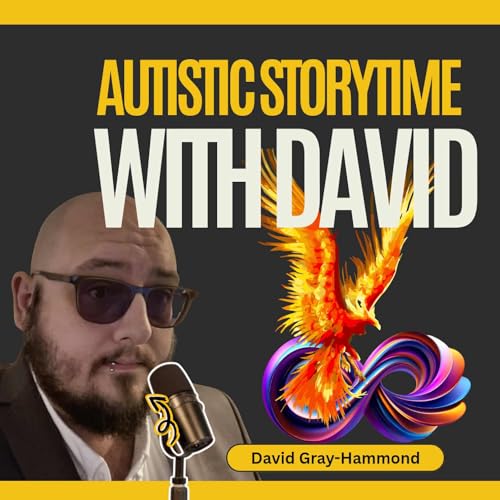
Autistic Storytime With David cover art

Autistic Storytime With David

Autistic Storytime With David

Written by: David Gray-Hammond
Listen for free

About this listen

David Gray-Hammond relays brief stories from his Autistic experience, and explores what his neurodivergence means to him.

news.neurohubcommunity.orgDavid Gray-Hammond
Self-Help Social Sciences Success
Episodes
  • Lilipadding And Monotropic Split
    Apr 26 2026

    In this episode of Autistic Storytime With David, we explore two interconnected concepts developed by fellow advocate and researcher Tanya Adkin: monotropic split, the cognitive injury that occurs when a monotropic person's attention is forced to fracture across too many competing demands, and lilipadding, a practical framework for navigating transitions and recovering from Autistic burnout one manageable step at a time. Drawing on personal experience and years of peer mentoring, David unpacks why autistic burnout so often feels like personal failure, why it isn't, and what a genuinely sustainable path forward looks like.

    NeuroHub Community Journal | Newsletter | Announcements is a reader-supported publication. To receive new posts and support my work, consider becoming a free or paid subscriber.


    This is a public episode. If you would like to discuss this with other subscribers or get access to bonus episodes, visit news.neurohubcommunity.org
    Show More Show Less
    13 mins
  • Not All Awareness Is Good Awareness
    Apr 14 2026

    Every April, the puzzle pieces come out, the buildings go blue, the corporate social media posts arrive, right on schedule.

    Every April, a lot of Autistic people brace themselves.

    This episode of Autistic Storytime With David is one I’ve wanted to make for a long time. We’re talking about harmful autism organisations, specifically, Autism Speaks; and why “Autism Awareness” as a concept has never been enough, and has sometimes made things actively worse for our community.

    I go into the specifics; the campaigns that caused real harm, the financials, the absence of Autistic voices in decision-making, and the uncomfortable links between some widely-promoted autism “therapies” and conversion therapy.

    I talk about what we actually need instead. Not awareness. Not puzzle pieces. Acceptance, solidarity, and organisations that are genuinely led by and accountable to Autistic people.

    This one matters to me. I’d love to know if it resonates with you.

    Have you had your own experiences with harmful autism organisations or “awareness” campaigns? Hit reply and tell me; I read every response.

    If this episode speaks to something you’ve felt for a long time, share it with someone who needs to hear it. Word of mouth from this community is everything.

    If you’re not yet a paid subscriber, the full episode is waiting for you.

    Thank you for being here. This community is the reason I keep making this show.


    This is a public episode. If you would like to discuss this with other subscribers or get access to bonus episodes, visit news.neurohubcommunity.org
    Show More Show Less
    13 mins
  • Autistic People Failed Between Services
    Mar 22 2026
    There is a place many Autistic people end up that doesn’t exist on any official map. It’s not a clinic, or a service. It’s not even acknowledged as a system failure. Yet, it is one of the most dangerous places an Autistic person can be.It is the space between mental health services and substance use services. A place where responsibility is passed back and forth, while the person at the centre quietly deteriorates.The Loop That Never EndsAutistic people experience significantly higher rates of mental health difficulties than the general population. Research consistently shows elevated prevalence of anxiety, depression, trauma-related distress, and suicidality among Autistic adults.Alongside this, there is growing evidence that Autistic people are also at increased risk of problematic substance use; often as a means of coping with overwhelming environments, chronic stress, and unmet support needs. My own research (Papdapoulos et al, 2025; Munday et al, 2025) paints an intense image of the scale of substance use in the Autistic community.These issues do not exist in isolation, they are deeply connected across an ecology of distressing environments that coalesce and take form as the negative outcomes that we see.Despite this, services continue to treat them as though they exist in near boxes.Here’s how it often plays out:* An Autistic person seeks help from mental health services.* They disclose their struggles , anxiety, depression, overwhelm, and, crucially, their substance use.* They are told:“We can’t begin treatment while there is active substance use. You’ll need to engage with addiction services first.”So they try again.This time, with substance use services.* They explain their use, but also their mental health difficulties, the distress that drives it.* They are told:“Your mental health needs stabilising first. We can’t support you at this level without mental health input.”And just like that, they are sent back. Back and forth, and back again.Fragmented Systems, Real HarmThis is fragmentation. It’s a system designed around categories trying to respond to lives that do not fit neatly into them. For Autistic people, this fragmentation is particularly harmful. It is often ignored that distress does not pause while services negotiate responsibility.* Mental health does not stabilise in the absence of support.* Substance use does not reduce while underlying distress escalates.Instead, what we see is a predictable pattern:* Worsening mental health* Increased reliance on substances* Escalation to crisis* Disengagement from services* Long-term harm that could have been preventedThe longer someone is left in this gap between services, the harder it becomes to return.Why Autistic People Are Disproportionately AffectedTo understand why this issue is so acute for Autistic people, we need to move beyond individualised, pathology-based explanations. Autistic distress is ecosystemic, it does not arise solely from within the bodymind. Distress has just as much sociopolitical context and it does a medical one.1. Chronic Environmental OverloadMany Autistic people exist in environments that are persistently overwhelming; sensory, social, and cognitive demands that exceed capacity over long periods of time.This creates a baseline of stress that is already elevated before any additional challenges arise.2. Relational DisconnectionAutistic people frequently experience misunderstanding, exclusion, and invalidation within relationships; including within healthcare systems.This compounds distress and reduces the likelihood of seeking support early.3. Institutional BarriersServices are often not designed with Autistic needs in mind.Rigid communication styles, inaccessible environments, and deficit-based assumptions all create barriers to effective support.4. Substance Use as RegulationSubstance use, in this context, is often not about risk-taking or lack of insight. It is about regulation. A way of managing overwhelming internal and external experiences when no other accessible support is available.When we understand this, the false divide between “mental health” and “substance use” begins to collapse. They are interconnected responses to the same ecology of distress.The Cost Of Being Passed Between ServicesEvery time an Autistic person is told “not here”;* Trust erodes.* Shame increases.* Hope diminishes.Over time, many begin to internalise the message:“I am too complex to be helped.”When that belief takes hold, help-seeking often stops.This is where outcomes worsen most significantly, because people are not just falling through gaps in services. They are being pushed into them.The Problem With “Stability First”One of the most common justifications for this fragmentation is the idea that one issue must be “stabilised” before the other can be addressed. This logic fails in practice. Mental health cannot stabilise without addressing the factors that sustain distress, ...
    Show More Show Less
    9 mins
adbl_web_anon_alc_button_suppression_c
No reviews yet