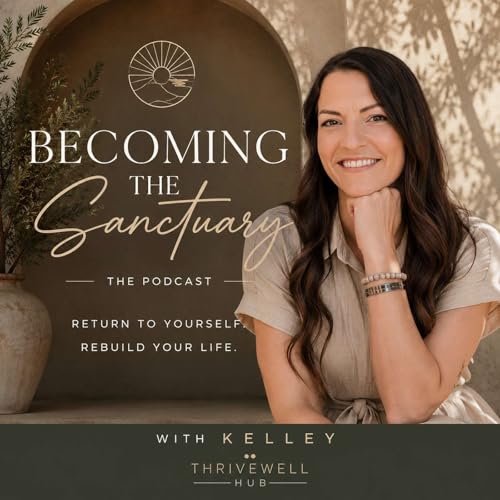
Becoming the Sanctuary cover art

Becoming the Sanctuary

Becoming the Sanctuary

Written by: Kelley
Listen for free

Becoming the Sanctuary is a podcast about healing, human connection, and the journey of returning to yourself in a world that constantly pulls you away from who you are. Through personal storytelling, the Thrivewell Core Philosophy, and honest conversations about growth, sobriety, mindfulness, and purpose, this podcast explores what it truly means to rebuild a life with intention.

© 2026 Becoming the Sanctuary
Philosophy Social Sciences
Episodes
  • Episode Tweleve: Learning to Receive
    Jul 24 2026
    There are moments in our healing journey when we think we've found the lesson, only to realize a few days later that life wasn't finished teaching us yet.That's exactly what happened to me this week.If you listened to last week's episode, you know I shared something deeply personal. After several rounds of interviews for a job I had genuinely hoped would become my next chapter, I learned I wasn't the one they chose. While I respected their decision, I had already begun imagining what life might look like if that door opened, so naturally, it hurt when it closed.Last week's conversation became about learning to hold two truths at once. It was about discovering that hope and disappointment can occupy the same space, that gratitude doesn't erase grief, and that healing isn't pretending everything is okay. Healing is learning to remain present even when life doesn't unfold the way we hoped it would.When I finished recording, I truly believed that was the lesson.But healing has a way of continuing the conversation long after we think we've reached the conclusion.Over the days that followed, my phone continued to light up with text messages, emails, comments, and conversations. Family reached out. Friends checked in. Customers stopped by the Hub simply to encourage me. Listeners of this podcast took time out of their own lives to send words of encouragement they never had to write but chose to anyway.Every message mattered.Every conversation reminded me that I wasn't carrying this season alone.Yet I noticed something about myself that honestly surprised me.As much as I appreciated every kind word, every offer of support, and every reminder to keep going, my instinct was still to gently push it away."I'm okay.""You really don't have to worry about me.""I'll figure it out."Those responses came so naturally that I almost didn't question them. They sounded responsible. They sounded independent. They even sounded grateful.But underneath those words was a much deeper belief that I hadn't fully recognized until now.Somewhere along the way, I had learned that receiving was far more uncomfortable than giving.The more I reflected on that throughout the week, the more I realized this episode wasn't simply something I wanted to talk about. It was something I needed to practice.Because I don't think this struggle belongs only to me.I think it's quietly woven into the lives of so many people.We live in a culture that celebrates the people who seem to carry everything without complaint. We admire the ones who never ask for help, who always have the answers, and who somehow keep every plate spinning while insisting they've got it all under control. We call them strong. We celebrate independence as though it is the highest expression of adulthood.There is nothing wrong with independence. Healthy independence allows us to trust ourselves, make decisions, and move through life with confidence.Hyper-independence is something entirely different.It often isn't born from confidence. It's born from survival.Sometimes it develops because support wasn't available when we needed it. Sometimes trust was broken, or we became the responsible one far too early. Addiction, grief, trauma, heartbreak, or disappointment can all teach us the same lesson: expecting less from other people feels safer than risking being hurt again.Our nervous system is remarkably intelligent. It learns how to protect us, but protection often stays long after the danger has passed. What once kept us safe can quietly become the way we live.Without realizing it, being capable slowly becomes carrying everything. Being responsible becomes refusing help. Being resilient becomes convincing ourselves that no one should ever see us struggle.The very strategies that once protected us can eventually become the walls that keep genuine connection out.Recovery taught me this lesson years ago.One of the greatest misconceptions about sobriety is that healing happens because someone simply stops drinking or using. Healing began the moment I allowed myself to stop pretending I could do everything alone. It began when I let people walk beside me instead of believing I had to carry everything myself.Building Thrivewell has continued teaching me exactly the same lesson.People often see the workshops, the podcast, the products, and the vision. What they don't always see are the countless people who have quietly helped build it. Family, friends, customers, and this community have encouraged me, challenged me, and believed in Thrivewell long before it made sense on paper. Nothing meaningful I've created has ever truly been built alone.Yet somehow, when disappointment arrived last week, my instinct was still to quietly carry it by myself.Isn't that interesting?Sometimes we intellectually understand a lesson long before we emotionally embody it.Receiving isn't just about accepting help during difficult seasons.Receiving touches nearly every part of our lives.It shows up when someone ...
    Show More Show Less
    45 mins
  • Episode Eleven: When Life Holds Two Truths at Once
    Jul 18 2026
    There are certain weeks that quietly change the conversation you thought you were going to have.When I first sat down to prepare this episode, I had an entirely different topic planned. The outline was finished, the title was chosen, and I knew exactly where I wanted the conversation to go. But life has a way of reminding us that some of our most meaningful lessons aren't the ones we prepare for, they're the ones we live through.This became one of those weeks.Across Massachusetts, the sky looked unfamiliar. Smoke from wildfires burning hundreds of miles away drifted over New England, casting a yellow haze across the landscape and leaving the air feeling noticeably heavy. Everywhere I went, people were talking about it. The sky looked different, the air smelled different, and even simple conversations began with the same observation: Something feels off today.It reminded me how deeply we're connected to the world around us. We often think our emotional state comes only from our circumstances or our thoughts, yet our environment quietly shapes our experience in ways we rarely acknowledge. Sometimes we feel the weight of something before we fully understand why.As I watched those hazy skies throughout the week, I couldn't help but recognize that they reflected something happening within me as well.For the past several weeks, I had been interviewing for a position that genuinely felt aligned with both my experience and the life I'm intentionally building. There were multiple interviews, assessments, reference checks, and thoughtful conversations. Eventually, it came down to one final decision.This week, I learned I wasn't selected.I want to pause there because I think it's important to say something that often gets overlooked whenever we talk about disappointment. The people involved in that process treated me with nothing but kindness, generosity, and respect. I left every conversation feeling grateful for the opportunity, and I sincerely hope the person they selected thrives in the role.The outcome wasn't what I hoped for, but gratitude and disappointment are not opposites.They can exist together.That realization became even more meaningful because there was another part of this story that very few people knew.Earlier this summer, I accepted a different opportunity. After spending time reflecting, I realized it wasn't aligned with the life I'm trying to build. Walking away wasn't the easier choice, especially financially, but it was the honest one. It reminded me that alignment and certainty are not always the same thing. Sometimes doing what's right creates more uncertainty before it creates clarity.Because I had already made that decision, this recent opportunity carried even more meaning. I wasn't simply looking for work. I was hoping to find something that could exist alongside Thrivewell rather than compete with it. Naturally, I hoped it would work out.When it didn't, I allowed myself to feel disappointed.Not defeated.Not hopeless.Simply disappointed.I think we've become so uncomfortable with difficult emotions that we often try to rush past them. We search for silver linings before we've allowed ourselves to acknowledge the loss. We convince ourselves we shouldn't feel hurt because "everything happens for a reason." While those thoughts can eventually bring comfort, they shouldn't become a way of avoiding what we're honestly feeling.Healing has never asked us to stop feeling.It asks us to feel honestly without allowing our emotions to become our identity.At exactly the same time all of this was unfolding, something completely different was happening.Every spare moment I had this week was devoted to building what has become the biggest Thrivewell project I've created to date. It challenged my creativity, stretched my problem-solving skills, and reminded me just how much I love building systems, creating experiences, and bringing ideas to life. If everything stays on track, I'll finally be able to share it with all of you this Sunday.As I reflected on the week, something became incredibly clear.One dream appeared to close.Another was quietly coming to life.One part of me was grieving.Another part of me was deeply inspired.Both were true.That's when I realized this episode needed a new title.When Life Holds Two Truths at Once.Because that's exactly what life had been teaching me.For so much of my life, I believed emotions competed with one another. If I was grateful, I thought I shouldn't still be disappointed. If I trusted the journey, I shouldn't question the outcome. If I believed good things were ahead, then sadness somehow meant I wasn't trusting enough.The longer I walk this healing journey, the more I realize that's simply not how life works.Life is beautifully complicated.We celebrate birthdays while missing people who aren't there to celebrate with us.We accomplish goals while quietly wondering what comes next.We laugh with friends while carrying worries no one else can see.Most of us are ...
    Show More Show Less
    42 mins
  • Episode Ten: Why Boundaries Feel So Uncomfortable
    Jul 10 2026
    If there's one word that seems to make people immediately uncomfortable, it's boundaries.For some, boundaries feel selfish. For others, they feel harsh, confrontational, or even unloving. Many of us know we need them, yet the moment we try to set one, guilt quickly follows. We begin questioning ourselves. Are we being unreasonable? Are we letting someone down? Are we creating distance where we should be creating connection?In this episode of Becoming the Sanctuary, Kelley explores why boundaries feel so emotionally complicated and why learning to protect your peace is one of the most important parts of any healing journey.This conversation naturally follows last week's episode on freedom. Because discovering who you are is only the beginning. Once you begin changing, growing, and becoming more aligned with yourself, a new challenge emerges: protecting the person you're becoming.Throughout the first season of the podcast, we've talked about surviving, learning to stay present, regulating the nervous system, allowing ourselves to rest, slowing down, practicing self-compassion, navigating loneliness during transformation, and asking bigger questions about what it means to be human. Boundaries are the natural next step in that journey. Growth without protection rarely lasts. The healthiest parts of our lives require care, intention, and sometimes the courage to disappoint others in order to remain true to ourselves.One of the biggest misconceptions about boundaries is that they're designed to keep people out.This episode offers a different perspective.What if boundaries aren't walls?What if they're fences around something that's still growing?When someone plants a young tree, they don't build a fence because the tree is weak or because they dislike the people walking past it. They build the fence because they understand something valuable is developing, and growth deserves protection. In many ways, boundaries serve the same purpose. They're less about rejecting others and more about creating the conditions necessary for your own growth.Kelley also explores one of the patterns so many people quietly carry: people pleasing. At first glance, people pleasing often looks like kindness. It looks generous. Helpful. Selfless. Reliable. But underneath that behavior is often something much deeper.A fear of disappointing people.A fear of conflict.A fear of rejection.A fear of being misunderstood.Sometimes we aren't saying yes because we genuinely want to. Sometimes we're saying yes because saying no feels unbearable. The problem is that every unnecessary yes eventually becomes a no to something else.A no to your own peace.A no to your own health.A no to your own creativity.A no to the life you're trying to build.Over time, those small compromises begin to shape our identity, until we become someone who instinctively prioritizes everyone else's needs before ever asking ourselves what we actually need.The conversation then shifts toward something that often gets overlooked whenever boundaries are discussed.Boundaries with ourselves.Many of the most important boundaries we'll ever establish are completely invisible to everyone else.No one sees the moment you decide to stop checking your email before bed.No one notices when you choose sleep instead of another hour of scrolling.No one applauds when you decide to keep the promise you made to yourself instead of abandoning it halfway through.No one hands you an award for honoring your values when it would have been easier to follow the crowd.These boundaries don't create applause.They create integrity.Because every promise we consistently break with ourselves quietly teaches us that our own word can't be trusted.Likewise, every promise we choose to honor slowly rebuilds that trust.Self-discipline isn't about punishment.It's about becoming someone you can rely on.Another important theme throughout this episode is emotional responsibility.Many of us unknowingly carry the belief that we're responsible for everyone else's feelings. We feel obligated to fix problems that aren't ours to solve. We absorb the emotions of those around us. We apologize for having needs. We overexplain our decisions in hopes that no one will be upset with us.But somewhere along the way, compassion became confused with responsibility.The truth is that you can deeply love someone without carrying everything they're carrying.You can support someone without rescuing them.You can disagree with someone while still respecting them.You can allow someone to experience disappointment without believing you've failed them.Sometimes the most compassionate thing we can do is allow people the dignity of navigating their own emotions rather than trying to manage them for them.This episode also introduces the Protect Pillar, one of the Five Pillars of Return within the Thrivewell Core Philosophy.Protection isn't about living in fear.It's about stewardship.We protect our peace because peace allows us to think ...
    Show More Show Less
    48 mins
adbl_web_anon_alc_button_suppression_t1
No reviews yet