PRIME MEMBER EXCLUSIVE | 3 Months Free Trial

Auto-renews at INR 199/mo after 3 months. Cancel anytime. Offer ends 15 July, 2026.
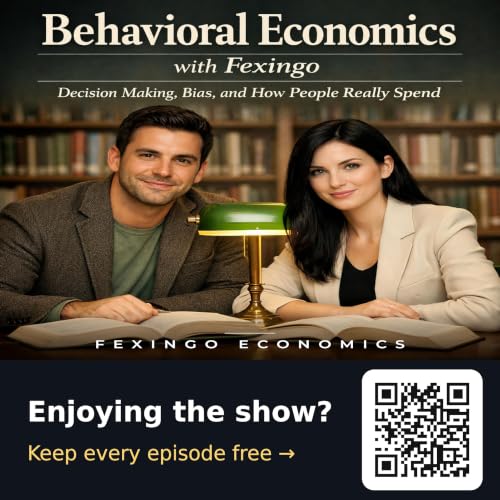
Behavioral Economics with Fexingo: Decision Making, Bias, and How People Really Spend cover art

Behavioral Economics with Fexingo: Decision Making, Bias, and How People Really Spend

Behavioral Economics with Fexingo: Decision Making, Bias, and How People Really Spend

Written by: Fexingo
Listen for free

What really drives the way people spend, save, and invest? Behavioral economics challenges the textbook assumption of the rational actor by revealing the systematic biases and mental shortcuts that shape every financial decision. In this show, Lucas and Luna sit down at the research library to dissect the experimental evidence, from Kahneman and Tversky's prospect theory to Thaler's nudge framework, and test those findings against real-world pricing, marketing, and policy design. They walk through specific studies — the endowment effect in housing markets, the sunk-cost fallacy in subscription pricing, the framing of credit-card interest rates — and ask what those experiments imply for a consumer choosing a mortgage or a CFO setting a price. Lucas brings the investigative journalist's rigor, pressing for the exact sample sizes, replication rates, and alternative interpretations; Luna pushes back with the practitioner's instinct, asking whether a bias that shows up in a lab actually translates to a shopping cart on Amazon. The listener is not a beginner: you already know that people aren't perfectly rational. What you want is the nuance — the boundary conditions where biases flip, the studies that fail to replicate, and the ethical line between a nudge and a manipulation. Each episode leaves one open question hanging: if we know these biases exist, should the government regulate against them, or is that a cure worse than the disease? #BehavioralEconomics #ProspectTheory #Nudge #Kahneman #Thaler #EndowmentEffect #SunkCost #Framing #Bias #DecisionMaking #ConsumerBehavior #BehavioralFinance #Economics #FexingoBusiness #BusinessPodcast #ResearchLibrary #PolicyDesign #CognitiveScience Keep every episode free: buymeacoffee.com/fexingo© 2026 Fexingo. All rights reserved. Economics
Episodes
  • The Spotlight Effect How We Overestimate How Much Others Notice Us
    Jun 18 2026
    In this episode of Behavioral Economics with Fexingo, Lucas and Luna explore the spotlight effect—our tendency to believe others are paying far more attention to us than they actually are. They anchor the discussion in a 2000 study by Thomas Gilovich and colleagues at Cornell, where students wore a Barry Manilow T-shirt into a room and dramatically overestimated how many peers noticed. The hosts break down why this bias persists even in professional settings, from awkward meeting moments to fashion faux pas, and discuss its implications for public speaking, negotiation, and everyday social anxiety. They also touch on the related illusion of transparency and offer a simple mental exercise to recalibrate your perception. Specific, research-backed, and immediately applicable. #SpotlightEffect #ThomasGilovich #CornellUniversity #CognitiveBias #IllusionOfTransparency #SocialAnxiety #PublicSpeaking #Negotiation #BehavioralEconomics #DecisionMaking #Psychology #BarryManilow #Research #Bias #SelfAwareness #FexingoBusiness #BusinessPodcast #Economics Keep every episode free: buymeacoffee.com/fexingo
    Show More Show Less
    5 mins
  • The Anchoring Effect How a First Number Hijacks Your Brain
    Jun 17 2026
    Episode 58 of Behavioral Economics with Fexingo dives into the anchoring effect — how an arbitrary first number can warp every decision that follows. Lucas and Luna use a classic 1996 study by Tversky and Kahneman where participants spun a rigged wheel of fortune, then guessed the percentage of UN countries in Africa. The spin's outcome, random as it was, predicted their guesses. We trace the effect into real-world pricing, from real estate listing prices to salary negotiations, and explore why a $150 sweater makes a $50 scarf feel like a steal. We also cover how to defend against anchors in your own spending and investing, including a 2012 study on car sales where women who saw a low initial offer paid less. Specific, actionable, and backed by data. #AnchoringEffect #BehavioralEconomics #CognitiveBias #TverskyAndKahneman #PricingPsychology #DecisionMaking #Bias #Heuristics #Negotiation #Salary #RealEstate #ConsumerBehavior #Economics #Psychology #Spending #Investing #FexingoBusiness #BusinessPodcast Keep every episode free: buymeacoffee.com/fexingo
    Show More Show Less
    12 mins
  • The Default Effect Why You Stay With What You Chose First
    Jun 17 2026
    Why do we stick with the default option, whether it's a 401(k) enrollment plan, a phone settings screen, or a brand of toothpaste we picked years ago? This episode of Behavioral Economics with Fexingo dives into the default effect — our brain's powerful tendency to favor the path of least resistance. Lucas and Luna use a striking real-world case: the difference in organ donor consent rates between opt-in countries like Germany (12 percent) and opt-out countries like Austria (99 percent). They explore the psychology behind status quo bias, how companies like Apple and Netflix leverage defaults to shape user behavior, and why changing a default can be more effective than any marketing campaign. The conversation also touches on the ethics of default design, from retirement savings to social media privacy settings. Tune in to understand how default options silently guide your decisions every day — and how you can reclaim control. #DefaultEffect #StatusQuoBias #BehavioralEconomics #OrganDonorConsent #OptInVsOptOut #NudgeTheory #ChoiceArchitecture #DecisionMaking #Economics #Psychology #BehavioralScience #RetirementSavings #ConsumerBehavior #DigitalDefaults #FexingoBusiness #BusinessPodcast #LucasAndLuna #DesignEthics Keep every episode free: buymeacoffee.com/fexingo
    Show More Show Less
    8 mins
adbl_web_anon_alc_button_suppression_t1
No reviews yet