Berkeley Talks cover art

Berkeley Talks

Berkeley Talks

Written by: UC Berkeley
Listen for free

About this listen

A Berkeley News podcast that features lectures and conversations at UC Berkeley

Hosted on Acast. See acast.com/privacy for more information.

All rights reserved
Social Sciences
Episodes
  • Why kind leaders finish first (according to science)
    Jan 9 2026

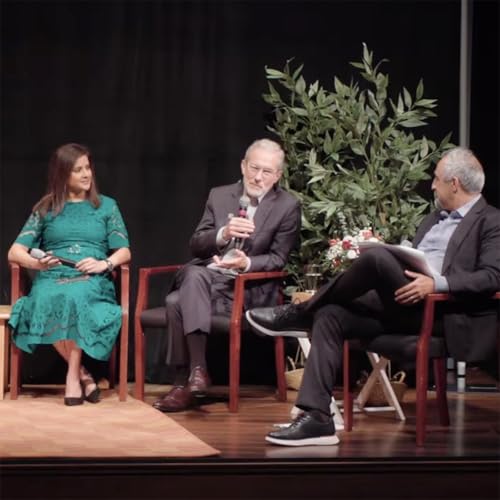
    A broad group of leaders from academia and the private sector — including UC Berkeley Chancellor Rich Lyons and neuroscientist Emiliana Simon-Thomas of the Greater Good Science Center — discuss how kindness is a strategic asset rather than a professional weakness, and why the traditional “jerk” model of leadership is scientifically flawed.

    This shift toward evidence-based management, the panelists point out, is backed by massive datasets.

    “When companies perform very well, we find that prosocial CEOs are more likely to share credit with others,” explains Weili Ge, a professor at the University of Washington’s Foster School of Business, drawing on data from a decadelong analysis of 3,500 corporate leaders.

    “And when firms don't do well,” she continues, “they're less likely to shift the blame, they're more likely to take responsibility. This is quite different from self-centered CEOs, who are more likely to take credit when things go well and shift the blame when things don't go well."

    The panelists include:

    • Rich Lyons: 12th chancellor of UC Berkeley
    • Emiliana Simon-Thomas: Science director at UC Berkeley’s Greater Good Science Center
    • Weili Ge: Professor of accounting at the University of Washington’s Foster School of Business
    • Yamini Rangan: CEO of HubSpot, Berkeley alum
    • KeyAnna Schmiedl: Chief human experience officer at Workhuman
    • Denis Ring: Former CEO of Ocho Chocolates, creator of the Whole Foods 365 brand
    • Kia Afcari (moderator): Director of Greater Good Workplaces at the Greater Good Science Center

    The event, which took place on Dec. 1, 2025, was hosted by the Greater Good Science Center in partnership with the Berkeley Center for Workplace Culture and Innovation.

    Listen to the episode and read the transcript on UC Berkeley News (news.berkeley.edu/podcasts/berkeley-talks).

    Music by HoliznaCC0.

    Video screenshot.

    Hosted on Acast. See acast.com/privacy for more information.

    Show More Show Less
    1 hr and 38 mins
  • How do we make better decisions? (revisiting)
    Dec 26 2025

    Today we are revisiting a Berkeley Talks episode in which a cross-disciplinary panel of UC Berkeley professors, whose expertise ranges from political science to philosophy, discuss how they view decision-making from their respective fields, and how we can use these approaches to make better, more informed choices.

    Panelists include:

    • Wes Holliday, professor of philosophy. Holliday studies group decision-making, including the best methods of voting, especially in the democratic context.
    • Marika Landau-Wells, assistant professor of political science. Landau-Wells studies the effect that threat perception has on national security decision-making, and how some decisions we make to protect ourselves can endanger many others.
    • Saul Perlmutter, Franklin W. and Karen Weber Dabby Professor of Physics and 2011 Nobel laureate. Perlmutter co-teaches a Big Ideas course, called Sense and Sensibility and Science, designed to equip students with basic tools to be better thinkers by exploring key aspects of scientific thinking.
    • Linda Wilbrecht, professor of neuroscience and psychology. An adolescent scientist, Wilbrecht studies how adolescent learning and decision-making changes from ages 8 to 18, and how it compares to that of adults and children.
    • Jennifer Johnson-Hanks, executive dean of the College of Letters and Science (moderator).

    The campus event was held on Oct. 9, 2024, as part of the College of Letters and Science’s Salon Series, which brings together faculty and students from a swath of disciplines to interrogate and explore universal questions or ideas from disparate perspectives.

    Watch a video of the discussion.

    Listen to the episode and read the transcript on UC Berkeley News (news.berkeley.edu/podcasts/berkeley-talks).

    Music by HoliznaCC0.

    Photo by Vladislav Babienko via Unsplash.

    Hosted on Acast. See acast.com/privacy for more information.

    Show More Show Less
    1 hr and 5 mins
  • The making of racialized US immigration control
    Dec 12 2025

    Before there was the Chinese Exclusion Act, there was the Page Act.

    Passed in 1875 amid growing anti-Chinese sentiment in the 19th century, the Page Act was one of the first national immigration laws in the United States. It targeted several categories of people, including contract laborers from Asia, women brought in for sex work and certain convicted criminals. In practice, however, it functioned mainly to restrict Chinese and other Asian women from entering the country.

    “It had enormous implications for the issues of race, gender and labor in U.S. immigration history and Asian American history,” says UC Berkeley history professor Hidetaka Hirota, who moderated a campus discussion in April to mark the Page Act’s 150th anniversary.

    In this Berkeley Talks episode, a panel of Berkeley scholars unpack how the Page Act helped institutionalize racially targeted exclusion and gendered surveillance at the border, and how it laid the groundwork for the 1882 Chinese Exclusion Act and later immigration laws. They also challenge the enduring myth of the “white bootstrapping ethnic,” supposedly living “the right way” without state support, showing instead how immigration and welfare regimes were structured to advantage European newcomers while systematically excluding Asians and other people of color.

    Panelists include Catherine Ceniza Choy, professor of ethnic studies; Cybelle Fox, professor of sociology; Leti Volpp, professor of law; and Hidetaka Hirota, associate professor of history, who moderated the conversation.

    The event, which took place on April 23, was hosted by Berkeley’s Social Science Matrix and was co-sponsored by the Berkeley Interdisciplinary Migration Initiative, the Department of Sociology, the Department of History, the Department of Ethnic Studies, the Asian American Research Center and the Center for Race and Gender.

    Watch a video of the discussion.

    Listen to the episode and read the transcript on UC Berkeley News (news.berkeley.edu/podcasts/berkeley-talks).

    Music by HoliznaCC0.

    Photo from the National Archives.

    Hosted on Acast. See acast.com/privacy for more information.

    Show More Show Less
    1 hr and 27 mins
No reviews yet