• Firing the Humans: JPMorgan’s Big Bet on AI Proxy Advisors
    Feb 17 2026

    What happens when one of the world’s largest asset managers decides to hand its proxy voting recommendations process to a robot? In this episode, Michael Levin, corporate governance expert and host of The Shareholder Primacy Podcast, unpacks JPMorgan Asset Management’s decision to stop using renowned proxy advisory firms ISS and Glass Lewis and instead rely on its in-house AI platform, Proxy IQ. Michael explains what proxy advisory firms do, why they are important, and why they face growing criticism from issuers and politicians. He unpacks how trends like ESG backlash, indexing, and “rational apathy” have reshaped institutional voting. Michael also explores what an AI-driven proxy system might do well, where it could fall short, and what this shift could mean for corporate governance and ordinary investors who depend on institutional stewardship. Join the conversation to find out what JPMorgan’s experiment means for the future of proxy advice and what is at stake for investors. Tune in now!


    Key Points From This Episode:

    • What proxy advisory firms actually do and why they work closely with large asset managers.
    • Learn how ISS and Glass Lewis became influential public companies.
    • Hear about the common criticisms of proxy advisory firms and their one-size-fits-all policies.
    • Assess the costs of proxy advisors for smaller investors and the possible conflicts of interest.
    • How ISS and Glass Lewis recommended Tesla shareholders vote on Elon Musk's compensation package.
    • Unpack Jamie Dimon’s “incompetent” comment about proxy advisory firms.
    • Why JPMorgan Asset Management decided to stop using ISS and Glass Lewis.
    • Understand why proxy firms are currently receiving significant criticism and pushback.
    • Discover how an AI system could apply internal processes and data for voting decisions.
    • Michael’s outlook for proxy advisory firms and whether they will be replaced by AI.
    • The risks associated with institutions' disengagement from voting and stewardship processes.
    • Find out what the current trends mean for retail investors and why Michael still recommends low-cost diversified funds.

    Links Mentioned in Today’s Episode:


    Michael Levin

    Michael Levin on LinkedIn

    The Shareholder Primacy Podcast

    Institutional Shareholder Services (ISS)

    Glass Lewis

    Egan-Jones

    JPMorgan Asset Management

    Fordham University School of Law Corporate Law Center


    Show More Show Less
    29 mins
  • Leaving Delaware? The Essential Role of Specialized Courts
    Feb 3 2026

    Who should be trusted to govern the most powerful relationships in the economy: markets, managers, or courts? During this conversation, we are joined by two legal scholars, Zohar Goshen and Tomer Stein, whose newest article focuses on the role of specialized corporate courts. Their shared insight is that corporate relationships are inherently incomplete, and no contract can anticipate every future conflict. This is why states establish business courts: to enforce fiduciary duties and resolve disputes, while enabling efficient risk-taking. But something else is at work here: gatekeeping claims and claim dismissal. Join us as we unpack the unique role of specialized business courts, stepping in where shareholder governance ends. We also discuss the Business Judgment Rule, the Delaware Supreme Court’s decision in Tornetta v. Musk, and more!

    Key Points From This Episode:

    • An introduction to our guests and what sparked their shared focus on specialized corporate courts.
    • Two reasons for any state to establish a corporate court.
    • Why a corporate relationship can be thought of as an incomplete contract.
    • How a specialized business court holds unique authority as a third-party participant.
    • Why shareholders should handle mismanagement on their own, and courts should handle self-dealing cases.
    • The Business Judgment Rule establishes whether shareholders or courts should intervene.
    • Why different specialized courts are necessary.
    • Safeguards to protect too much power being concentrated in the hands of managers.
    • Whether or not federal preemption is likely or beneficial.
    • Thoughts on Delaware Supreme Court decision in Tornetta v. Musk.

    Links Mentioned in Today’s Episode:


    Zohar Goshen

    Zohar Goshen on LinkedIn

    Zohar Goshen on X

    Tomer Stein
    Tomer Stein on LinkedIn
    Tomer Stein on X

    Leaving Delaware? The Essential Role of Specialized Corporate Courts

    Fordham University School of Law Corporate Law Center


    Show More Show Less
    41 mins
  • The Black Hole of Capital Gains: ETF Swap Funds
    Jan 20 2026

    Billions of dollars are flowing into a new tax strategy known as ETF swap funds, which critics say allow the ultra-wealthy to avoid capital gains tax, legally. The strategy has drawn attention from lawmakers and some academics for testing the limits of existing tax law. In this episode of Bite-Sized Business Law, host Amy Martella speaks with Jeffrey Colon, a professor at Fordham Law whose research focuses on tax and financial law. Jeff is the author of the forthcoming DePaul Law Review article, ‘The Black Hole of Capital Gains: ETF Swap Funds’, examining how ETF swap funds exploit long-standing provisions of the tax code. The conversation begins with a clear explanation of why ETFs are often more tax-efficient than mutual funds. Jeff then breaks down how Section 852(b)(6) allows ETFs to distribute appreciated securities without triggering tax at the fund level, and how techniques like heartbeat trades magnify that benefit. From there, he explains the rise of Section 351 swap funds, which allow investors with highly appreciated stock to diversify while deferring capital gains. Amy and Jeff close by discussing who benefits from these strategies, why they raise fairness concerns, and what recent proposals from Senator Ron Wyden could mean for future reform. Listen in for a comprehensive look at this consequential tax issue and the questions it raises going forward.


    Key Points From This Episode:

    • Introducing Jeffrey Colon and his research focus.
    • The billions of dollars flowing into ETF swap funds and why they have drawn scrutiny.
    • How ETFs differ from mutual funds in structure and trading mechanics.
    • Why ETFs are widely viewed as more tax-efficient than mutual funds.
    • Section 852(b)(6) and how it provides an advantage to ETFs.
    • How heartbeat trades move gains out of ETFs without triggering tax.
    • The rise of tax-motivated ETFs over the past year and a half.
    • What Section 351 swap funds are and how they operate.
    • Using swap funds to diversify appreciated stock without selling.
    • Why these strategies primarily benefit ultra-wealthy investors.
    • Concerns about fairness and turning income tax into a consumption tax.
    • Senator Ron Wyden and his proposed legislative responses.
    • IRS limits and why congressional action may be required.
    • Risks to the tax system if ETF swap funds continue to expand.


    Links Mentioned in Today’s Episode:


    Jeff Colon

    Jeff Colon on LinkedIn

    ‘The Black Hole of Capital Gains: ETF Swap Funds’

    Ron Wyden

    Fordham University School of Law Corporate Law Center

    Show More Show Less
    35 mins
  • Disclosureland: How Corporate Words Constrain Racial Progress
    Jan 6 2026

    Corporate statements about race have become commonplace, yet they often deliver far less than they promise. In this episode of Bite-Sized Business Law, host Amy Martella speaks with Atinuke Adediran, Professor of Law at Fordham Law School, about her book Disclosureland: How Corporate Words Constrain Racial Progress. Drawing on research at the intersection of business, law, and society, Professor Adediran examines how corporate disclosures shape public understanding of racial inequality, and how companies frequently treat public statements as a stand-in for real action. The conversation addresses the surge of corporate commitments following the murder of George Floyd in 2020, when companies rapidly issued public statements on racial equity after years of relative silence. Professor Adediran introduces the idea of race-conscious image construction, explaining how companies use these statements to build reputations that benefit them, even when meaningful follow-through is limited. The episode also explores the growing pattern of companies revising or removing earlier commitments amid political and legal pressure, a process Professor Adediran calls race-conscious retraction. She closes by explaining why racial progress cannot rely on corporate speech alone and why stronger oversight and accountability remain essential. Listen to the full conversation for a clear, timely examination of how corporate words can shape and limit racial progress.

    Key Points From This Episode:

    • What inspired Disclosureland and Professor Adediran’s research into the inauthenticity of corporate language and its impact on racial progress.
    • An overview of the wave of corporate statements after George Floyd’s murder.
    • Examining how rare public disclosures about race were before 2020.
    • The kinds of racial commitments companies began making during this period.
    • Why companies turned to disclosure as a response to public and employee pressure.
    • Defining “race-conscious image construction” and its role in corporate reputation.
    • How racial disclosures can boost reputation without actually changing internal practices.
    • The problem of pledges made without context, history, or measurable grounding.
    • How companies use past statements to block shareholder audits and scrutiny.
    • Introducing “race-conscious retraction” and what it looks like in practice.
    • Political and legal pressures driving companies to revise or erase commitments.
    • How empty commitments and later retraction actively constrain racial progress.
    • Why federal government involvement is essential for accountability and racial progress.

    Links Mentioned in Today’s Episode:

    Atinuke Adediran

    Atinuke Adediran on LinkedIn

    Atinuke Adediran | Fordham Law School

    Disclosureland: How Corporate Words Constrain Racial Progress

    Amelia Martella on LinkedIn

    Fordham University School of Law Corporate Law Center


    Show More Show Less
    32 mins
  • When Companies Act Like Countries: Inside Corporate Power and the Politics of Change
    Dec 16 2025

    What happens when corporations start to look and act more like countries? In this episode of the Bite-Sized Business Law Podcast, Amelia Martella sits down with Matteo Gatti, professor of business law at Rutgers Law School, to unpack his new book, Corporate Power and the Politics of Change. Professor Gatti’s work sits at the intersection of corporate governance, capital markets, and public policy, and he has spent years studying how business decisions interact with democratic institutions and social movements. In their conversation, they discuss the history of the corporation from early state-serving charters and infrastructure projects to today’s corporate responsibility debates and culture wars. Professor Gatti introduces his concept of “corporate governing” and explains how corporate speech and corporate action now interact with politics and social movements. They also delve into the incentives and risks for companies that enter into socio-political advocacy, the democratic and institutional costs of relying on corporations to fill public gaps, and why standard corporate governance tools are a poor fit for public governance. Join the conversation to find out what lies ahead for the corporate landscape and what corporate power looks like when companies start acting like countries. Tune in now!

    Key Points From This Episode:

    • How Professor Gatti became interested in the intersection of corporate power and politics.
    • The evolution of corporations and the role they played in providing public functions.
    • Hear how a shift in expectations caused companies to engage with socio-economic issues.
    • Learn what “corporate governing” is and the interplay between corporations and government.
    • Key drivers behind the rise in corporate advocacy and the cost of remaining silent.
    • What changes in politics have created a backlash against corporate responsibility.
    • Explore whether corporate governance is good for democracy and public governance.
    • Unpack the undemocratic nature of corporate decision-making and its impact on politics.
    • Why government solutions are more general, stable, and durable than corporate initiatives.
    • His critique of leveraging tools from corporate spheres for solving socio-economic issues.
    • Lessons about the importance of authenticity, stakeholder expectations, and political risk.
    • Professor Gatti’s future outlook and his proposals for revitalizing public governance.

    Links Mentioned in Today’s Episode:

    Professor Matteo Gatti

    Professor Matteo Gatti on LinkedIn

    Rutgers Law School

    European Corporate Governance Institute (ECGI)

    Corporate Power and the Politics of Change

    Citizens United

    Amelia Martella on LinkedIn

    Fordham University School of Law Corporate Law Center

    Show More Show Less
    36 mins
  • The BitLicense Architect on How It All Began and Where It's All Headed for Crypto Regulation
    Dec 9 2025

    Effective regulation is essential for cryptocurrency to develop successfully! Today, we are joined by New York State’s first Superintendent of Financial Services and the CEO of the Lawsky Group, Benjamin Lawsky, to discuss how the regulatory landscape has evolved since the early days of crypto and where he sees Bitcoin heading next. Tuning in, you’ll hear all about Benjamin’s interesting career, how it led him to where he is today, his initial reaction to the concept of the BitLicense, how the regulations were written, and more. We delve into what the BitLicense is and why it’s important before discussing state versus federal regulation and how regulation has become more challenging over time. Benjamin even tells us how he keeps up with an industry that evolves so quickly. Finally, our guest tells us how he sees crypto evolving in the near future. To hear all this and be inspired to always say yes in the early stages of your career, be sure to press play now!

    Key Points From This Episode:

    • An introduction to today’s guest, Benjamin Lawsky, and an overview of his career.
    • He tells us what he was doing when the idea of a BitLicense arose and his involvement.
    • What the BitLicense is, what it does, and the process of writing the regulations.
    • How the stakes have risen for regulation over time, and state vs. federal regulation.
    • Benjamin explains how he bridges the expertise void in crypto as a regulator.
    • Why he loves working with students and the power of always saying yes.
    • How Benjamin sees cryptocurrency evolving in the near future.
    • He shares his advice for young lawyers who are interested in this space.

    Links Mentioned in Today’s Episode:

    Benjamin Lawsky on LinkedIn

    Benjamin Lawsky in X

    The Lawsky Group

    NYDIG

    Amelia Martella on LinkedIn

    Fordham University School of Law Corporate Law Center


    Show More Show Less
    41 mins
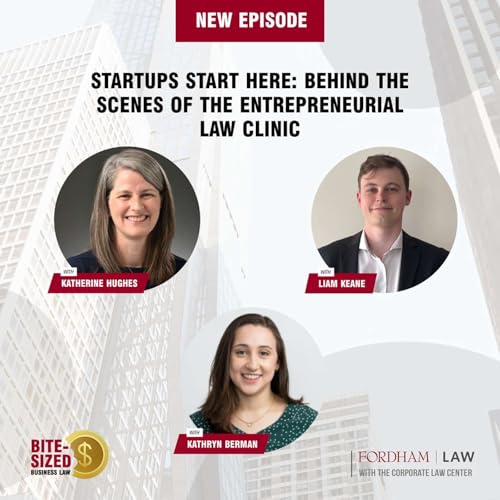
  • Startups Start Here: Behind the Scenes of the Entrepreneurial Law Clinic: Katherine Hughes, Kathryn Berman, Liam Keane
    Nov 25 2025

    What does it actually look like when law students become the primary lawyers for real-world startups and mission-driven businesses? In this episode, host Amelia Martella goes behind the scenes of the Entrepreneurial Law Clinic at Fordham Law School to explore how experiential learning prepares students for high-stakes corporate practice while serving New York’s entrepreneurial community. Amelia sits down with Professor Katherine Hughes, director of the Entrepreneurial Law Clinic, and clinic students Kathryn Berman and Liam Keane, who are all currently working with real founders on real legal problems. Together, they delve into what a law clinic is, how the Entrepreneurial Law Clinic differs from traditional litigation-focused offerings, and how corporate and transactional work can be leveraged as a powerful pro bono tool to support low-income and mission-driven organizations. They also explore real-world examples, common startup pitfalls, how the clinic manages client expectations, and Professor Hughes’ approach to supervising students. Join the conversation to hear how the Entrepreneurial Law Clinic is shaping future big-law associates and expanding access to legal support for small businesses. Tune in now!

    Key Points From This Episode:

    • Discover what a law clinic is and how it supports the entrepreneurial community.
    • The Entrepreneurial Law Clinic (ELC) at Fordham and what sets it apart from other clinics.
    • Kathryn and Liam share what drew them to the ELC and how the experience is structured.
    • Example of how the ELC is helping an entrepreneur to overcome the typical startup pitfalls.
    • Hear about the common challenges and hurdles of working with entrepreneurs and startups.
    • Learn about the expected time horizons and how transitioning students is handled.
    • Professor Hughes’ approach to teaching students and working with entrepreneurs.
    • How clients are selected and vetted through cold emails, legal services, and incubators.
    • What Professor Hughes finds most rewarding about her pro-bono work and corporate law.
    • Find out what motivates Professor Hughes and how students benefit from law clinics.
    • Kathryn and Liam’s biggest takeaways from their time working with Professor Hughes.

    Links Mentioned in Today’s Episode:

    Katherine Hughes on LinkedIn

    Kathryn Berman on LinkedIn

    Liam Keane on LinkedIn

    Lincoln Square Legal Services Inc.

    Fordham University | Entrepreneurial Law Clinic (ELC)

    FrameShare

    Communitas Ventures

    Amelia Martella on LinkedIn

    Fordham University School of Law Corporate Law Center


    Show More Show Less
    20 mins
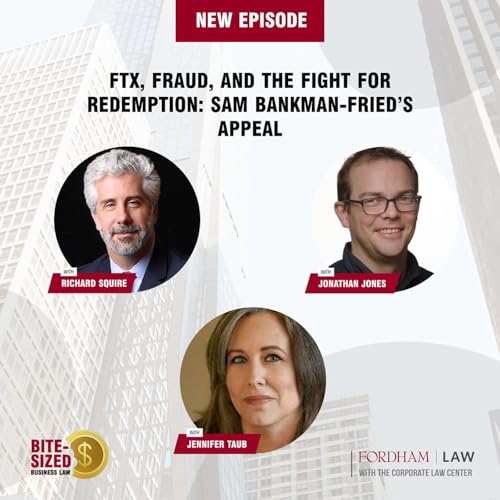
  • FTX, Fraud, and the Fight for Redemption: Sam Bankman-Fried's Appeal
    Nov 11 2025

    The rise and fall of FTX remains one of the most shocking financial scandals in modern history, and the story is far from over. In this special live episode of Bite-Sized Business Law, host Amy Martella moderates a discussion on FTX, fraud, and the fight for redemption, examining what Sam Bankman-Fried’s ongoing appeal could mean for his legacy and for crypto itself. Joining the panel are Richard Squire, Fordham Law professor and bankruptcy expert; Jennifer Taub, Wayne State Law professor and author on white-collar crime; and Jonathan Jones, Emmy Award-winning investigative journalist with The Center for Investigative Reporting. Together, they revisit how a single tweet triggered FTX’s collapse, the governance failures that let it happen, and the overlapping bankruptcy and criminal cases that followed. The panel then unpacks Bankman-Fried’s appeal, including claims of judicial bias, mishandled evidence, and a defense arguing he acted in good faith, believing no one would lose money in the long term. Closing with lessons for investors, lawyers, and regulators alike, the conversation explores whether redemption is possible when trust and billions of dollars have been “lost.” Tune in for a sharp, timely look at the legal and moral fallout of the FTX saga.

    Key Points From This Episode:

    • Jonathan’s reporting on Bankman-Fried and what prompted his investigations.
    • How and why FTX entered bankruptcy under the guidance of Sullivan & Cromwell.
    • An outline of Bankman-Fried’s indictment, trial, and 25-year sentence.
    • Understanding the overlap between FTX’s bankruptcy and criminal case.
    • How to distinguish ordinary Chapter 11 filings from bankruptcies spurred by criminal activity.
    • Details of Bankman-Fried’s appeal, including claims of judicial bias and excluded evidence.
    • Unpacking whether prosecutors moved too fast before bankruptcy losses were known.
    • A breakdown of the “good faith” defense: Bankman-Fried’s claim he meant no harm.
    • Examining Sullivan & Cromwell’s dual role at FTX and potential conflicts of interest.
    • Debating whether this could have been a governance scandal rather than criminal fraud.
    • Crypto asset valuations and repayment timing in a bankruptcy case.
    • The costs of bankruptcy and who profits when companies collapse.
    • Lessons from FTX: buyer beware, demand oversight, and don’t invest based on the vibe.
    • Audience Q&A: exploring political influence and crypto’s regulatory future.

    Links Mentioned in Today’s Episode:

    Richard Squire

    Richard Squire on LinkedIn

    Jonathan Jones

    Jonathan Jones on LinkedIn

    Jennifer Taub

    Jennifer Taub at Wayne State Law

    Jennifer Taub on LinkedIn

    ‘FTX’d: Conflicting Public and Private Interests in Chapter 11’

    The Dual State

    The Secret Story of FTX's Rise and Ruin Part I, Reveal Podcast

    The Secret Story of FTX's Rise and Ruin, Part II

    Amelia Martella on LinkedIn

    Show More Show Less
    58 mins