Episodes

  • Frankenstein - Mary Shelley
    Jan 13 2026

    In 1816, the poet Percy Bysshe Shelley was saying on the shores of Lake Geneva with his young wife Mary, and his friends Lord Byron and John Polidori. It was the year without a summer, and, confined to the house by the terrible weather, they each agreed to write a ghost story. Over the next few weeks, the 19 year old Mary produced Frankenstein, one of the most consequential and influential books ever written. Fusing the Gothic and Romantic, it tells the story of the brilliant young scientist Victor Frankenstein, who discovers how to make a living creature out of old body parts. His creation is the Monster; endlessly recreated in film, TV and painting, the story has haunted the western imagination ever since. Is Frankenstein’’s creation a tragic figure or an inhuman force for evil? What responsibility do we have for what we create? Why are we terrified of new technologies? And whatever happened to Mary Shelley? Join Rupert and Charlie as they explore this most iconic of novels.


    Show More Show Less
    55 mins
  • Small Things Like These - Claire Keegan
    Jan 5 2026

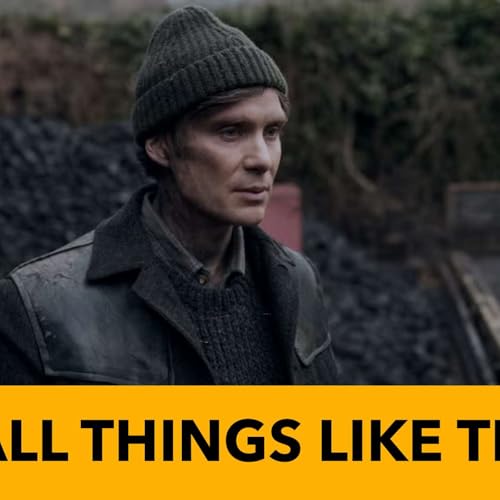
    Small Things Like These is a short novel by the Irish writer Claire Keegan. It tells the story of Bill Furlong, a coal merchant in a small provincial town in the mid 1980s. As Christmas approaches, he delivers some coal to the local convent, and by chance discovers a girl there who is being kept in a coalshed. It is clear she is in distress and Bill is faced with a choice - should he do nothing, or act? Through Bill's story, we learn of the hold of the Catholic Church on the community, and the existence of the Magdalene laundries, in which unmarried mothers were kept, normally against their will. Does Keegan's light and deft style fully convey the horror of the laundries, which were common throughout the Church until the 1990s? Are there echoes of A Christmas Carol? And does the book ever topple over into overt sentimentality? Surely not from an Irish writer! Join Charlie and Rupert as they discuss this fine novella, short listed for the 2022 Booker Prize.

    Show More Show Less
    54 mins
  • Christmas Poems
    Dec 23 2025

    Charlie and Rupert look at three great poems associated with Christmas - In the Bleak Midwinter by Christina Rossetti, a section from In Memoriam by Alfred, Lord Tennyson and The Magi by W.B.Yeats. Rossetti's is a much loved and beautiful Christmas Carol, Tennyson's is a highly crafted meditation on some of the great themes of the mid C19th, and Yeats' a more primal reflection on faith and the connections between folklore and religion. But they all refer to Christmas either directly or indirectly; Charlie explores their derivations and intentions and reflects on how successful each one is.

    Show More Show Less
    44 mins
  • Charles Dickens: A Christmas Carol
    Dec 11 2025

    The tale of the miserable Ebeneezer Scrooge, and how he came to find humanity, generosity and love, is probably the most famous Christmas story ever written outside the Bible. It is a ghost story and a classic morality tale; the book firmly established Christmas as a time for family, for joy, for generosity, presents and huge lunches, as well as a time of forgiveness and a chance to mend ones ways and set a path for a better life. But in the background are the familiar Dickensian themes of misery, grinding poverty and the appalling living conditions which existed in London at the time. Did Dickens invent the modern version of Christmas with this book? How important is Christianity? Does it matter that it is sentimental? And where have we seen the Ghost of Christmas Past before on Book In? Join Rupert and Charlie as they get in the mood for Christmas past, present and future.


    Show More Show Less
    55 mins
  • Poets: Philip Larkin
    Nov 28 2025

    Philip Larkin wrote some of the greatest poetry in English in the second half of the twentieth century. Brilliant, famous and successful, he chose to live as a librarian in Hull, largely avoiding the public gaze, and watching the world from the edge of England. His simple language and easily accessible work have made him hugely popular, and his ability to use everyday scenes and events to convey profound ideas and feelings on life, love and death are deeply moving, and achieved in part through superb poetic technique. And yet, while he had multiple relationships, he never really found love; in one of his poems, he says "Life is first boredom, then fear", and both feature heavily in his work. Complicated, irascible, misogynistic, borderline racist, increasingly reactionary as he grew older, he is not on the face of it sympathetic for a modern audience. So why does he remain as popular as ever? What were his attitudes to sex and to death? How does he achieve his technical mastery? And how does Charlie ruin for ever Rupert's love of one of his most celebrated poems?Join Book In to find out.

    Show More Show Less
    56 mins
  • Poets: Sylvia Plath
    Nov 21 2025

    Sylvia Plath was an American from a prosperous middle class background whose life was changed for ever when she met Ted Hughes at a party in London. He kissed her on the spot, and they were married four months later, on June 16th, deliberately selected as it was Bloomsday in Joyce's Ulysses. Their relationship was tumultous; Hughes had multiple affairs and Plath suffered from severe depression, but during this period she wrote some of the finest poetry of the twentieth century. Her greatest work came towards the end of her life and was published posthumously in "Ariel". Charlie and Rupert look at her background, her marriage, her tragic death through suicide at the age of 30, and her legacy. Was she a greater poet than her husband? Did she find any joy in her brief life? Book In explores all these issues and much more.


    Show More Show Less
    57 mins
  • The BIG Scale
    Nov 13 2025

    Book In introduces the Books in Greatness Scale - or BIGS. Charlie has developed a method of ranking books according to their greatness, with each being awarded a score out of 10. He explains the system, and he and Rupert award marks out of 10 to all the books they've covered so far. Who is the more generous? Who took it upon themselves to declare that Hamlet may not be a 10? Is The Great Gatsby really a great book? And is this a useful exercise or just a couple of balding middle aged blokes making up lists? Join Rupert and Charlie to decide.

    Show More Show Less
    46 mins
  • Booker Prize Winners: Lincoln In The Bardo
    Nov 10 2025

    In 1862, with the Civil War nearly a year old, Abraham Lincoln's son Willie died of TB aged 11. He was buried in West Oak Cemetery in Washington DC, and a grieving and devastated Lincoln went at night to visit his son's coffin, and physically hold his dead body for one last time. Out of this single event, George Saunders creates a unique novel where Lincoln's visit is observed and commented on by the ghosts of the bodies buried in the cemetery. They each have their own story, and through them, we see Lincoln holding his dead son and experience his grief, at a pivotal moment in American history where he was consumed by the struggle for the abolition of slavery and the survival of the Union. Saunders' portrayal of his humanity, dignity and strength is profoundly moving, but the book is also a meditation on the end of life, death, and what comes next, and uses a unique, experimental and at times bizarre structure to explore these themes and relate the story. Does it work or is it just self-indulgent and pretentious? Can Willie's ghost connect with his grieving father? Is there life after death? And what exactly is a Bardo? Join Rupert and Charlie as they discuss this remarkable book, which won the Booker Prize in 2017.

    Show More Show Less
    1 hr and 1 min