Episodes

  • The Hidden Side of Birth: Injury, Trauma, and PTSD with Angela Ballantyne
    Jul 2 2026

    Send us Fan Mail

    Did you know that over 80% of people who give birth experience an injury? That anywhere between 30 and 50% of people who give birth find it traumatic? And that up to 15% of people experience PTSD from giving birth?

    Professor Angela Ballantyne (University of Otago) talks about what birth trauma means, who is at the highest risk for experiencing it, and why so few people talk about it despite how common it is (spoiler: it's only partially because blokes don't get it).

    Remember people, be savvy!

    Show More Show Less
    48 mins
  • Brains in Jars with Insoo Hyun
    Jun 1 2026

    Send us Fan Mail

    Could a blob of cells in a petri dish one day think? Feel? Have rights? In this episode, Professor Insoo Hyun (Harvard Medical School, one of the world's leading experts on the ethics of stem cell and organoid research, joins Sinead and James to discuss what organoids are, why scientists are so excited about them, and why bioethicists are watching very closely. Insoo explains who has rights over donated cells that end up being brain models, whether organoids can have moral status, and what happens when an organoid has no donor at all — or many donors at once. Would you want a copy of your brain in a jar?

    Remember people, be savvy!

    Show More Show Less
    56 mins
  • To smoke or to vape? With Johannes Kniess
    May 14 2026

    Send us Fan Mail

    In this episode, guest-host Kat Muyskens and Sinead chat with Dr. Johannes Kniess from Newcastle University (UK) about what governments are legitimately allowed to make us do, whether we like it or not. Using case studies of tobacco restrictions and vaping bans, Johannes discusses how governments must grapple with their duties to let us live our lives the way we see fit, but also their duties to protect us from harms such as poor health. When can governments override our life plans, and can Gen Z fight back?

    Remember people, be savvy!

    Show More Show Less
    54 mins
  • Feminist Science: Wait what? with Deboleena Roy
    Apr 30 2026

    Send us Fan Mail

    Is feminist science more than just having more women in STEM? Is science itself capable of being a form of feminism? Have you ever wondered whether there's more to science than Nobel Prizes and almost magical discoveries? In this episode, Professor Deboleena Roy (Emory University), a neuroscientist and behavioural biologist, discusses what it means to do feminist science and be a feminist scientist. In so doing, Deboleena helps Sinead find meaning in the five laborous, monotonous weeks she spent in a lab in 2018, doing what amounted to what she thought was nothing.

    Remember people, be savvy!

    Show More Show Less
    46 mins
  • Therabot versus a Tic Tac with Charlotte Blease
    Apr 2 2026

    Send us Fan Mail

    In this episode of CBmE & U, Associate Professor Charlotte Blease (Uppsala University) talks about the placebo process for validating and testing mental health chatbots. With James and Sinead, Charlotte discusses whether, if we don't have the means to measure whether things like ChatGBT and theratbot are making us better or worse off, are justified in letting people use them? And importantly, when you get those pesky or uncomfortable messages from people, should you use openAI to write them? Or are we doing something wrong turning to AI instead of people?

    Remember people, be savvy!

    Show More Show Less
    52 mins
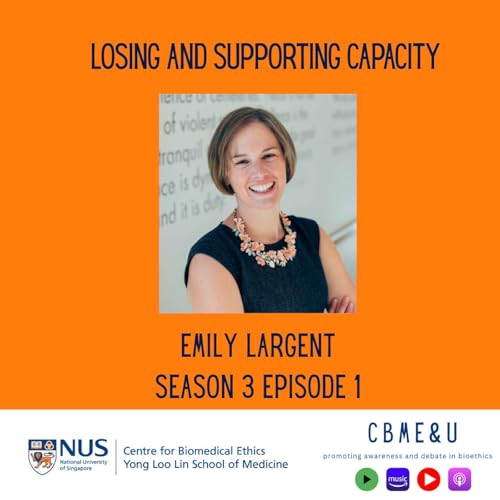
  • Losing and Supporting Capacity with Emily Largent
    Feb 23 2026

    Send us Fan Mail

    Welcome back to CBme&U! For our first episode of 2026, and the new season 3, we have Assistant Professor Emily Largent (University of Pennsylvania), a bioethics expert, trained nurse, and Harvard law juris doctor graduate. With Sinead and James, Emily discusses decision-making capacity, dementia, and how legal frameworks should adapt to recognise the whole class of people who have mild cognitive impairments who need to make decisions. Emily's research brings significant implications for governments and resource strapped healthcare systems grappling with an aging society.

    Remember people, be savvy!

    Show More Show Less
    41 mins
  • Who are your parents? with Hilary Bowman-Smart
    Nov 14 2025

    Send us Fan Mail

    The New York Times recently published an article on a woman who is fighting for custody and legal parenthood of twin children that she is not genetically related to, whom she did not gestate and birth herself, and who have not been living with her: her only connection with the twins is that she wanted them and so (under very interesting conditions) paid for the IVF and surrogate to birth them.

    In this episode, Dr. Hilary Bowman-Smart (University of South Australia) discusses the impact of assisted reproductive technologies on what we think it means to be a parent. Hilary discusses this case and answers questions such as what if the embryo that made you, was made from 4 different people's gametes? What if you could have children with your friends, instead of your romantic partner? Should James start a cult?

    Remember to review, subscribe, and like the podcast!

    Remember people, be savvy!

    Show More Show Less
    47 mins
  • The Ethics of Making Babies the Modern Way with I. Glenn Cohen
    Nov 1 2025

    Send us Fan Mail

    In this episode, Prof. I. Glenn Cohen (Harvard University) gives us his world leading answers to some of the stickiest issues in modern reproductive ethics: What does in-vitro gametogenesis (and can Sinead pronounce it correct at least once) mean for parenthood? If there is no other means for a person to exist but with a genetic condition, is trying to select against certain embryos even good for anyone? Is there a possible way to make coffee even more gross than just instant? What is the importance of genetic relatedness in determining who our parents are, and to us as individuals? What's the difference between IVF and IVG?


    Remember people, be savvy!

    Show More Show Less
    45 mins