CITO Conversations cover art

CITO Conversations

CITO Conversations

Written by: Camilla Noonan
Listen for free

About this listen

We live in a technological age in which our practices, infrastructures, institutions, and whole ways of being are shaping and being shaped by technology. It is an age marked by tremendous possibility and opportunity but also heightened levels of anxiety, alienation, nihilism and divisiveness – all occurring within a global context of rising economic inequality and destructive forms of environmental exploitation.


University College Dublin (UCD) Centre for Innovation, Technology & Organisation (CITO) is home to a multi-disciplinary international research community of scholars and practitioners who share specific concerns about, and orientations to, a variety of contemporary technical/social challenges.


Our shared project at UCD CITO is one of care for the institutions and communities that enact our current and future collective humanity. We aim to offer informed critical and constructive commentary on the growing technologisation of human and organisational life and, by so doing, to interrogate what it means to be human in a technological age. More specifically, our research activities are concerned with understanding and assessing the cultural and political dynamics of the technosocial change processes that continue to animate contemporary ways of working, organising, governing and living. We endeavour to play a role in actively shaping the development of our organisations and broader social institutions in ways that might better serve future generations of workers, managers, leaders, policy makers, citizens, and the broader world that will sustain them.

Hosted on Acast. See acast.com/privacy for more information.

Camilla Noonan
Economics
Episodes
  • Johno (Robert Johnston) on Psilocybin, Heidegger and being-toward-death
    Feb 10 2026

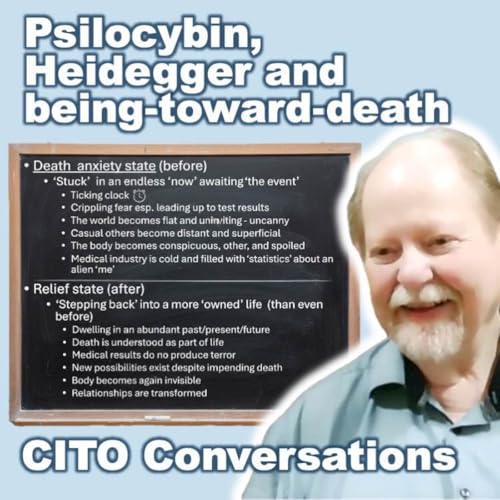
    Psilocybin, Heidegger and being-toward-death


    Between 2020 and 2023 psychologist Marg Ross and psychiatrist Justin Dwyer, together with collaborators, ran the largest Australian randomised control of psychedelic assisted psychotherapy for the treatment of extreme death anxiety in terminally ill patients using psilocybin (the active ingredient in magic mushrooms) (Ross et al, 2025).


    Over the past 15 months I have contributed to the analysis and reporting of qualitative interview data collected by these researchers before and after treatment. The therapy has been shown to be remarkably effective with 21 out of 28 patients who completed the full trial reporting sustained relief. Whereas before the treatment the patients had found themselves 'stuck' in an oppressive lingering present, after treatment they are able to 'step back into' a life that is in some ways fuller even than before the diagnosis (Dwyer et al, 2026).


    In this reading group/seminar I will briefly present Heidegger's account in Division II of Being and Time of being-toward-death and its role in prompting a more authentic human existence and richer lived temporality. I will point out its striking similarity to the change phenomenon we observed in the qualitative analysis. I invite discussion of this observation, its implications, and suggestions. Note I will devote little time to describing the clinical trial so reading the accompanying paper (Dwyer et al, 2026) is advised.


    Johno


    Robert B. Johnston is a professor (emeritus) at University College Dublin, and a person in his own right.


    Dwyer, J., Johnston, R. B., O'Callaghan, C., and Ross, M. 2026. "Stepping Back into Life: How Psychedelic Assisted Psychotherapy Transforms the Way of Life of the Terminally Ill," General Hospital Psychiatry (98), pp. 86-96.

    doi: 10.1016/j.genhosppsych.2025.12.002


    Acknowledgements

    Music

    Title: Justice Little League

    Artist: Ema Grace

    Source: https://bit.ly/2tJ6Bnd

    License: CC BY 4.0


    Artist notes: Ema Grace is an AI vocaloid produced by Ryoma MAEDA (@Ryoma_Maeda). Styled as virtual Singer&Idol 架空のバーチャルアイドル & シンガー、それがEma Grace.


    Cover Art

    Title: Inspired by zoom

    Artist: Allen Higgins

    Source: CITO-podcast-Johno.pptx

    License: CC BY-NC-SA 4.0


    Podcast License

    Design Talk (dot IE) CC BY-NC-SA 4.0

    The license can be viewed at https://creativecommons.org/licenses/by-nc-sa/4.0

    By taking part you give permission for your voice to be recorded, for the recording to be edited, and for it to be posted and published as a podcast.

    Hosted on Acast. See acast.com/privacy for more information.

    Show More Show Less
    1 hr and 25 mins
  • Data Practices with Hippolyte Lefebvre
    Oct 28 2025

    Welcome to the CITO Podcast.

    Séamas Kelly invites Hippolyte Lefebvre to present an overview of his research interests and direction. Hippolyte is a member of CITO and the Management Information Systems group in the UCD College of Business, Dublin, and previously at the Université de Lausanne, Switzerland.


    Notes, extra questions, and further reading:

    Homepage at UCD - https://people.ucd.ie/hippolyte.lefebvre

    Hippolyte’s Google scholar page is

    https://scholar.google.com/citations?user=Uxo4pH4AAAAJ&hl=en&oi=ao


    Acknowledgements

    Music

    Title: Justice Little League

    Artist: Ema Grace

    Source: https://bit.ly/2tJ6Bnd

    License: CC BY 4.0


    Artist notes: Ema Grace is an AI vocaloid produced by Ryoma MAEDA (@Ryoma_Maeda). Styled as virtual Singer&Idol 架空のバーチャルアイドル & シンガー、それがEma Grace.


    Cover Art

    Title: Inspired by selfie and AI

    Artist: Allen Higgins

    Source: CITO-podcast-DataPractices.pptx

    License: CC BY-NC-SA 4.0


    Podcast License

    Design Talk (dot IE) CC BY-NC-SA 4.0

    The license can be viewed at https://creativecommons.org/licenses/by-nc-sa/4.0

    By taking part you give permission for your voice to be recorded, for the recording to be edited, and for it to be posted and published as a podcast.

    Hosted on Acast. See acast.com/privacy for more information.

    Show More Show Less
    29 mins
  • Making New Money by Quinn DuPont
    Oct 17 2025

    Welcome to the CITO Podcast.

    This episode is a seminar by Quinn DuPont titled “Making New Money: How autonomous communities produce and govern cryptocurrencies.”

    Paul Dylan-Ennis will open the session with a brief introduction after which Quinn will present an overview of his project, after which Donncha Kavanagh will make some observations and invite reactions.

    Decentralized cryptocurrencies are upending the foundations of economic power, challenging centuries of state and bank control over money. This research critically examines the rise of digital wildcat banking and its profound implications for economic sovereignty. Leveraging digital forensics, data science, and OSINT, this work reveals who actually produces and governs cryptocurrencies—and how their collective labor reshapes value and risk. It explores the forces behind decentralized money, the vulnerabilities these systems introduce, and the future role of state-issued currencies in an era of rapid monetary transformation.


    Reflecting on the project Quinn notes:

    "I've been working on this for well over a year now, and while it is still in development, the basic outline is complete. I make some pretty provocative claims, like arguing that global forces first emerging in the 1970s lead us inexorably to this point where the labour required to produce and govern new money has become involuted[1]. It’s a unique project that reveals how new money is made and details the implications for banks, nation states, and society. I also have some fun stories to share, like my effort to vampire attack Trump's WLFI token or my reverse engineering of the FBI's Operation Token Mirrors."


    [1] Involution; the theory from Clifford Geertz where, in the original context, rice production becomes internally competitive and the processes require more labour without an increase in output - analogous to this story of technological development and precarious technological labour. I argue that the operational infrastructure of crypto expands to require more labour, despite no correlated increase in output. Thus, crypto overtakes national currencies not by meeting a market demand, but by accommodating excess labour supply.


    Notes, extra questions, and further reading:

    Quinn’s homepage - https://iqdupont.com

    China’s “Involuted” Generation by Yi-Ling Lu | The New Yorker Published MAY 14

    The president and the billion-dollar crypto businesses – How the Trump companies made $1bn from crypto by Joe Miller and Alex Rogers in Washington, Paul Caruana Galizia, Nikou Asgari, Eade Hemingway, Oliver Hawkins and Chris Cook in London | FT.com Published OCT 16 2025

    "Overcapacity" or "involution"? How China's manufacturing suffers from over-competition Tracing the roots and perils by Elena Wang and Nina Chen | Baiguan.news Published APR 18 2024

    Acknowledgements

    Music

    Title: CrazyMix

    Artist: Sandbox Korg Ableton

    Source: CrazyMix.aif

    License: : CC BY-NC-SA 4.0


    Cover Art

    Title: Inspired by Wordpress Defaults

    Artist: Allen Higgins

    Source: CITO-podcast-STS.pptx

    License: CC BY-NC-SA 4.0


    Podcast License

    Design Talk (dot IE) CC BY-NC-SA 4.0

    The license can be viewed at https://creativecommons.org/licenses/by-nc-sa/4.0

    By taking part you give permission for your voice to be recorded, for the recording to be edited, and for it to be posted and published as a podcast.

    Hosted on Acast. See acast.com/privacy for more information.

    Show More Show Less
    1 hr and 10 mins
No reviews yet