• Make America (and Europe) Humble Again
    Dec 17 2025

    In the final CNE podcast of 2025, host Evert van Vlastuin brings together Jeff Fountain (Schuman Centre of European Studies, based in the Netherlands) and Kevin Swanson (pastor and podcast host from Denver, Colorado) for a frank cross‑Atlantic conversation. The big question: are America and Europe simply in decline, or is God quietly at work in ways the headlines miss?

    Swanson arrived with strong language about Europe as the “post-Christian” continent, in a [podcast](https://www.sermonaudio.com/sermons/2212565333861) after the Munich Security Conference. The “worship of man” had replaced the “fear of God”, he said, and the pro-life movement in Europe had shrunk to only seven pro‑lifers in the Netherlands. In this CNE conversation, those claims are put to the test.

    In the CNE podcast, Kevin Swanson cheerfully admits that he sometimes uses an “Eeyore’s viewpoint”, referring to the pessimistic friend of Winnie the Pooh, in combination with an “occasional hyperbole”.

    Jeff speaks about the “paradox of Europe”. On one side, it is most shaped by the Gospel and its rejection. However, he also sees surprising signs of hope, from high-profile converts like Ayaan Hirsi Ali to growing migrant congregations in cities like Amsterdam and London, and a “quiet revival” among Gen Z.

    Kevin, by contrast, looks at “despicably low” church attendance rates and the power of humanist education, and wonders whether Europe’s foundations are already rotten.

    Jeff Fountain is the author of *Deeply Rooted*, in which he explains the basis of European integration from the Christian convictions of Robert Schuman, who pleaded for reconciliation between nations.

    Kevin says that he disagrees with the “popular eschatology” among American Evangelicals that says that Europe is the “beast” from the Apocalypse. But he still sees that the Enlightenment is destroying the foundation of the culture and that humanist ideology is guiding the schools on the continent.

    During the podcast recording, the conversation takes a surprising turn: Swanson admits America needs less bravado and more repentance. Kevin disagrees with the continuous attacks on Europe from Donald Trump. He says he is no fan of the American President. “He is an accident waiting to happen”, although he had praised his re-election in an earlier podcast.

    At the end, Jeff and Kevin agree that America and Europe are “equally in trouble”, also looking at the abortion legislation. They both feel “betrayed” by the present administration in Washington. Kevin: “I am working for a MAHA: Make America Humble Again.” But so far, he has not sold more than eight hats, he says.

    With CNE podcast host Evert van Vlastuin, Jeff and Kevin share concerns about the transatlantic cooperation within NATO and other bodies.

    For more, visit https://CNE.news or subscribe to our newsletters at https://cne.news/subscribe

    Show More Show Less
    47 mins
  • Why further steps against trafficking in the German prostitution are needed
    Dec 8 2025

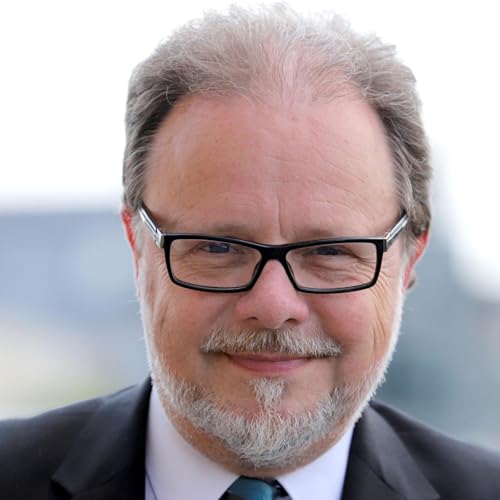
    Organising a brothel was easier than having a Tupperware party, Frank Heinrich says. Before Germany introduced its new prostitution law, in 2017, regulations on brothels were shockingly loose. Even a Tupperware party was scrutinised more critically than the sex industry.

    In the CNE podcast, he explains why more than 99 per cent of all stakeholders in this slavery system are men, why nobody knows precisely how many people are trafficked, and why he opposes a simple ban on prostitution.

    Having worked with the Salvation Army, in the German Bundestag, and the Evangelical Alliance, Heinrich says this mission is closest to his heart. As his name is Frank, he loves freedom and “this became a life thing for me”, he tells.

    The new prostitution legislation was introduced in 2017. That has already shed more light on the dark sector. But Frank believes further steps are needed. That includes the Nordic model, which penalises buyers rather than sellers of sex, whilst prostitution in itself could be decriminalised. When France introduced this system, the sex tourism in German border towns reportedly dropped within weeks.

    Therefore, he advocates for this system to be introduced in Germany as well. “In ten years, I don’t want to live in a country that has not looked into this value”, he shares with CNE podcast host Evert van Vlastuin.

    Germany is the “brothel of Europe”, the President of the German Parliament said recently. She echoes other authoritative sources.

    To solve the problem, the help of other countries is necessary, Frank says. For this reason, he appreciates the several declarations of the European Parliament in favour of the Nordic model.

    The organisation “Gemeinsam gegen Menschenhandel” is not specifically a Christian organisation. But many people who are involved in the battle against trafficking work from a Christian mindset, Frank says. “It is a reflection of my heart to be the spokesman for people who cannot speak for themselves. Trafficking is an affront to our values.”

    For more, visit https://CNE.news or subscribe to our newsletters at https://cne.news/subscribe

    Show More Show Less
    24 mins
  • How John MacArthur’s voice continues to echo across Europe
    Dec 1 2025

    Many pastors in Europe became aware that God was calling them to the ministry after reading or listening MacArthur. That says Paul Mitchell, the European director of Grace to You.

    Grace to You (GTY) is the organisation that coordinated much of MacArthur’s activities in California, US. The renowned American pastor passed away this July at the age of 86. But he was never a celebrity, Paul says.

    MacArthur served the Grace Community Church in Los Angeles for 56 years. This is a Reformed Baptist congregation that is known worldwide. At this church, MacArthur spent 42 years on a sermon series about the New Testament, during which he preached on each verse. When he arrived as a young pastor, he negotiated a guaranteed 30 hours per week for study.

    What was the result of this? Shortly after his death this summer, Charlie Kirk stated that MacArthur was among the top ten theologians after the Reformation.

    In the podcast, Mitchell states that John MacArthur visited Europe frequently after the fall of the Iron Curtain in 1990. He mainly visited former Eastern Bloc countries, such as Romania and Ukraine.

    What did he do there? Supporting pastors. “The people that he loves the most outside his family and his church are pastors”, Paul Mitchell shares with CNE podcast host Evert van Vlastuin.

    There are at least two organisations that grew out of MacArthur’s work, and those are The Master’s Academy International (TMAI), which has stations worldwide. The other is the European Bible Training Center (EBTC) in Germany and Switzerland.

    At the moment, his extensive catalogue of teaching is now accessible in several languages –including Romanian and Spanish– thanks to re-preaching projects such as Grace Reaches Out.

    MacArthur knew that he was famous, but he remained humble, Mitchel says. In the podcast, he shares whether MacArthur preferred to be announced as Doctor or as John. There is also an interesting detail about Dr Martyn Lloyd-Jones’ study desk.

    Grace to You Europe has an office in Ashford in the English county of Kent, near London.

    Listeners of the podcast will hear in several audio clips how MacArthur never bowed to the prevailing winds of culture. Whether challenging trends in Western Europe or critiquing stances on morality, his focus has consistently remained on the authority and sufficiency of Scripture.

    For more, visit https://CNE.news or subscribe to our newsletters at https://cne.news/subscribe

    Show More Show Less
    43 mins
  • Religious freedom in Europe: What if prayer gets forbidden?
    Nov 24 2025

    Every day, Anja Tang and her colleagues search newspapers from all corners of Europe to look for incidents of intolerance against Christians. And sometimes, the breaches of religious freedom come even from the governments.

    Anja Tang tells all about that in the CNE podcast.

    At the office of OIDAC (Observatory on Intolerance and Discrimination against Christians), they search in all languages. But director (and CNE columnist) Anja Tang-Hoffmann knows that many incidents of hatred against Christians do not make it into the news.

    When OIDAC presented its 2025 report in Brussels last week, one story caught everyone’s attention. A visitor reported that a church liturgy in Brussels was disrupted by a man shouting “Allahu Akbar.” “We have a few of these cases”, Anja says.

    Most often, those disturbances come from France, Spain and England. These countries are at the top in the annual report, together with Germany. In the podcast, she shares examples of vandalism. It even happens that churches are set on fire.

    To CNE’s podcast host Evert van Vlastuin, Anja Tang shares that she finds it “surprising” that many times the intolerance comes from the governments themselves in the form of restrictions. In contrast, governments are expected to protect religious freedom.

    Concrete examples are the buffer zones around abortion clinics. In a radius of 150 or 200 metres, you are not allowed to give any sign of disapproval to abortion. “Adam Smith Connor was punished for just having his head slightly bowed while he was silently praying. He did not speak a word and did not interact with anyone. But even that was a violation of this buffer zone rule.”

    Tang is convinced that this is a breach of religious freedom on the part of the government. She rejects the “narrative” that people remain free to pray outside this zone. “Religious freedom has a public dimension. Individuals are free to pray wherever they want. The burden is on the government that restrictions are as narrow as possible, and that restrictions are only allowed if they are necessary to protect public order.” In the podcast, she clarifies that in most cases, there is no harassment of public order.

    Behind all this, there is a “post-Christian ethics”, as Tang calls it. “Christianity emphasises the role of the individual and individual freedom and dignity. But the post-Christian ethics only looks at self-determination without any ties to human nature.”

    Tang’s conclusion as OIDAC director is that the European Commission needs to appoint a coordinator for combating anti-Christian hate crime. Such an office already exists for Jews and Muslims. In the podcast, she explains why such a person is needed for Christians as well.

    Hear Anja Tang explain why she believes Europe needs to act –and how faith freedom affects everyone– in this week’s CNE podcast.

    For more, visit https://CNE.news or subscribe to our newsletters at https://cne.news/subscribe

    Show More Show Less
    33 mins
  • Religious freedom in court in Norway
    Nov 17 2025

    That is the concern from the Norwegian lawyer Anders Ryssdal. He represents the Jehovah’s Witnesses in a court case regarding state grants for this religious group and certain Christian schools.

    In the talk with CNE’s podcast host Evert van Vlastuin, Anders Ryssdal explains the tensions between faith, state and society in one of Europe’s most secular countries. Anders has dealt with more cases regarding religious freedom, and he thinks there is an “indirect threat” to this liberty. A very secular state and society can give you a “stigma”, he says.

    This stigma is there already for Jews, Ryssdal says. “They need police protection for the synagogue. There could be a personal risk to be a Jew.” This direct risk is not there for Christians. “If the government refuses funds to particular Christian societies, these societies are undermined and could suffer”, the lawyer says. This could be a path to marginalisation.

    Ryssdal stresses that religious freedom is not only a liberty to believe, but also a liberty to assemble with others.

    In this week’s CNE podcast, Ryssdal explains the Norwegian system of state money for all (recognised) religious groups. But the Jehovah’s Witnesses lost all grants because of their exclusion policy if members live a sinful life. This is especially sensitive if it concerns young members between 15 and 18 years, who are still minors legally.

    Although Ryssdal won the first round, the case will reach Norway’s Supreme Court in February 2026 — and could redefine religious freedom in the country.

    The conversation doesn’t end with Jehovah’s Witnesses. Christian schools in Norway tied to the conservative church community Menigheten Samfundet face scrutiny from the Ministry of Education. Their “crime”? Not teaching about homosexuality according to state expectations.

    Ryssdal sees government interference as overreach: “It’s possible to teach both science and religious belief. The question is, are we allowed to stress the religious dimension?”

    State money was originally only there for the state church. However, since the Church of Norway is no longer an official state church, the free churches also receive government funding to create legal equality. This means that pastors in independent churches and among Jehovah’s Witnesses also receive funding from Oslo.

    Ryssdal admits that the government money makes the issue of religious freedom more complicated. “As soon as you get money from the state, the state gets a grip on you,” Ryssdal observes.

    For more, visit https://CNE.news or subscribe to our newsletters at https://cne.news/subscribe

    Show More Show Less
    34 mins
  • Abortion talk to distract attention from scandals in Spanish politics
    Nov 10 2025

    But is this truly about abortion — or is it a calculated distraction from corruption scandals shaking his party? With Sánchez’s party facing corruption scandals, the timing of the proposal has raised eyebrows. “It feels like a strategy to shift public attention”, Godden explains to CNE podcast host Evert van Vlastuin. “He wants to appear progressive and pro-women, but the reality is more complex.”

    And even though the proposal does not specifically stigmatise doctors, it does contain a list with medical experts who conscientiously object to performing abortions. While intended to ensure sufficient medical staff, critics fear it could stigmatise professionals and infringe on privacy. “The intention of the law is to know which ones are objectors to abortion, so people who want an abortion can be referred to the right one”, Paula explains in the podcast. However, it remains the question how this legislation would work out in practice.

    In the podcast, Paula offers a sharp legal and cultural analysis, tracing the evolution of abortion laws in Spain from Franco-era criminalisation to today’s liberal framework. During the time of the Franco dictatorship, she says in the podcast, abortion was severely criminalised. The ban was also associated with Roman Catholic and Christian beliefs, Paula adds. The influence of that is still seen today. “Being against abortion is understood as something Christian, not as something that could be bad for women, without needing to be involved into religious thoughts”.

    Furthermore, Paula explains how recent reforms have already made abortion widely accessible, raising the question: Why push for constitutional change now?

    Paula challenges popular narratives, arguing that abortion, while politically charged, does not meet the criteria of a human right. She also warns against the emotional and ideological framing that often clouds public debate.

    She criticises the ideological framing of abortion as a feminist issue. “It’s become emotionally charged and politically weaponised,” she says. “We need to step back and ask: What is this practice really about? Do women really need abortion? What's the problem that women are facing that makes them consider abortion? How can we really empower and help women?”

    The conversation also delves into a deeper philosophical question: *Is abortion a human right?* Paula argues that it is not. “Human rights are inherent to all human beings—like the right to life. Abortion doesn’t fit that definition,” she explains. She warns against the emotional and ideological framing that often dominates public discourse, urging a return to legal clarity and ethical nuance.

    Tune in to hear Paula’s thoughtful perspective on law, ethics, and the future of abortion in Spain.

    For more, visit https://CNE.news or subscribe to our newsletters at https://cne.news/subscribe

    Show More Show Less
    27 mins
  • Reem Alsalem about surrogacy as child trafficking
    Oct 27 2025

    Most countries stay silent when babies are traded as goods, says a UN expert in the CNE podcast. Children are sold around the world as if they were commodities.

    The UN Human Rights Commission appointed Reem Alsalem as special rapporteur on violence against women and girls. She has already written reports about the degrading character of prostitution and the danger in which female sports are at the moment.

    This month, she presented a [report](https://docs.un.org/en/A/80/158) on surrogacy in the UN General Assembly, requesting a worldwide ban on this practice.

    For Reem Alsalem, the matter is simple: Surrogacy is turning the most intimate parts of a woman into a marketplace for money. She says in the CNE podcast that this should be forbidden.

    Surrogacy is the practice in which other women can carry and deliver a child for you when you cannot do that yourself. Officially, this helps poor women earn money by carrying someone else’s child. But the UN expert shows another side: this makes it easy for child abusers.

    As soon as the child is born, they are immediately separated from the biological mother, says Alsalem. All people in the world are quickly breastfed, but those kids are not. Why not? They should not bond with the woman they have lived with for nine months, although this is the child’s right. In the podcast, the UN expert speaks about the “immense harmful consequences” of this.

    Some justify surrogacy by pointing to the Bible and the history of Abraham and Hagar. This interpretation is wrong, says Alsalem, and in the podcast, she explains why.

    In the Western world, the legislation differs from country to country. Italy and Slovakia have banned the practice, and Ukraine and Georgia are the European hotspots.

    Reem Alsalem –herself a citizen of Jordan– is very outspoken. Surrogacy is exploiting female bodies. Does it make any difference that the women give consent? No, since legally, “you cannot consent to situations of exploitation or abuse”, she explains in the CNE podcast.

    The circumstances in which those women carry such a child are degrading. “They can be forced to an abortion”, she tells CNE podcast host Evert van Vlastuin.

    She is not impressed by the argument that surrogacy is a means to give offspring to childless people. “There is no right to have your own children as part of your reproductive rights.”

    She rejects the comparison with adoption. In those cases, the intended parents are checked thoroughly. There are examples of children who ended up in the hands of criminals and people who (sexually) abused the child. “We have also seen that they often struggle with long-term questions of identity and origin.”

    For more, visit https://CNE.news or subscribe to our newsletters at https://cne.news/subscribe

    Show More Show Less
    35 mins
  • Matti Sankamo: How does Päivi Räsänen's lawyer prepare himself?
    Oct 19 2025

    Just one more week, and then attorney Matti Sankamo will plead before the highest court ever in his career: Finland’s Supreme Court. Christians from all over the world will follow the case, but this does not give him stress. “I sleep well”, he says in the CNE podcast.

    Sankamo is the lawyer for the Finnish Member of Parliament, Päivi Räsanen. On October 30th, she will appear in an oral hearing at the Supreme Court in Helsinki. And the decision of this court is final, at least in Finland.

    The persecution started in 2019 after Räsänen posted a tweet with questions about the Lutheran Church’s support for the Gay Pride in Helsinki together with a photo of Romans 1, in which the apostle calls sex between men dishonourable.

    Two earlier courts acquitted her unanimously of all the charges. But the prosecutor wants this case to be heard at the highest level: the Supreme Court.

    No doubt, this case could shape the future of freedom of both speech and religion in Finland and perhaps the rest of Europe.

    In the podcast, the advocate states that it is “very rare” that the Supreme Court in Finland holds an oral hearing. Most attorneys never have cases at this court, making it a unique event in Sankamo’s professional life.

    He assumes the judges did this because this is a “high-profile case” with broad media attention. In such cases, it could be important for the court to show that justice exists for all parties.

    Another reason could be that the judges are interested in “Räsänen’s intention behind the tweet”.

    To podcast host Evert van Vlastuin, Matti explains that it is not the duty of the Supreme Court to find new evidence but rather to find out whether the evidence was interpreted correctly at lower levels.

    So far, he says the prosecutor’s legal argumentation was “very abstract.” She quoted more international conventions than national law.

    Matti agrees that this case can have international consequences. He himself borrowed some of the argumentation from the case of the Swedish pastor Ake Green []. “So, if we win, it can influence other lawyers in other countries. Obviously, it is not going to be binding for foreign courts.”

    If Räsänen loses, she can appeal to the European Court for Human Rights (ECtHR) in Strasbourg. “But that’s a very different kind of process, and the consequences are different. So, it’s important for us to win in Finland.”

    For more, visit https://CNE.news or subscribe to our newsletters at https://cne.news/subscribe

    Show More Show Less
    33 mins