PRIME MEMBER EXCLUSIVE | 3 Months Free Trial

Auto-renews at INR 199/mo after 3 months. Cancel anytime. Offer ends 15 July, 2026.
Coaching in Organizations cover art

Coaching in Organizations

Coaching in Organizations

Written by: Dominique Mas from Group Coaching HQ
Listen for free

Real stories and strategies for building coaching cultures within organizations - with an unapologetic love of group coaching.© 2026 Group Coaching HQ LLC Economics
Episodes
  • Building Coaching Programs Through Experimentation
    Jun 15 2026
    📝 EPISODE SUMMARY What happens when one internal coach is supporting 3,000 employees in a rapidly growing organization? In this episode of the Coaching in Organizations podcast, Betsy Campbell, Dream Coach at IMA Financial Group, shares how experimentation, collaboration, and group coaching became essential to scaling a coaching culture. From launching an ADHD-focused group coaching pilot to designing future programs around mindful change management, Betsy offers an honest look at what it takes to build coaching programs that truly meet people where they are. This episode explores psychological safety, coaching culture, internal coaching, and how group coaching can support growth and connection during periods of organizational change. 🧠 5 KEY TAKEAWAYS Pilots are designed for learning, not perfection: Betsy shares how treating coaching pilots as experiments creates room for iteration, growth, and honest feedback instead of pressure to “get it right” the first time. Group coaching often becomes more powerful through connection: What started as a structured coaching program for women diagnosed with ADHD evolved into a space where participants most valued conversation, support, and shared understanding. Coaching culture cannot be built alone: Building coaching in organizations requires collaboration across HR, leadership, and learning teams rather than relying on a single coach to drive the culture. The best coaching programs start with real human signals: Betsy’s pilot emerged after repeatedly hearing women disclose ADHD challenges during one-on-one coaching sessions, revealing an unmet need for community and support. Coaching helps organizations navigate growth and change: As IMA continues to expand rapidly through acquisitions, Betsy explains why group coaching and mindful change management can help employees stay connected, grounded, and engaged. “Coaching is not a performance. It’s not a movie. Other people aren’t watching it in that way.” ↪️ WHAT WE COVER IN THIS EPISODE 02:48 - Betsy Campbell’s Coaching Origin Story: Betsy shares how a colleague introduced the dream coach concept to IMA after reading “The Dream Manager.” This sparked her interest in coaching. She then found a program that resonated with her. 05:07 - Making the Leap to Dream Coach: Betsy describes taking a leap into coaching without knowing the exact outcome. She made a case for her institutional knowledge and passion for the organization. She eventually became IMA’s dream coach. 06:08 - Developing IMA’s Coaching Culture: Betsy discusses her approach to building IMA’s coaching culture. She emphasizes creativity, experimentation, and collaboration. She works with the HR team to introduce coaching principles to managers and leaders. 08:13 - The Coaching Landscape at IMA: Betsy explains that IMA uses external resources for coaching programs for managers and leaders. She also provides both group and one-on-one coaching internally. The coaching culture is still growing and developing. 09:14 - The Freedom and Challenges of Creating the Role: Betsy enjoys the freedom to create programs based on the organization’s needs. This allows her to focus on what coachees need. However, this freedom can also be challenging due to a lack of pre-defined structure. 10:23 - The ADHD Pilot Program: Betsy noticed many women in one-on-one sessions disclosed ADHD, leading her to create a group coaching pilot. She trusted this pattern because it was repeated often and felt important. The pilot targeted women in their women’s network who were already engaged in groups. 13:15 - Pilot Program Participation and Learnings: The pilot received more interest than anticipated, requiring a cutoff for participation. Betsy learned the importance of checking in with participants who miss sessions. She realized that in future pilots, a shorter duration would allow for quicker iterations. 16:07 - Coaching Program vs. Support Space: Betsy initially planned a structured coaching program with a book. However, the participants mostly wanted to connect and share. She learned the importance of clarifying expectations and distinguishing between a coaching program and a support space. 20:59 - Navigating Individual and Organizational Needs: Betsy sees individual and organizational needs as a Venn diagram, looking for areas of overlap. Group coaching can multiply the benefits for individuals by fostering connection in a safe space. This approach helps serve both the individuals and the organization. 22:25 - Mindful Change Management Pilot: Betsy’s next pilot idea is mindful change management for new employees joining through acquisitions. This addresses the stress of rapid change and the need for connection within a growing organization. The goal is to ground and energize employees during this period of change...
    Show More Show Less
    34 mins
  • What Coaching Changes in Law Firms
    May 26 2026
    📝 EPISODE SUMMARY What does it take to introduce coaching into a profession built on expertise, billable hours, and high-performance expectations? In this episode of the Group Coaching in Organizations Podcast, Traci Mundy Jenkins, Director of Career Development at Venable, shares how coaching is being integrated into the development of legal professionals. Drawing on her background as a lawyer, legal recruiter, and career development leader, Traci explains how she discovered coaching and began applying it to conversations she was already having with associates and partners. You’ll hear how Venable piloted a group coaching program designed to support lawyers transitioning toward partnership, why preparation and expectations are critical before the first session begins, and how group coaching creates powerful peer learning across offices. If you’re passionate about coaching cultures, internal coaching, or expanding group coaching inside professional services organizations, this episode is a must-listen. 🧠 5 KEY TAKEAWAYS What happens when coaching enters a profession traditionally built on expertise and advice? Traci Mundy Jenkins, Director of Career Development at Venable, shares how coaching can complement traditional development approaches and help lawyers navigate major career transitions. Coaching strengthens conversations leaders already have: coaching skills shift discussions from giving advice to helping professionals reflect and find their own solutions. Group coaching supports identity transitions: lawyers preparing for partnership benefit from structured reflection on leadership expectations and career direction. Preparation drives engagement in group coaching programs: orientation sessions and expectation-setting before the first session dramatically improve participation and outcomes. Cross-office groups build relationships: bringing lawyers together from different locations creates learning and connections that rarely happen through daily work. Peer learning is the real engine of group coaching: when participants start coaching each other, the group becomes far more powerful than any single coach. “Coaching just adds another layer to the conversations I was already having. It gives you tangible tools to help people step back, reflect, and often realize they already have the answers.” ↪️ WHAT WE COVER IN THIS EPISODE 04:25 - Traci’s Origin Story in Coaching: Traci discusses her journey into coaching, highlighting her enjoyment of engaging with people. 05:33 - Cultivating a Coaching Culture at Venable: Traci shares how her background informs the coaching culture at Venable, emphasizing support for associates and managers. 09:05 - The Balance of Advising and Coaching: Traci explains the difference between advising and coaching and how this impacts her program design. 11:23 - Designing Group Coaching for Counsel: Traci details why she chose to create a group coaching program for counsel on the partnership path. 16:46 - Practical Program Design and Structure: Traci outlines the practical aspects of her program design, including outreach and session structure. 22:02 - The Value of Pre-Meetings in Program Success: Traci explains why one-on-one pre-meetings are essential for participant understanding and commitment. 24:38 - Fostering Peer Coaching and Engagement: Traci discusses the challenge of ensuring participants coach each other and ideas for improving engagement. 29:00 - Flexibility in Program Delivery: The Imposter Syndrome Story: Traci recounts a session where an unexpected turn in discussion led to important learning. 32:50 - Becoming Comfortable with Silence: Traci shares her experience as a lawyer learning to tolerate and appreciate silence in coaching sessions. 36:00 - Protecting Reflection Time in Coaching Programs: Traci talks about the importance of building in dedicated time for reflection to enhance learning retention. 🗝️ KEY THEMES Coaching culture in professional services organizations Advising vs coaching in internal development roles Supporting lawyers transitioning toward partnership Designing group coaching programs inside organizations Preparing participants for group coaching success Peer learning and shared reflection in groups Cross-office collaboration through group coaching The role of silence and reflection in coaching conversations Building coaching cultures pragmatically ABOUT TRACI MUNDY JENKINS Traci Mundy Jenkins is the Director of Career Development at Venable, where she leads initiatives supporting the professional growth and career progression of approximately 300 associates across the firm. Her work focuses on helping lawyers navigate career transitions, strengthen leadership capabilities, and build sustainable careers within a demanding profession. She integrates coaching approaches into her work ...
    Show More Show Less
    35 mins
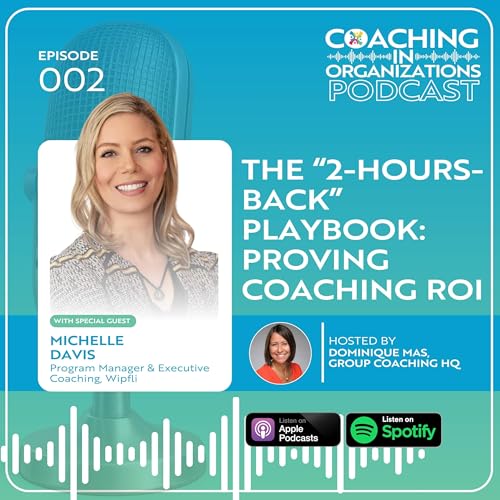
  • The "2-Hours-Back" Playbook: Proving Coaching ROI with Michelle Davis
    May 5 2026
    📝 EPISODE SUMMARY How do you prove coaching works without reducing people development to a single performance score? In this episode of Coaching in Organizations, Michelle Davis (Program Manager for Executive Coaching at Wipfli) shares how her firm built an internal coaching practice, launched a group coaching pilot focused on strategic time management, and translated results into business language leaders trust. You’ll hear what she measured, what she stopped measuring (and why), and how manager involvement strengthens impact while protecting confidentiality. If you’re passionate about coaching cultures, internal coaching, or building capacity through group coaching in organizations, this episode is a must-listen. 🧠 5 KEY TAKEAWAYS What if your coaching ROI story started with a simple question leaders actually care about: “How many hours did we get back?” Michelle Davis, Program Manager for Executive Coaching at Wipfli, breaks down what it really takes to measure coaching impact inside a professional services firm where “metrics are the language.” Start your ROI story with a metric leaders care about: translate coaching outcomes into business language, like time saved. Internal coaching changes the contract: hold the coachee’s agenda while staying aligned to organizational priorities and context. Build group coaching around a clear, repeatable business need: the strategic time management pilot targeted high-potential leaders. Measure what you can defend: engagement, time management satisfaction, and hours saved created a credible impact case for expansion. Protect confidentiality while involving managers: use alignment up front, midpoint check-ins, and post-engagement feedback to strengthen results without exposing coaching conversations. “The business priorities and goals are the frame, and I get to work with my clients within that frame.”   ↪️ WHAT WE COVER IN THIS EPISODE 02:29 Michelle’s Coaching Origin Story: Michelle shares what led her to become a coach and her transition from an external to an internal coach. 07:49 Accountability to Business Outcomes: Michelle discusses how her role shifted when she became an internal coach and accountable for business outcomes. 09:30 Coaching Culture at Wipfli: Michelle describes the coaching culture at Wipfli, including who receives coaching and the types of programs offered. 13:17 The Group Coaching Pilot: Michelle details the group coaching pilot, its participants, and the business needs it addressed. 14:40 Measuring Impact of the Pilot: Michelle explains the three key metrics used to measure the pilot’s impact: engagement, satisfaction with time management, and time saved. 19:48 Translating Impact to ROI: Michelle discusses how they translated the pilot’s results into ROI for leadership, combining quantitative and qualitative data. 21:38 Removing Performance as a Metric: Michelle explains why the decision was made to remove overall performance as a measurement in coaching programs. 23:19 Including Managers in Impact Measurement: Michelle describes how managers are involved in measuring the impact of coaching engagements. 26:26 Personal Realizations as an Internal Coach: Michelle shares her personal insights and shifts experienced while building the coaching culture at Wipfli. 28:06 Managing the Dual Role of Internal Coach: Michelle addresses the challenge of being both a coach and an employee, and how she manages boundaries when learning sensitive information. 🗝️ KEY THEMES Coaching ROI that leaders trust Time management as a high-leverage coaching topic Designing group coaching programs around a clear business need Simple, measurable outcomes (and what they tracked) Scaling coaching access through multiple modalities Dropping “performance” as a coaching metric Manager involvement without breaking confidentiality Internal coach boundaries + ethical escalation How to build a coaching culture pragmatically ABOUT MICHELLE DAVIS Transforming people and workplaces from functioning to flourishing drives Michelle's work as an internal coaching leader. She envisions the workplace as a space where professionals can live out their values, cultivate meaning, and become their best selves. Michelle leads the internal coaching practice at Wipfli, a professional services and advisory firm, where the practice's mission is to empower associates to realize their highest potential and live the lives they imagine. Prior to becoming a certified coach, she spent 15 years in business development at the University of Michigan. 🤝 CONNECT WITH MICHELLE Wipfli: https://www.Wipfli.com/ Email: michelle.davis@Wipfli.com LinkedIn: https://www.linkedin.com/in/michelle-bard-davis/ 📩 STAY CONNECTED WITH GROUP COACHING HQ! Receive updates about future episodes and events!  Join our ...
    Show More Show Less
    33 mins
adbl_web_anon_alc_button_suppression_t1
No reviews yet