CollapseCast cover art

CollapseCast

CollapseCast

Written by: Scott "Zeroack"
Listen for free

About this listen

CollapseCast: Uncovering Intriguing Collapses Join host Scott "Zeroack" as he dives into the hidden cracks threatening our world, from aquifer depletion to magnetic pole shifts. With a nod to the Cassandra Effect—warnings ignored until it’s too late—each 30 minute episode unpacks gripping collapse scenarios, blending current events, offbeat risks, and honest insights. Featuring AI commentator Zerobit’s data-driven takes, CollapseCast delivers thought-provoking discussions without the mean. Visit collapsecast.com for blogs, polls, and more. Are you ready to heed the warnings? Each episode explores real-world collapse scenarios: • From the vanishing Ogallala Aquifer to magnetic pole reversals • From fertility freefall to transformer grid shortages • From biological memory blackouts to elite immunity and the collapse of consequenceCopyright 2025 Collapse Cast Earth Sciences Politics & Government Science Social Sciences
Episodes
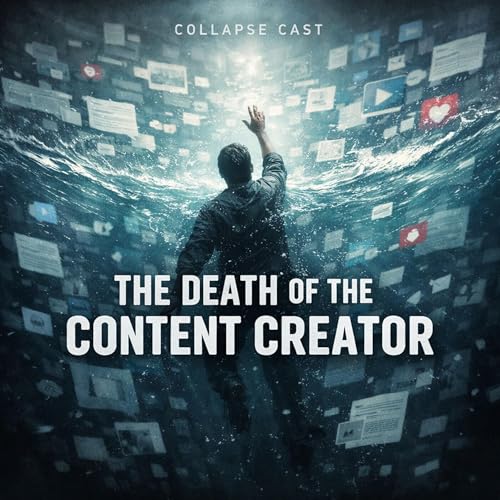
  • Death of the Content Creator - EP 6
    Jan 30 2026

    We are living through a creative paradox.

    More content is being produced than at any point in human history — books, audiobooks, music, videos, scripts — yet more human creators are quietly disengaging, adapting, or disappearing altogether.

    This episode of CollapseCast explores The Death of the Content Creator — not as a sudden collapse, but as a slow, stabilizing shift. As AI-generated content floods every platform, attention fragments, signal collapses, and audiences adapt to an environment where nothing pauses long enough to matter.


    Creators face a new reality:

    create as a human voice and risk invisibility,

    operate as an AI manager within the system,

    or quietly exit without notice.


    This is not an episode about banning technology or blaming audiences.

    It’s about understanding what changed — and why effort, originality, and human presence no longer anchor the systems that distribute culture.


    Collapse doesn’t always arrive as destruction.

    Sometimes it arrives as abundance.

    Show More Show Less
    36 mins
  • The Brondo Effect — When Thinking Became Optional - EP 5
    Dec 29 2025

    There was no vote.

    No announcement.

    No moment where humanity decided to stop thinking.

    We just… stopped needing to.

    In this episode of CollapseCast, we examine The Brondo Effect — the quiet collapse that happens when convenience replaces cognition and thinking becomes optional.

    Borrowing its name from Idiocracy, the Brondo Effect isn’t about intelligence. It’s about incentives. Systems that reward speed over understanding, automation over effort, and comfort over competence — until no one remembers how things used to work, or why they mattered.


    This episode isn’t about killer AI or sudden catastrophe.

    It’s about delegation.

    About trust without verification.

    About how small, reasonable choices slowly add up to irreversible dependence.


    Because most collapses don’t arrive with explosions.

    They arrive with upgrades.

    “The most dangerous collapses don’t break systems — they make thinking optional.”
    Show More Show Less
    35 mins
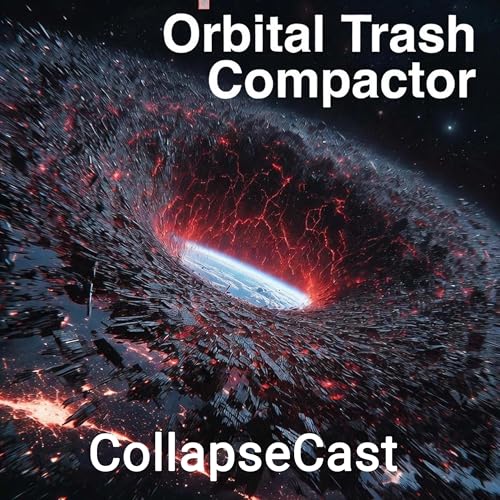
  • Orbital Trash Compactor: How Kessler Syndrome Could Kill the Sky - EP 4
    Nov 26 2025
    What if one bad day in orbit turned the sky above your head into a permanent shotgun blast?

    Since 1957 we’ve hurled over 60,000 objects into orbit. More than 36,000 of them are still up there. Only about 6,000 are working satellites. The rest? Dead hulks, exploded fuel tanks, lost tools, and millions of fragments screaming along at 17,500 mph. In 1978, NASA scientist Donald J. Kessler warned that low Earth orbit could reach a tipping point: density so high that collisions breed more collisions, creating an unstoppable debris cascade that eventually coats the planet in a lethal shell. No new launches. No GPS. No weather satellites. No Starlink. No ISS rescue missions. Just a glittering ring of shrapnel that might stay deadly for centuries.

    In this episode we dig into:

    • The real collisions that have already happened (2009 Iridium-Cosmos smash, the 2021 Russian ASAT test, China’s 2007 disaster) and how each one made the math worse
    • Why the “25-year de-orbit rule” is mostly theater and how mega-constellations like Starlink and Kuiper are pouring gasoline on the fire
    • The terrifyingly small number of active debris-removal missions actually funded right now (literally single digits)
    • The geopolitical nightmare: no one owns outer space, no one can enforce cleanup, and everyone has an incentive to keep launching until the door slams shut forever
    • What a full-blown Kessler Syndrome endgame actually looks like for civilization—no more satellites, no quick recovery, and a collapse cascade that could ripple through finance, defense, agriculture, and emergency response for generations

    The sky isn’t infinite. We’re turning it into a junkyard at escape velocity, and the clock is ticking louder than most people realize.

    Zerobit, final word:

    “Probability of catastrophic Kessler cascade by 2050 currently estimated between 12 and 38 percent and rising. Orbital carrying capacity already exceeded in multiple shells. Mitigation funding remains less than 0.3 percent of annual launch expenditure. Trendline suggests closure of low Earth orbit within most listeners’ lifetimes.”

    Buckle up. The trash compactor is already closing.

    Show More Show Less
    33 mins
No reviews yet