College & Career Readiness Radio cover art

College & Career Readiness Radio

College & Career Readiness Radio

Written by: T.J. Vari
Listen for free

About this listen

College & Career Readiness Radio with T.J. Vari

A podcast about all things career and college readiness. Brought to you by MaiaLearning.

MaiaLearning Inc. 2024
Episodes
  • If Kids Can See It, They Can Be It with Marlon Styles
    May 12 2026

    In this episode of College & Career Readiness Radio, Dr. TJ Vari sits down with Marlon Styles to discuss how schools can build stronger connections between students, business partners, and future careers. Marlon shares how his district reimagined career exploration through the Ready Now 100 initiative and why early, meaningful exposure matters for every student.

    Marlon explains that the work began with a simple but powerful idea: if kids can see it, they can be it. Through Ready Now 100, the district created a “Passport to Tomorrow” model that gave students access to career-based experiences from kindergarten through high school, with the goal of helping them see themselves in future career clusters and build the skills to thrive.

    A major theme of the conversation is partnership. Marlon describes how the district worked with business and community partners not just for funding, but for human capital—employees, experts, facilities, and real-world experiences that students could engage with both inside and outside school. He also shares how small-group meetings, follow-up conversations, and clear communication helped build trust and secure long-term support.

    The episode also explores accountability and student agency. Marlon explains that students created portfolio artifacts to show what they learned and to reflect on their interests, confidence, and growth. He emphasizes that career exposure at younger ages helps students become more self-aware and can even drive academic engagement by connecting classroom learning to future goals.

    Finally, Marlon reminds listeners that this kind of work cannot be done alone. Schools of any size or setting can build strong partnerships by taking an asset-based approach and inviting community organizations to co-create opportunities for students.

    Guest takeaway: If kids can see it, they can be it—and every student deserves access to adults and experiences that help them imagine and pursue their future.

    College & Career Readiness Radio is brought to you by MaiaLearning.

    Show More Show Less
    38 mins
  • Career Advising and Internships at the College Level with Dr. Andy Osheroff
    Apr 28 2026

    Dr. Osheroff says that career development should begin as soon as students arrive at college, not in their final year, because early engagement helps them build confidence, find opportunities, and avoid missing out on internships or other high-impact experiences.

    He explains that his office at the University of Southern Maine uses peer career guides to create a low-pressure first step for students who may be hesitant to meet with a professional advisor.

    Dr. Osheroff notes that the peer career guide model works because students connect more easily with near peers who are still figuring things out, and because empathy is essential to effective peer advising.

    He says the program includes training, ongoing development, and employer-led sessions so students can learn what the job market values and share that insight with others.

    He emphasizes that internships should be more accessible, not just highly competitive summer opportunities, and says his team runs the program three times a year to create more entry points.

    He describes a process in which his team handles student recruitment, screening, interview coaching, and employer matching, making the internship process easier for both students and employers.

    He says spreading internships across fall, spring, and summer reduces competition and helps students fit part-time internships around their classes.

    He explains that the program grew because USM invested in it over time and was able to show that it improved student retention, classroom success, and post-graduation outcomes.

    He says paid internships are essential for equity because many students are commuters, work part-time, and have rent, childcare, or other financial responsibilities.

    Dr. Osheroff explains that funding comes from grants and cost-sharing with employers, with each partner’s share varying by organization size and other factors.

    He says the goal is to create meaningful, project-based internships rather than busywork, and his team helps employers design stronger roles from the start.

    He notes that each internship begins with a learning agreement and three student-set learning outcomes, followed by midpoint check-ins to address issues before the internship ends.

    He tells listeners that the team measures outcomes through surveys, resume support, and longer-term follow-up with alumni to see where participants go afterward and how the experience shaped them.

    His main message is simple: if an idea is useful, start small, try it, and let it grow in your own context.

    Show More Show Less
    39 mins
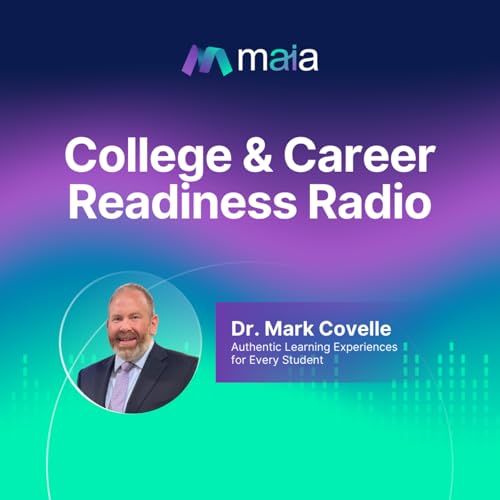
  • Authentic Learning Experiences for Every Student with Dr. Mark Covelle
    Apr 14 2026

    Our guest for this episode of College & Career Readiness Radio is Dr. Mark Covelle, Administrative Director of Middle Bucks Institute of Technology and a Founding Member of the CTE Collective.

    Mark says that interest in CTE has surged post-COVID because hands-on, authentic learning could not be replicated online. The skilled trades gap has added further momentum nationally.

    He notes that in CTE, students practice — they work on real brakes, deploy real safety equipment, and build real things. Traditional classrooms more often ask students to pretend. Kids know the difference, and it affects their engagement.

    His school serves 1,000 students across 21 career programs and issued over 1,500 industry-recognized credentials last year — roughly 1.5 per student. These credentials are portable, tangible evidence of skill beyond a transcript.

    Business and industry partners tell Mark the biggest gaps in young workers are persistence (stalling when stuck), communication, and general professionalism. MBIT grades students on employability weekly — resumes, interviewing, professional conduct, and workplace interaction are all part of the curriculum.

    Mark believes that every K-12 school should have an internship program. Students need professional feedback at 18, not 24. Even virtual or industry-problem-based experiences count. Getting that feedback earlier — with educator support — changes outcomes.

    Mark and TJ discuss how authentic problems can live in any classroom. An English problem-solution paper can be drawn from a real local business challenge. A student who needs math to complete an engineering project will learn that math. Purpose drives motivation.

    Mark tells a story about involving students in school branding. MBIT's "ambition" identity came from a student who noticed MBIT sits inside the word ambition. It became a neon lobby sign, a podcast, and a school-wide hashtag — and it stuck because students created it.

    Mark's closing message: authenticity matters. Authentic learning builds trust, persistence, and a positive relationship with school — the skills employers say are missing most.

    College & Career Readiness Radio is brought to you by MaiaLearning, a fully comprehensive college and career readiness platform serving students worldwide.

    Show More Show Less
    35 mins
adbl_web_anon_alc_button_suppression_c
No reviews yet