DMPK Insights cover art

DMPK Insights

DMPK Insights

Written by: Pharmaron
Listen for free

About this listen

DMPK Insights is a by-monthly podcast by Pharmaron about the latest research and developments in DMPK science with a focus on three different areas:- Current Considerations: Breaking DMPK science with a focus on recent scientific publications, regulatory and other considerations - Influential Individuals: Key DMPK scientific influencers – career path, research focus, future plans- Trending Technologies: Technological advances in DMPK science – what does it do and why is it needed?

© 2025 Pharmaron DMPK Insights
Biological Sciences Science
Episodes
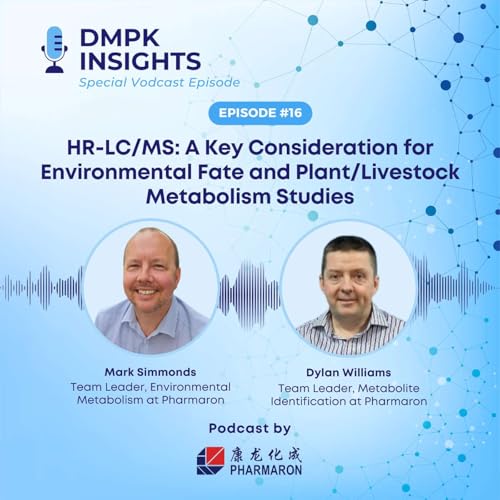
  • DMPK Insights #16: HR-LC/MS: A Key Consideration for Environmental Fate and Plant/Livestock Metabolism Studies
    Dec 8 2025

    For a captioned and video version or to access the transcript and ask a question for our experts about this podcast episode, please visit: https://www.pharmaron.com/knowledge-center/dmpk-insights-16-metabolism-studies/#cprtstatus=_cp_0!channel!AAIDoxPJjQQe


    In this special episode of the Pharmaron DMPK Insights Podcast Series, our experts explore the critical role of metabolism studies in agrochemical research. The discussion focuses on metabolite identification and its importance in determining the environmental fate of agrochemicals and the metabolic pathways they undergo. By examining both the scientific foundations and practical applications, this episode highlights how metabolism studies support regulatory decision-making and environmental safety assessments.

    We will address the following points:​

    • Challenges within Environmental Metabolism
      • Requirements for identification within regulatory studies
      • Challenges, e.g. application rate, volatility, matrices
      • Methods for secondary confirmation
      • Tools to aid metabolite identification
    • High-Resolution LC-MS in Practice
      • High-resolution mass spectrometry (HRMS) instrumentation
      • Analytical challenges in agrochemical metabolism studies
      • Use of stable isotopes
      • Real-world case studies in metabolism studies

    Our Speakers:

    Mark Simmonds – Team Leader, Environmental Metabolism at Pharmaron


    Mark is the Team Leader for Environmental Metabolism at Pharmaron with more than 24 years’ experience working in the CRO industry, with the last ~4 years working in the Environmental Metabolism group at Pharmaron. He graduated with a degree in Chemistry from the University of Greenwich in 1995 studying for seven years whilst working for Rhône-Poulenc Agriculture – later becoming Aventis CropScience. In 2001, after the sale of the crop science division to Bayer, Battelle UK was formed, a CRO performing environmental fate, plant metabolism and residue studies and as an active study director, Mark took up the position of Researcher and remained in the environmental fate and plant metabolism arena for the next 20 years. In January 2021, Mark moved to Pharmaron as Environmental Metabolism Team Leader, overseeing the delivery of environmental fate, plant and livestock metabolism studies to our agrochemical clients and environmental risk assessments to our pharma clients.


    Dylan Williams –
    Team Leader, Metabolite Identification at Pharmaron


    Dylan is a Team Leader in Metabolite Identification at Pharmaron with more than 22 years’ experience working in the pharmaceutical CRO industry. He received his Ph.D. in Chemistry (specifically mass spectrometry) under Dr Rod Mason’s supervision at the University College of Wales, Swansea in 2002. Following his Ph.D, Dylan began his career with the regulated bioanalysis group at Biodynamics (now Pharmaron UK) before moving to the Pharmaron UK Metabolism department in 2004 where he joined the fledgling Metabolite Identification Team. In 2017, Dylan became the Team Leader for the Metabolite Identification Team and now leads a large, highly-experienced team, using accurate mass LC-MS to solve some of the most interesting scientific challenges for our clients.


    Stay tuned for more podcasts in our Pharmaron DMPK Insights Series!

    Show More Show Less
    31 mins
  • DMPK Insights #15: Pharmacokinetics-Pharmacodynamics: Driving decision making with PKPD throughout Drug Discovery
    Aug 28 2025

    For a captioned version or to access the transcript and ask a question for our experts about this podcast episode, please visit: https://www.pharmaron.com/knowledge-center/dmpk-insights-15-pkpd-drug-discovery/

    In this episode of the Pharmaron DMPK Insights Podcast Series, Simon Taylor and Dr. Emile Chen​ discuss the relationship of drug concentration and effect (PKPD). PKPD is critical to decision making from initial modality selection, through molecule optimization, translational science and clinical dosage planning. Simon and Emile discuss the concepts and practical applications of PKPD and explore the concept of model-based target pharmacology assessment in combination with physiologically based pharmacokinetic-pharmacodynamic (PBPK-PD) modelling to improve decision making.*

    * Model-based Target Pharmacology Assessment (mTPA): An Approach Using PBPK/PD Modeling and Machine Learning to Design Medicinal Chemistry and DMPK Strategies in Early Drug Discovery”, J Med Chem. 2021 Mar 25;64(6):3185-3196.​

    We will address the following points:​

    • What is PKPD and its importance throughout a discovery project lifecycle​
    • How PKPD can be used to guide decision making including case study examples​
    • How a combination of physiologically based pharmacokinetic/ pharmacodynamic (PBPK/PD) modeling and machine learning (ML) can be used to elucidate the optimal combination of properties for the targeted pharmacology

    Our Moderator:

    Simon Taylor – Vice President, Drug Discovery at Pharmaron

    Simon Taylor is Vice President of Drug Discovery and is based in Hoddesdon, UK. With over 27 years of industry experience, he is responsible for DMPK/ADME and PKPD strategy, including human extrapolation and PBPK modelling and simulation, for Pharmaron’s integrated drug discovery projects from early discovery through to IND submission. Before Pharmaron, Simon worked at GSK for 20 years, leading DMPK and Quantitative Pharmacology teams and projects from the Hit Identification stage through to the clinic. He has worked across respiratory, inflammation, oncology, and cardiovascular therapy areas with drugs of varying routes of administration. Simon has a BSc in Pharmacology from the University of Leeds and an MSc in Model Based Drug Development from the University of Manchester. He has co-authored over 30 scientific publications in the literature.


    Our Speakers:

    Dr. Emile Chen – Formerly Director, Modeling and Translational Biology at GlaxoSmithKline

    Dr. Emile Chen has thirty years of industrial experience divided between early discovery involved in lead optimization and candidate selection, and late-stage development, including authoring and reviewing of regulatory documentation and NDA submission. Until March 2024, he was in the System Modeling and Translational Biology group, using PBPK, Mechanistic PKPD modeling, QSP, and machine learning techniques to solve project questions and thereby enhance scientific productivity.

    Emile received his undergraduate degree from the University of California, Los Angeles, and his PhD from Northwestern University in the field of Biomedical Engineering, specializing in the development of mathematical models for information processing in the brain. He began his pharmaceutical career at Hoffmann-La Roche in 1993, following a postdoctoral fellowship at the University of California, San Francisco. He joined GlaxoSmithKline in 1996. Over the years, he has led ADME and PK groups at various times, supporting both early discovery and late development DMPK efforts. More recently, r


    Stay tuned for more podcasts in our Pharmaron DMPK Insights Series!

    Show More Show Less
    42 mins
  • DMPK Insights #14: Evolution of CNS Drug Disposition Models
    Aug 1 2025

    For a captioned version or to access the transcript, please visit: https://www.pharmaron.com/knowledge-center/dmpk-insights-14-cns-modelling/

    In this podcast, Scott Summerfield and Professor Elizabeth de Lange discuss the evolution of CNS drug disposition models, highlighting the increasing sophistication of physiologically based pharmacokinetic (PBPK) models, such as LeiCNS-PK3.0. They discuss how these tools are enhancing our understanding of CNS drug distribution, predicting human pharmacokinetics, and supporting translational research across species.

    We will address the following questions:

    • What scientific needs led to the development of early CNS drug models?
    • How have tools like microdialysis and PBPK modeling shaped current CNS pharmacokinetic models?
    • What role does the unbound drug concentration (Kpuu) play in predicting CNS drug effects?
    • How do modern models like LeiCNS-PK3.0 integrate complex physiological and pharmacodynamic data?
    • What are the future research directions and translational opportunities in CNS PK/PD modeling?

    Our Moderator:

    Scott SummerfieldExecutive Director Metabolism at Pharmaron

    Scott Summerfield is the head of Metabolism, leading clinical and nonclinical radiolabeled ADME (Pharma and Environmental), in vivo support, imaging, as well as Discovery/Development and bioanalysis metabolite ID. Scott joined Pharmaron in 2022, having worked in the Pharmaceutical Industry for over 20 years, supporting both small and large molecule DMPK projects (Discovery and Development). He holds a PhD and a postdoctoral degree in protein mass spectrometry. He has published extensively in the areas of bioanalysis and the permeation of drugs across the blood-brain barrier.


    Our Speaker:

    Elizabeth de Lange Professor Predictive Pharmacology at Leiden University

    Elizabeth de Lange is a Professor in Predictive Pharmacology and Principal Investigator at the Research Division of Systems Pharmacology and Pharmacy of the Leiden Academic Center for Drug Research (LACDR). With her team, she is helping to unravel the rate and extent of mechanisms that govern central nervous system (CNS) target site pharmacokinetics (PK) and related pharmacodynamics (PD), with a special emphasis on physiologically based (PB) translation between species and conditions. The ultimate aim is to have mathematical models that support CNS drug development (including reduction and replacement of nonclinical studies) and can predict the best possible treatment for CNS conditions in the individual patient (‘tailor-made’). Elizabeth has contributed over 160 peer-reviewed publications, delivered more than 170 invited lectures, and organized numerous conferences, symposia, courses, and workshops. She has had multiple leadership positions in scientific projects, also at LACDR, nationally with the NVF, in large international organizations (e.g., AAPS), and is currently the scientific coordinator of the EU consortium QSPainRelief. She has several roles on advisory board, provides both advice and consultancy, and alongside all of this Elizabeth contributes to education in the BioPharmaceutical Sciences bachelor’s and master courses. Among other honors, Elizabeth received the AAPS Fellow Award (2013), an Honorary Doctorate in Pharmacy from Uppsala University (2020), and the prestigious Sheiner Lecture Lifetime Achievement Award from ISOP (2020).


    Stay tuned for more podcasts in our Pharmaron DMPK Insights Series!

    Show More Show Less
    32 mins
No reviews yet