Episodes

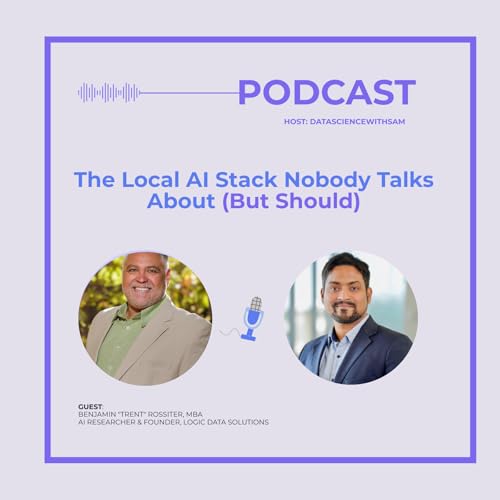
  • EP 38: The Local AI Stack Nobody Talks About (But Should)
    Apr 22 2026

    You want to run AI locally. You have questions: What hardware do I actually need? Which framework should I use? How much will this cost? What's the realistic performance?

    In this episode, Sam brings back Trent Rossiter, founder of Logical Data Solutions, for a practical walkthrough of building a production-grade local AI lab. Trent has built real systems for enterprise clients, tested frameworks on multiple hardware stacks, and made the hardware choices that matter. This is not theory. This is what actually works.

    WHAT WE COVER:

    ▪ Hardware & Framework Choices: VRAM is the critical metric (not all VRAM is equal — memory throughput matters as much as capacity).

    ▪ Model Architecture & Capability: Mixture of Experts (MoE) lets you fit more power into less VRAM by using fewer active parameters.

    ▪ Real Enterprise Applications: Computer vision for quality assurance on assembly lines. Proprietary data handling without cloud exposure.

    ▪ Your Starter Stack (All Free): Langflow (agentic workflow builder), Goose (MCP-enabled chat), AnythingLLM (with vector stores for RAG), MCP servers (Model Context Protocol — standardised tool integration).

    ▪ Agentic AI & Security: OpenClaw is powerful but controversial — manages email, Telegram, calendars, creates sub-agents. Trent runs it in Docker on an isolated machine for safety. NVIDIA's NemoClaw is the enterprise version (security-first, nothing-allowed-by-default, explicit permissions).

    HARDWARE TRENT MENTIONS:

    NVIDIA DGX Spark — 128GB unified memory, CUDA stack

    Apple MacBook Pro/Mac mini — up to 512GB unified memory, market leader for personal AI

    AMD integrated AI PCs — emerging competitor

    NVIDIA RTX gaming cards (30/40/50/60 series) — high VRAM, high power consumption, complex

    FIND TRENT ROSSITER:

    LinkedIn: https://www.linkedin.com/in/benjamin-trent-rossiter-mba-0157945/

    Logic Data Solutions: https://logicdatasolutions.com/

    Contact: BenjaminRossiter@LogicDataSolutions.com

    Show More Show Less
    41 mins
  • EP 37: Neurons: Future of AI Processing
    Apr 19 2026

    What if the next generation of computers wasn't made of silicon — but of living human neurons? Not simulated neurons, not artificial neural networks inspired by biology, but actual brain cells grown in a lab, connected to electrodes, and used to process information. That's not science fiction anymore. It's happening right now at FinalSpark, a Swiss startup building the world's first remotely accessible biocomputing platform.

    In this episode, Sam talks with Dr. Ewelina Kurtys, a neuroscientist with a PhD in brain imaging and a postdoctoral researcher at King's College London, about how living neurons could revolutionise computing — and why they use one million times less energy than silicon-based AI hardware.

    ▸ WHAT YOU'LL LEARN

    ▪ How FinalSpark was founded in 2014 by Fred Jordan and Martin Kutter — and why they pivoted from digital AI to biological computing when they realised the energy and cost problem was unsolvable with silicon

    ▪ Why 20 watts powers the human brain while silicon-based AI requires megawatts — and what that means for AI's sustainability crisis

    ▪ The difference between neurons as processors (not power sources) — a crucial distinction most people get wrong

    ▪ Why biological neural networks learn continuously while digital systems require full model updates — and what that means for energy efficiency

    ▪ The honest challenge: nobody yet knows exactly how neurons encode information — the biggest scientific hurdle in biocomputing right now

    ▪ How the I/O interface works: electrodes measuring neural spikes, analog-to-digital converters, researchers writing Python code to control neurons remotely

    ▪ The remote access breakthrough: researchers in Tokyo or Bristol can log in and control living neurons in Switzerland in real time via browser

    ▪ Why neurons won't outperform GPUs on speed: biocomputing specialises in efficiency and adaptability, not clock cycles

    ▪ FinalSpark's current stage: they've stored 1 bit of information and are collaborating with 9 universities on fundamental research

    ▪ The cost argument: even at 10× lower price than NVIDIA, biocomputers would still generate billions in profit due to energy and infrastructure savings

    ▪ Bioethics, consent, and regulation: how FinalSpark is working with philosophers now to establish ethical frameworks before biocomputing scales

    ▪ Why human-machine integration is not new: prosthetics, pacemakers, and smartphones are already blending biology and technology

    ▪ The hybrid computing future: silicon, quantum, and biocomputing will coexist, each doing what they do best

    ▪ The real game-changer: cheap, accessible AI for everyone — Ewelina's vision for what biocomputing means for society in 10–20 years.

    ▸ LINKS MENTIONED IN THIS EPISODE

    → Dr. Ewelina Kurtys on LinkedIn

    → Ewelina's Personal Blog & Articles

    → FinalSpark (official website)

    → FinalSpark Neuroplatform (with live neuron view)

    → FinalSpark Team

    → Psync (Ewelina's mental wellness startup)

    → FinalSpark Contact Form

    Show More Show Less
    30 mins
  • EP 36: NVIDIA GTC 2026: Everything That Matters - Recapped
    Mar 28 2026

    Jensen Huang took the stage at SAP Center in San Jose on March 16th and announced that NVIDIA now expects one trillion dollars in chip orders through 2027 — double the forecast from just one year ago. Sam breaks down the five biggest stories from GTC 2026 in under 10 minutes.

    In this episode: the Vera Rubin platform (7 new chips, 5 rack types, built for inference and agentic AI), the Groq 3 LPU (NVIDIA's $20B inference play), NemoClaw (the enterprise-ready agentic AI stack built on viral open-source project OpenClaw), the autonomous vehicle announcement with Uber and seven major automakers, and the Nemotron Coalition for open frontier models.

    Whether you're building in ML, working in data, or just trying to stay ahead of where AI infrastructure is heading - this is your less than 15-minute briefing.

    Links:

    NVIDIA GTC 2026 Press Kit: nvidianews.nvidia.com/online-press-kit/gtc-2026-news

    Jensen Huang Keynote On Demand: nvidia.com/gtc/keynote

    Vera Rubin Press Release: nvidianews.nvidia.com/news/nvidia-vera-rubin-platform

    GTC 2026 Sessions On Demand: nvidia.com/gtc/

    Show More Show Less
    13 mins
  • EP 35: Who Actually Controls AI? The Governance Gap Explained
    Mar 23 2026

    There's no international treaty governing AI, no agreed definition of "safe AI," and nobody with actual authority over frontier model deployment. A handful of CEOs make decisions with civilizational implications while governance structures lag years behind.

    This episode examines who's responsible for AI governance. The current state? Fragmented and lagging. The US has no comprehensive federal AI legislation—Biden's executive order was rolled back under Trump. The EU AI Act is most comprehensive but heavy provisions don't kick in for years. China's regulation focuses on censorship over safety. The UK AI Safety Institute does serious work but has no enforcement authority.

    What's working? AI safety institutes are building evaluation capacity. Open-source releases like DeepSeek enable external research. Academic safety community advances interpretability work. Market pressure matters—Anthropic gained users by taking public safety stands.

    Three urgent needs: mandatory disclosure requirements for high-capability systems, international coordination with shared evaluation standards (AI safety summits need teeth), and public deliberation beyond experts and officials.

    This concludes the AI Governance and Regulation series. People who understand AI deeply - technically, commercially, ethically, politically - will shape governance's future. Stay curious, stay critical, never outsource thinking to any single company or voice.

    Show More Show Less
    7 mins
  • EP 34: DeepSeek R1 vs GPT-4: The $6M Model That Changed AI Economics
    Mar 23 2026

    In January 2025, Chinese AI lab DeepSeek released DeepSeek R1—a model matching GPT-4 class performance at a fraction of the training cost. It wiped $600 billion off NVIDIA's market cap in a single day. Twelve months later, the ripple effects are still reshaping the AI industry.

    This episode cuts through the "China beats America" headlines to explain the actual technical and economic implications. DeepSeek R1 benchmarked comparably to OpenAI's O1 on reasoning tasks. The shock wasn't performance—it was cost. DeepSeek claimed under $6 million in training costs versus hundreds of millions for comparable Western models.

    What changed: The assumption that massive compute spending creates an insurmountable moat for frontier AI models was proven wrong. Smaller labs with less funding can now compete effectively. This turbocharged efficiency research across all AI labs globally.

    The DeepSeek moment was a genuine inflection point—not because China won an AI race, but because it proved the rules of competition differ from industry assumptions. Efficiency matters as much as scale. Open weights change deployment strategies. The global AI ecosystem is multipolar in ways it wasn't two years ago.

    Essential listening for data scientists tracking model economics, ML engineers exploring efficiency techniques, and tech leaders navigating AI geopolitics and competitive strategy.

    Show More Show Less
    8 mins
  • EP 33: Agents Everywhere: What Agentic AI Actually Means for Your Job
    Mar 18 2026

    Everyone's talking about agentic AI, but there's a gap between the hype ("AI will do your job for you") and the reality, which is more nuanced and frankly more interesting. The word "agentic" has officially crossed from technical jargon into buzzword territory—simultaneously everywhere and nowhere. Everyone's using it, few can define it precisely. This episode cuts through the noise to explain what agentic AI systems actually are, what they can and cannot do today, and the realistic implications for people working in data, tech, and knowledge work.

    What is an agent? Traditional AI interaction: you send a prompt, the model produces a response, done. An AI agent is different: it takes a goal, breaks it into steps, takes actions in the world (browsing the web, writing and running code, calling APIs, managing files), observes results, and iterates until the goal is achieved or it gets stuck. The key agentic feature: it operates across multiple steps autonomously without you manually directing each one.

    Examples include OpenAI's Claude (consumer-facing), but in enterprise settings, agents are being deployed for automated customer support escalation, multi-step data pipeline management, code review and testing workflows, and research synthesis across large document sets.

    What can agents do today in early 2026? Agents are reliable for well-defined, bounded tasks with clear success criteria—taking support tickets, classifying them, drafting responses, flagging uncertain ones for human review. But for autonomously managing complex, open-ended strategic projects? Still unreliable. Failure modes include hallucinations, tool use errors, context window limitations in long tasks, and difficulty recovering gracefully when something unexpected happens mid-task. These are real limitations the best researchers are actively working on.

    The realistic workforce impact right now is task displacement rather than job displacement. Specific tasks within jobs are being automated: first drafts of documents, initial data analysis, standard code patterns, customer FAQ responses. Higher-order judgment, stakeholder navigation, creative problem framing, and ethical calls remain under human control.

    For data scientists specifically, repetitive engineering work is most likely to be automated: data cleaning pipelines, standard visualizations, model deployment scripts. But statistical thinking, algorithmic design, understanding model outputs, and evaluating trustworthiness remain human responsibilities. The work becoming more valuable: knowing what questions to ask, evaluating whether AI output is trustworthy, and designing systems that fail safely.

    The advice: become a power user of agentic tools before your role requires it. Not because you'll be replaced by an agent, but because practitioners who understand these tools deeply will be disproportionately effective. Learn how to prompt agents for complex multi-step tasks, evaluate outputs critically, and understand failure modes so you can deploy humans strategically.

    Agentic AI is real, useful today for specific tasks, and improving rapidly. The hype is ahead of the reality, but not by as much as you might think.

    Show More Show Less
    8 mins
  • EP 32: AI Discovers Drugs: The 2026 Clinical Trial Moment for AI in Biotech
    Mar 16 2026

    For years, AI in drug discovery has been a promise—billions invested, hundreds of papers published, dozens of startups founded, but actual drugs coming out the other end? Not yet. This is changing in 2026. Several AI-discovered drug candidates are now entering mid-to-late stage clinical trials. This is the year the receipts arrive for AI in drug discovery.

    The biotech industry is calling 2026 a landmark year. For a sector that's been hyped as much as it's been scrutinized, the fact that we're finally getting real clinical data on AI-designed drug candidates is a big deal. Multiple candidates discovered and optimized using AI systems are now in Phase 2 and Phase 3 clinical trials, primarily focused on oncology and rare diseases—areas where existing options are limited and financial incentives for innovation are high.

    Companies furthest along include Insilico Medicine, Recursion Pharmaceuticals, and Exscientia. Their drug candidates were identified by AI systems analyzing massive biological datasets and predicting molecular structures likely to interact with disease targets in useful ways. What used to take teams of medicinal chemists years to accomplish, these systems can explore in weeks—a massive boost for clinical trial phases by reducing R&D time.

    Why this matters: Traditional drug discovery takes 10-15 years and over $1 billion per approved drug. Most candidates fail—the attrition rate in clinical trials is brutal. AI's promise is dramatically improving the hit rate by better predicting which candidates will actually work before spending money on trials. Even a modest improvement in clinical trial success rates would have enormous downstream impact on human health.

    But 2026 is a stress test. Clinical trials expose whether AI-predicted drug behavior holds up in actual human biology, which is extraordinarily complex. AI models are trained on known data; when candidates reach trials, you're testing the model's ability to generalize to real biological complexity that wasn't in training. Early signals have been mixed—some candidates performing well, others hitting unexpected toxicity issues. The honest answer: we don't know yet how much AI improves success rates at the clinical stage.

    For data scientists interested in this space, the most interesting current work is in molecular property prediction, protein structure modeling building on AlphaFold, and multi-objective optimization across efficacy, safety, and synthesizability simultaneously. Recursion's operating system approach treats drug discovery as a data problem end-to-end—one of the most ambitious attempts to apply ML infrastructure thinking to biology at scale.

    AI in drug discovery is no longer just a story about potential—it's now a story about evidence. The next two years of clinical data will either validate or seriously challenge what's been claimed.

    Show More Show Less
    8 mins
  • EP 31: Google's $30M Bet: The AI Impact Summit India and the Global South
    Mar 14 2026

    Every major AI summit has been held in San Francisco, London, or Washington — until now. In this episode, Sam breaks down what happened when Google CEO Sundar Pichai flew to New Delhi to open India's AI Impact Summit, and why it sent a clear geopolitical signal about the future of AI's global expansion.

    Sam unpacks Google's major commitments announced at the summit — including a $30 million AI for Science Impact Challenge, a new DeepMind partnership with Indian government bodies and universities, a Climate Technology Center, and new fiber optic infrastructure connecting the US, India, and the Southern Hemisphere.

    But this episode goes beyond the announcements. Sam explores why India specifically is positioned to become a pivotal player in the global AI race, the equity argument for why AI benefits must extend beyond Silicon Valley and a handful of developed nations, and the urgent governance gap — why the world may need an AI equivalent of the nuclear nonproliferation treaty.

    If you've only been following US and European tech news, this episode will expand your lens.

    Show More Show Less
    7 mins