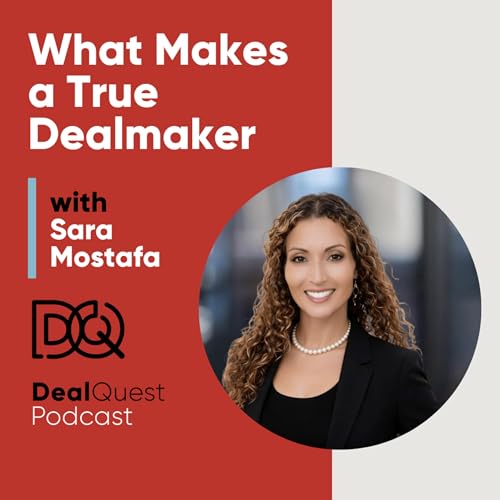
DealQuest Podcast with Corey Kupfer cover art

DealQuest Podcast with Corey Kupfer

DealQuest Podcast with Corey Kupfer

Written by: Corey Kupfer
Listen for free

Why do some companies grow by leaps and bounds while others only inch forward? Simple. They embrace Deal-Driven Growth in addition to organic growth! DealQuest is where you learn how to strategize, prepare for, find, and complete deals to grow your company faster. Listen in as host Corey Kupfer takes you behind the scenes with some of the world’s most fascinating deal-savvy business leaders. This is the one place where they can share openly the secret to deals they have done (or failed to do) and the issues, opportunities, benefits, pitfalls and lessons learned. Here you learn first-hand all about: Powerful deals that require little capital, mergers, acquisitions, and tuck-ins, Joint ventures, partnerships, and strategic alliances, licensing, raising capital and onboarding key employees, negotiating, structuring, finding, valuing, closing and integrating deals. Don’t be the one at the table who doesn’t grasp the power of Deal-Driven Growth!© 2026 014078 Economics Leadership Management & Leadership Politics & Government
Episodes
  • Episode 404: What Makes a True Dealmaker with Sara Mostafa
    May 20 2026
    From sketching fashion designs as a kid to leading complex M&A and private equity deals, Sara Mostafa shares what separates true dealmaking attorneys from ordinary transactional lawyers, why minority investment deals are like marriages with prenups, and what founders should understand before bringing in growth capital. In this episode of the DealQuest Podcast, host Corey Kupfer sits down with Sara Mostafa, the newest partner at Kupfer. Sara has spent more than two decades representing private companies and entrepreneurs across M&A, financing, private equity, governance, employment, real estate, and outside general counsel matters. Like Corey, she came out of big law and built a relationship-first practice that supports clients from inception through exit. WHAT YOU'LL LEARN: In this episode, Sara explains what separates a true dealmaking attorney from an ordinary transactional lawyer, why minority investment deals require “eyes wide open,” and how experienced attorneys balance legal risk against business upside without over-lawyering. She also discusses why AI-related transactions are dominating parts of the California M&A market, why dental and medical practices are commanding strong multiples, what the 2008 recession taught her about resilience and pivoting, and how long-term client relationships often evolve into serving the next generation of entrepreneurs. GUEST'S JOURNEY: Sara originally wanted to be a fashion designer, inspired by her aunt and her childhood love of sketching clothes. While studying at the University of Pennsylvania, she unexpectedly completed her degree requirements early and took a paralegal role at Drinker Biddle & Reath in Philadelphia, which inspired her to pursue law school. She began her legal career at Cooley in San Diego, working on biotech M&A deals before deciding big law was not the long-term fit she wanted. During the 2008 Great Recession, she pivoted to immigration law and nonprofit work in Hawaii before returning full-time to business transactions. She remains licensed in both California and Hawaii. THE DESIGNER DEALMAKER: Outside of law, Sara continues to pursue creative work. Last year she bought a sewing machine and now spends much of her free time designing and making clothes, including garments she is exhibiting at the San Diego County Fair. Like others at Kupfer, she believes building a successful legal career does not require abandoning personal passions or entrepreneurial pursuits. KEY INSIGHTS: A true dealmaking attorney focuses on helping both sides move forward rather than over-lawyering every issue. Business-mindedness, perspective, and the ability to negotiate practical middle ground matter as much as technical legal skill. Minority investment deals can dramatically change how founders operate. Investors often require approval rights over major decisions and expect a future exit, which means founders need to fully understand both the growth opportunity and the downside risk. Sara believes lawyers must balance risk against opportunity. Businesses cannot grow without taking risks, and experienced attorneys help clients evaluate likelihood and impact rather than simply redlining every possible issue. She also explains that curiosity and adaptability matter more than narrow industry specialization in most transactional work. Over her career, she has represented clients across industries ranging from restaurants and fitness centers to technology, healthcare, entertainment, and construction. Perfect for founders considering outside capital, business owners planning an exit, and entrepreneurs evaluating whether their attorney is truly helping get deals done or simply executing documents. FOR MORE ON THIS EPISODE: https://www.coreykupfer.com/blog/saramostafa FOR MORE ON SARA MOSTAFA:https://www.kupferlaw.com/ https://www.linkedin.com/in/sara-mostafa-02404211/ FOR MORE ON COREY KUPFER: https://www.linkedin.com/in/coreykupfer/ https://www.coreykupfer.com/ Corey Kupfer is an expert strategist, negotiator, and dealmaker. He has more than 35 years of professional deal-making and negotiating experience. Corey is a successful entrepreneur, attorney, consultant, author, and professional speaker. He is deeply passionate about deal-driven growth. He is also the creator and host of the DealQuest Podcast. Get deal-ready with the DealQuest Podcast with Corey Kupfer, where like-minded entrepreneurs and business leaders converge, share insights and challenges, and success stories. Equip yourself with the tools, resources, and support necessary to navigate the complex yet rewarding world of dealmaking. Dive into the world of deal-driven growth today! Episode Highlights with Timestamps:[00:00:03] Introduction: Sara Mostafa's two decades of transactional experience and her arrival as the newest partner at Kupfer [00:03:28] The sewing machine bought last September and exhibiting garments at the San Diego County Fair [00:08:12] Why transactional work appealed and the value ...
    Show More Show Less
    42 mins
  • Episode 403: Mastering Post-Deal Integration with Mark Sims
    May 13 2026
    From experiencing an acquisition early in his career when the AT&T division he worked for was sold to a UK private equity firm, to time at $4 billion Scotts Miracle-Gro where the company created what it called the Integration Factory, Mark Sims shares 25 years of insights on why post-deal integration often determines whether M&A deals succeed or fall short, and why integration planning has to start during due diligence. In this episode of the DealQuest Podcast, host Corey Kupfer sits down with Mark Sims, managing principal of technology solutions at Consult MSG. Mark applies 25 years of experience in strategy, M&A, and information technology across consumer products, retail, manufacturing, and private equity. He has held roles as CEO, Head of Strategy, and CIO, and now leads the technology solutions practice at a firm built around helping middle market PE-backed companies transact, transition, and transform. WHAT YOU'LL LEARN: You'll discover why post-deal integration often determines whether M&A deals succeed or fall short, why integration planning needs to start during due diligence, and what founders selling to private equity should expect when they suddenly have a boss after decades of being the boss. Mark also explains why companies trying to implement AI keep wanting to start at step five before doing the foundational data work. MARK'S JOURNEY: Mark wanted to be an architect as a kid but pursued engineering instead, earning his bachelor's and master's in Industrial Engineering. He started his career in consulting working with Fortune 500 clients, then spent about 15 years at Scotts Miracle-Gro working in corporate M&A at the $4 billion company. About three years ago he moved into the PE advisory space full time. Mark also completed the Advanced Management Program at The Wharton School. THE INTEGRATION ARCHITECT: Mark has lived all three sides of the typical PE deal. Early in his career, he watched a UK private equity firm take over the small AT&T division he worked for, eventually moving headquarters from Cleveland to Houston where the new CEO lived. At Scotts Miracle-Gro, he worked on corporate M&A and was part of the team that created what it called the Integration Factory to snap acquired businesses into the mothership. Today he advises PE-backed middle market companies on building the integration capacity their acquisition pace demands. FOR MORE ON THIS EPISODE: https://www.coreykupfer.com/blog/marksims FOR MORE ON MARK SIMS: Website: https://consultmsg.com/ LinkedIn: https://www.linkedin.com/in/markjsims/ FOR MORE ON COREY KUPFER: https://www.linkedin.com/in/coreykupfer/ https://www.coreykupfer.com/ Corey Kupfer is an expert strategist, negotiator, and dealmaker. He has more than 35 years of professional deal-making and negotiating experience. Corey is a successful entrepreneur, attorney, consultant, author, and professional speaker. He is deeply passionate about deal-driven growth. He is also the creator and host of the DealQuest Podcast. Get deal-ready with the DealQuest Podcast with Corey Kupfer, where like-minded entrepreneurs and business leaders converge, share insights and challenges, and success stories. Equip yourself with the tools, resources, and support necessary to navigate the complex yet rewarding world of dealmaking. Dive into the world of deal-driven growth today! Episode Highlights with Timestamps [00:01:00] - Introduction to Mark Sims and his background [00:05:25] - Mark's career arc across public companies, Scotts Miracle-Gro, and PE advisory [00:08:54] - The founder who gets a giant check and discovers they now have a boss [00:17:32] - Why decisive integration protects the people you actually want to keep [00:22:37] - The Integration Factory at Scotts Miracle-Gro [00:29:21] - From PE to public market readiness and the standardization push [00:33:35] - Why companies want to start AI at step five before doing steps one through four [00:40:08] - What freedom means and the ability to pursue interests Guest Bio: Mark Sims is managing principal of technology solutions at Consult MSG. He applies 25 years of experience in strategy, M&A, and information technology across consumer products, retail, manufacturing, and private equity. He has held roles as CEO, Head of Strategy, and CIO, and spent about 15 years at Scotts Miracle-Gro before moving into PE advisory three years ago. Mark holds a bachelor's and master's in Industrial Engineering and completed the Advanced Management Program at The Wharton School. Host Bio: Corey Kupfer is an expert strategist, negotiator, and dealmaker with more than 35 years of professional deal-making and negotiating experience. Corey is a successful entrepreneur, attorney, consultant, author, and professional speaker deeply passionate about deal-driven growth. He is the creator and host of the DealQuest Podcast. Show Description: Do you want your business to grow faster? The DealQuest Podcast with Corey Kupfer reveals how successful ...
    Show More Show Less
    40 mins
  • Episode 402: Building a Transferable Business and Surviving the Exit with Nate Collins
    May 6 2026
    From buying into a mismanaged family business on his mother's advice to selling at an incredibly high multiple to a PE-backed acquirer, Nate Collins shares how he built a transferable licensing company, what the post-exit "liminal period" really looks like, and why personal well-being is a greater predictor of company success than the reverse. In this episode of the DealQuest Podcast, host Corey Kupfer sits down with Nate Collins, a former CEO who managed a successful exit of his international theatrical licensing company to a large PE-backed music licensing company. Nate now works as a financial advisor and certified exit planning advisor at Raymond James, helping business owners, CEOs, and their families navigate exits both financially and emotionally. WHAT YOU'LL LEARN In this episode, you'll discover why switching from cash to accrual-based GAAP accounting early creates enormous buyer confidence, how cloud-based systems reduced licensing time from four weeks to four hours, and what makes a business truly transferable. Nate explains the "liminal period" that researchers have identified in post-exit CEOs, why feelings of worthlessness can persist for years even with significant wealth, and why a Dutch study found that personal well-being is a greater predictor of company success than the reverse. NATE'S JOURNEY Nate's path to business ownership started with a phone call from his mother. A privately held theatrical licensing company owned by about 16 different families had shares available. His mother owned some from her mother, and she told Nate he needed to buy in. By any professional investment standard, it made no sense. No dividends. An overpaid CEO. No reinvestment in the business. But he trusted his mother, the price was low, and he bought in. About eight years later, the existing CEO had to be fired, and Nate stepped into leadership. He had been working in private equity and investment banking on the capital markets side and held an MBA, but none of that fully prepared him for the CEO role. He describes himself as a CEO operator, not a CEO salesperson, someone who looked at the org chart upside down and focused on supporting the rest of the team rather than being the public face. Over eight to nine years, Nate transformed the company. He oversaw roughly a 97% attrition rate while rebuilding the team, switched to accrual-based GAAP accounting on his CFO's advice, and invested in a cloud-based tech stack that made the company fully remote in 2012, two weeks before Superstorm Sandy knocked out power in lower Manhattan. The company reduced licensing time from over four weeks to under four hours. When it came time to sell, the buyer, a music licensing company roughly ten times larger, adopted the entire tech stack for its own future growth. The company sold at what Nate describes as an incredibly high multiple. Then the real challenge began. THE LIMINAL PERIOD Nate references research by South African researchers who identified the "liminal period," the time between leaving one chapter and finding the next, marked by feelings of worthlessness, confusion, and depression. Nate experienced it for three to four years, with stretches where he would sleep only three or four hours a night, flooded with anxiety. He had significant money in the bank, was an expert in financial planning, and was still convinced he would be living out of the back of his car with his family in ten years. He talks about purpose, community, and identity as the elements that collapsed overnight. A business coach later helped him add a fourth dimension, health. Together, these capture what disappears when you sell. The purpose of supporting a team every day. The community of colleagues. The identity of being CEO. And the health foundation that gets undermined when income shifts from a regular paycheck to capital you don't know how to relate to. KEY INSIGHTS Exit readiness and operational excellence are the same pursuit. Nate didn't build cloud systems or switch to GAAP accounting to sell. He did it because he hated putting out fires. Every improvement that made the business better to run also made it dramatically more transferable and valuable. Purpose comes from relevance, not soul-searching. The advice to "go find a purpose" is too abstract. What works is finding where you are relevant to others, where your presence is improving someone's life. Personal well-being predicts company success. A Dutch study found that personal well-being was a greater predictor of company success than the reverse. Business owners who wait until after the exit to invest in their own health are leaving both fulfillment and business performance on the table. Wealth management has three legs, not one. Tax strategy and asset protection are as critical as investment management, especially for business owners whose wealth is concentrated in a single illiquid asset. Build community and purpose outside your business while you still have it. The people in ...
    Show More Show Less
    48 mins
adbl_web_anon_alc_button_suppression_c
No reviews yet