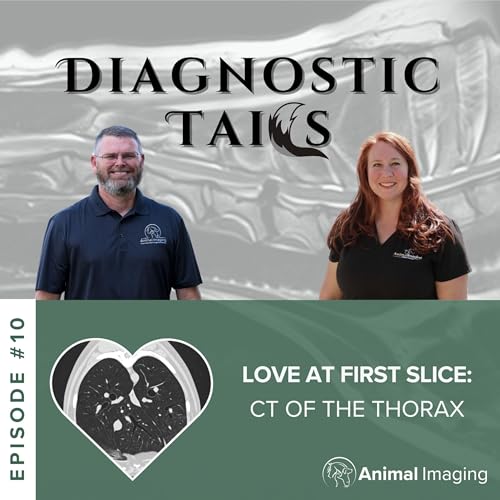
Diagnostic Tails cover art

Diagnostic Tails

Diagnostic Tails

Written by: Animal Imaging
Listen for free

About this listen

Focus on real-life stories of pets and animals where imaging saved the day, highlighting the importance of accurate diagnostics. Dive into different technologies like nuclear scintigraphy, MRIs, and CT scans for various animals. Each episode offers insights into the world of veterinary imaging, sharing stories, breakthroughs, and advancements in imaging techniques.Copyright 2025 Animal Imaging Careers Economics Personal Success Science
Episodes
  • It Takes a Team: The Realities of Veterinary Referrals
    Dec 17 2025

    In this episode of Diagnostic Tails, Dr. Amy Armentrout, Dr. Lon Hays, and veterinary technician Hannah pull back the curtain on how referral systems really work and why effective communication between clinics and specialty teams directly impacts patient care.

    From scheduling a CT or thyroid scan to managing urgent same-day cases, the Animal Imaging team explains how they act as an extension of general practice, supporting veterinarians with timely diagnostics while protecting client relationships. You’ll learn what makes a complete referral form, how to avoid common stumbling blocks, and why a simple phone call can save valuable time for pets, owners, and practitioners alike.

    Blending humor, relatable stories, and practical guidance, this conversation reveals the often-unseen systems that keep advanced veterinary imaging running smoothly.

    Timestamps & Highlights

    [00:00:00] Welcome to Diagnostic Tails – introducing the focus on real-world imaging stories and advanced technologies.

    [00:01:00] Meet the hosts and guest Hannah; quick background on Animal Imaging’s role as a referral-only diagnostic center.

    [00:02:45] Dr. Hays’ journey from small-animal practice owner to imaging expert.

    [00:04:00] Why Animal Imaging only accepts cases through veterinarian referrals and how that protects continuity of care.

    [00:05:00] Step-by-step: how to submit a referral through the online portal or by phone/fax for equine and small-animal cases.

    [00:06:30] The technician’s role in reviewing records, verifying lab work, and prepping for approval.

    [00:09:00] Common issues: missing lab work, unclear case details, and how better info speeds up scheduling.

    [00:11:00] Importance of clear communication when patients are under anesthesia—why rapid doctor-to-doctor contact matters.

    [00:13:00] The challenge of reaching busy general practitioners and tips for training front-desk staff to route calls.

    [00:15:30] How to streamline medical records—send only relevant, recent information to prevent delays.

    [00:17:30] Notable red flags: heart murmurs, kidney disease, and behavioral notes that affect anesthesia plans.

    [00:19:30] Time-sensitive procedures like thyroid scans—why punctuality is critical when handling nuclear medicine.

    [00:21:00] The balance between client education and respecting the referring veterinarian’s relationship.

    [00:22:30] Handling urgent cases and same-day scheduling—how direct communication ensures fast care.

    [00:24:00] Funny and “lost in translation” moments from referral forms—when “spicy” cats, “tummies,” and “grumpy old ladies” show up on submissions.

    [00:26:00] Why temperament and owner notes help create safer, smoother imaging days.

    [00:28:00] Emergency examples—how picking up the phone leads to faster solutions.

    [00:31:00] Encouraging veterinarians to understand all imaging options—from MRIs to bone scans.

    [00:32:00] The importance of recent bloodwork and chest x-rays before anesthesia—and what happens when results reveal surprises.

    [00:33:30] Balancing affordability with advanced care—why Animal Imaging works to keep costs competitive.

    [00:36:00] Storytime: unexpected foreign bodies and the “miracle dog” Darby’s imaging surprise.

    [00:37:20] Closing invitation: students, technicians, and veterinarians are welcome to tour the facility and learn about imaging careers.

    Key Takeaways

    • Referrals Protect Patients & Practices Animal Imaging is referral-only to maintain continuity of care, ensuring diagnostics support—not replace—primary veterinarians.
    • Communication Is Critical When time matters, a quick phone call between doctors can mean same-day answers instead of costly delays.
    • Efficiency Through Collaboration Clear instructions, pre-visit sedation plans (for
    Show More Show Less
    38 mins
  • Love At First Slice: CT of the Thorax
    Nov 19 2025

    In this episode of Diagnostic Tails, Dr. Amy Armentrout and Dr. Lon Hays break down the power of CT in small-animal medicine, spotlighting why CT consistently outperforms radiographs - especially for detecting pulmonary nodules, planning oncology cases, and guiding complex procedures. They explore when sedation is enough, when anesthesia is required, and how contrast, breath-holds, and modern fan-beam technology elevate diagnostic accuracy.

    The conversation moves through real cases including Sancho’s hidden metastatic disease, a CT-guided lung mass aspirate, a young dog with a vascular anomaly, and an inventive urethral stricture study - illustrating how CT changes outcomes, improves surgical planning, and saves patients from unnecessary procedures. They wrap with a practical comparison of CT vs. MRI and clear guidance on choosing the right modality for the right case.

    EPISODE HIGHLIGHTS:

    00:00–01:00 — Intro to thoracic CT & why it’s a go-to modality.

    01:00–02:30 — CT advantages: speed, clarity, and value over radiographs.

    03:30–05:15 — Sedation vs. anesthesia, contrast use, and why breath-holds matter.

    05:15–06:30 — Fan-beam vs. cone-beam CT: what’s the difference?

    07:00–09:15Case 1: Sancho - clean X-rays, but CT reveals multiple pulmonary nodules.

    10:12–11:25Case 2: Snickers - CT-guided lung mass aspirate and why ultrasound can’t reach it.

    11:58–12:35Case 3: Persistent Right Aortic Arch - diagnosing a congenital vascular anomaly.

    15:00–15:57Case 4: Urethral stricture - creative retrograde contrast CT for surgical planning.

    16:15–17:40 — Why thoracic CT should accompany most soft-tissue studies.

    18:00–18:45 — Big-dog abdomen workups: when CT beats ultrasound.

    19:20–22:10 — CT vs. MRI: which modality to choose and when.

    23:26–24:30 — Final takeaways + call for clinicians to consult the imaging team.

    KEY TAKEAWAYS:

    • CT provides far greater detail than radiographs, especially for pulmonary, abdominal, and oncologic cases.
    • Small nodules and subtle abnormalities are frequently invisible on X-ray but obvious on CT.
    • Cone-beam CT has its place (dentistry/skull) but cannot replace fan-beam CT for thorax or abdomen.
    • CT-guided aspirates offer precise, safe sampling for challenging masses surrounded by air.
    • 3D reconstructions and vascular studies improve surgical planning and owner decision-making.
    • For elbows, carpi, and below-stifle issues → CT excels; for shoulders, hips, and neuro → MRI is preferred.
    • Adding a thoracic CT when evaluating masses is cost-effective and often case-changing.

    Animal Imaging Veterinary Radiology Specialists: https://animalimaging.net/

    (972) 869-2180 info@animalimaging.net

    Facebook: https://www.facebook.com/AnimalImaging/

    Linked In: https://www.linkedin.com/company/animalimaging

    Instagram:

    Show More Show Less
    25 mins
  • Scan Masters Unleashed: Veterinary Technician Triumphs in Imaging
    Sep 26 2025

    Welcome to another episode of Diagnostic Tails Animal Imaging’s Uncovered Pawdcast! In this episode, we spotlight the essential role of veterinary technicians in advanced animal imaging. Join Dr. Amy Armentrout and star technicians Hannah and Mia as they share real-life stories, discuss the challenges and rewards of their work, and reveal what sets their team apart in the world of veterinary medicine.

    Timestamps & Episode Highlights

    0:00 – Introduction

    Overview of the podcast’s mission and today’s focus on veterinary technicians.

    1:12 – Meet the Technicians

    Hannah and Mia introduce themselves and their backgrounds in small animal and equine medicine.

    2:04 – Pathways into Veterinary Medicine

    The technicians share their unique journeys into the field.

    3:05 – Rewards & Challenges

    Insights into what makes the job rewarding and the emotional highs and lows.

    4:16 – Core Technician Skills

    Discussion of essential skills: blood draws, catheter placement, emergency response.

    7:00 – What Sets This Team Apart

    The value of diverse backgrounds and technician-led case management.

    10:00 – Advanced Imaging’s Impact

    How working with advanced imaging has changed their approach to diagnostics.

    13:00 – Memorable Cases

    Stories of critical interventions and life-saving moments.

    16:00 – Coping with Stress

    Strategies for handling the emotional demands of veterinary medicine.

    19:00 – Misconceptions About Technicians

    Debunking myths and highlighting the complexity of the technician’s role.

    22:00 – Diagnostic Tools Spotlight

    The benefits of I-131 for hyperthyroid cats and the power of CT imaging.

    25:00 – Final Thoughts & Appreciation

    Advice for aspiring technicians, the importance of recognition, and a shout-out to the team’s TikTok channel.

    Thanks for listening! Don’t forget to check out our TikTok channel for behind-the-scenes fun, and stay tuned for more stories from the world of animal imaging.

    https://www.tiktok.com/@animalimaging

    Animal Imaging Veterinary Radiology Specialists

    https://animalimaging.net/

    (972) 869-2180

    info@animalimaging.net

    Facebook https://www.facebook.com/AnimalImaging/

    Linked In https://www.linkedin.com/company/animalimaging

    Instagram https://www.instagram.com/animalimaging/?hl=en

    Show More Show Less
    42 mins
No reviews yet