• What it takes to get AI working in government: Lessons from Estonia
    May 27 2026

    The last time Ott Velsberg appeared on this podcast was early 2022. Popular LLMs had not yet been released. The conversation was about how AI could support data-driven decision-making in government – a topic that felt, at the time, more prospective than operational.

    Four years on, with Estonia counting over 220 public sector AI use cases and close to 60 million euros in estimated annual impact, the frame has shifted. So, it is now less about what AI in government could look like and more about what it has taken to get there.

    In this episode of the Digital Government Podcast, Ott Velsberg, outgoing Chief Data Officer of the Estonian government and responsible for Estonia's AI policy, tells us about the path from strategy to working infrastructure. And the long institutional work that makes it possible to coexist with both consent-based data sharing and AI adoption at scale.

    Show More Show Less
    45 mins
  • Supporting the EU Member States in advancing reforms and innovation
    May 14 2026

    When governments across Europe try to modernise, the challenge is rarely that they lack ambition or resources. More often, what is missing is the space to think carefully before acting – to understand what the actual problem is, what has already been tried elsewhere, and who inside the administration will need to carry the change forward.

    The European Union’s Technical Support Instrument (TSI) was built around exactly that gap: not funding, but structured expert support, delivered at the moment when a reform is still being designed.

    In this episode of the Digital Government Podcast, recorded around Europe Day, we speak with Florian Hauser, Deputy Head of Unit for Public Administration at SG REFORM – the European Commission’s Task Force for reforms and investment – and with Hannes Astok, Executive Director of the e-Governance Academy (eGA), which has been working closely with the TSI across a growing portfolio of themes in recent years.

    Explore the European Union’s approach to reform support and what it actually takes to make them work. Tune in!

    Show More Show Less
    43 mins
  • Ivo Visak: AI in education starts with a question, not an answer
    Apr 15 2026

    Thirty years ago, Estonia launched Tiger Leap, a programme that put computers and internet in every school and, in many ways, laid the groundwork for a digital society what we have known to call e-Estonia. Today, the country is attempting something just as ambitious with artificial intelligence (AI) in education. But the conditions are different this time.

    When Tiger Leap started in 1996, neither the schools nor the students had the technology – everybody had to learn together. Now, the asymmetry runs the other way: the students have leaped, while the education system is catching up.

    In this episode of the Digital Government Podcast, Ivo Visak, CEO of AI Leap (TI-Hüpe), the national programme integrating artificial intelligence into Estonian high schools, Visak makes the case for why treating AI in schools as an intervention rather than an experiment is the only responsible path forward.

    Tune in to explore the Estonian path in implementing AI in education!

    Show More Show Less
    47 mins
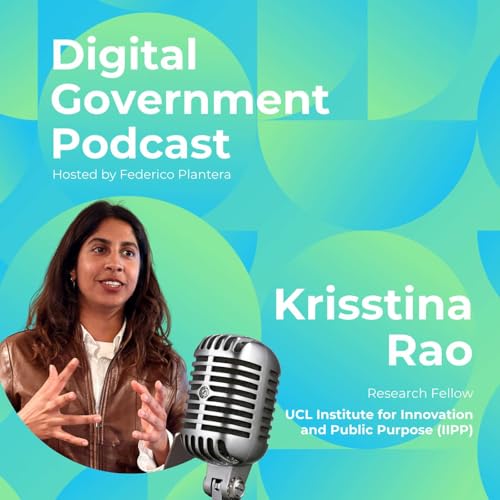
  • Digital public infrastructure and the foundations of AI in government with Krisstina Rao
    Apr 1 2026

    Governments are racing to adopt AI in public services. EU-funded projects show the pace is only accelerating. But this push raises a deeper question: what lies beneath? Too often, the answer is the same – weak or uneven digital foundations.

    Digital public infrastructure (DPI) can help integrate and connect siloed systems into a coherent digital government platform. So, where does it stand globally, as an enabler of AI development? What makes it work? And why does it matter more than ever for AI adoption? We explored these questions on this episode of the Digital Government Podcast with Krisstina Rao, now at Co-Develop, and outgoing Research Fellow at the Institute for Innovation and Public Purpose at University College London (UCL), where she led the work on the Digital Public Infrastructure Map.

    Listen now and explore what’s really powering AI-enabled public services behind the scenes!

    This podcast and podcast blog were produced within the project “EU Commission Project (24ES06/24DE33): Supporting regional entrepreneurship through the adoption of innovative technologies, including AI, in public services” with the financial assistance of the European Union via the Technical Support Instrument. The views expressed by the speakers in the project video are their own and do not necessarily reflect the official opinion of the European Union.

    Show More Show Less
    41 mins
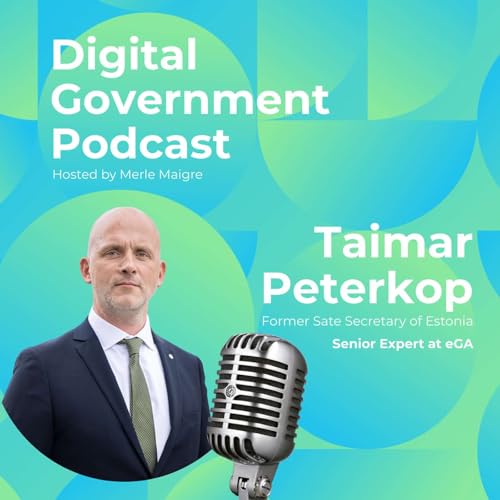
  • What leadership through digital change actually looks like with Taimar Peterkop
    Feb 25 2026

    Leadership in the public sector has always demanded resilience. This is best exemplified by three elements: 1) the ability to hold long-term vision steady while reacting to short-term pressures, 2) to build consensus across institutions that do not naturally cooperate, and 3) to keep an organisation moving when the ground shifts beneath it. Digital transformation has sharpened all of these demands. The leaders steering this process need more than technical knowledge. They need self-awareness, the capacity to build the team and trust it, and the judgment to know when a crisis is also an opportunity.

    In this episode of the Digital Government Podcast, hosted by Merle Maigre, Head of Cybersecurity at e-Governance Academy, we hear from Taimar Peterkop – former State Secretary of Estonia, former Director General of the Information System Authority, and now Senior Expert at the e-Governance Academy. Drawing on over two decades at some of Estonia's most consequential institutions, Peterkop shares practical wisdom on what it takes to lead through change and crisis – with honesty and without pretending to have all the answers.

    Tune in!

    Show More Show Less
    38 mins
  • Ukraine builds citizen control into its data infrastructure
    Jan 27 2026

    Following Estonia’s example, Ukraine is launching a Personal Data Access Monitoring Subsystem embedded in Trembita, the government’s secure data exchange platform. The mechanism allows every Ukrainian to see who accessed their personal data stored in government registers.

    In this episode we host Yurii Kopytin, Senior Expert at the e-Governance Academy, and Hannes Astok, our Executive Director, about what transparency means in practice in Ukraine and, on the side, in Estonia too.

    Tune in!

    Show More Show Less
    31 mins
  • With the data tracker, visibility prevents misuse
    Jan 14 2026

    The topic of data protection spans the entire spectrum of the internet, from when users surf the web to when they benefit from efficient online services as citizens.

    Cookie banners, privacy policies, GDPR compliance notices – all and more. And yet, for how practical the concept and its implications are, it still remains quite abstract for many. The rules exist, across the globe, actually, but the reality of what happens to your data most often stays invisible.

    Estonia has taken a different approach. Through the Data Tracker, every Estonian citizen can log in and clearly see who has accessed their personal data in government registers, when it was accessed, and for what purpose.

    In this episode of the Digital Government Podcast, we speak with Maarja Kirss, Head of Cooperation at the Estonian Data Protection Inspectorate (DPI), about what happens when transparency becomes a working system for the government.

    Dive in!

    Show More Show Less
    33 mins
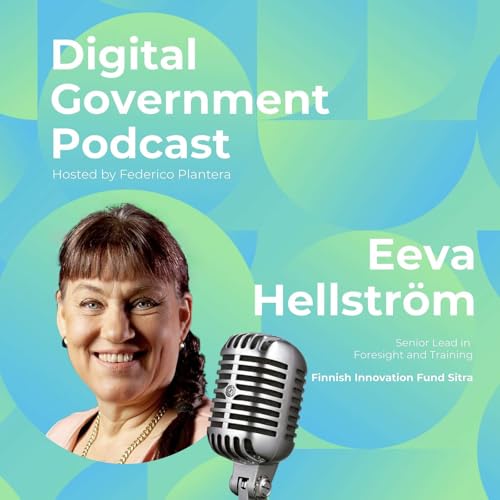
  • How to rethink growth in the intangible economy? A Case from Finland
    Dec 10 2025

    We sit down with Eeva Hellström, Senior Lead in Foresight and Training at the Finnish Innovation Fund Sitra, to explore one of today’s most urgent questions: how do we value what we cannot see?

    Eeva explains why traditional economic models overlook the “invisible” factors that increasingly shape our economies. And why failing to recognise them leaves policymakers with critical blind spots.

    We discuss:
    ✅ Why digital transformation shouldn’t be measured only by short-term ROI.
    ✅ The environmental and social costs of we rarely consider.
    ✅ What “post-growth” means for high-income countries.
    ✅ Why governments need new indicators of well-being and long-term public value.

    Tune in!

    Show More Show Less
    29 mins