

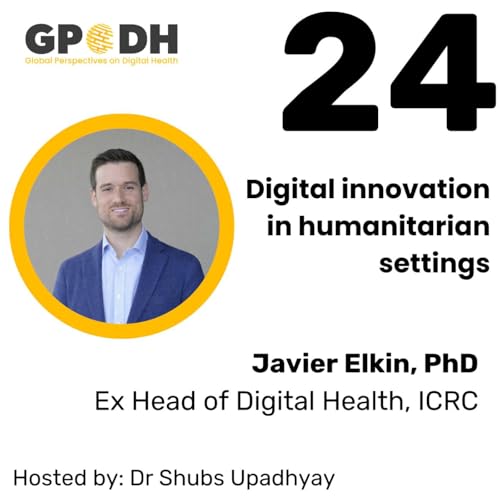
Digital innovation in humanitarian settings
Failed to add items
Add to cart failed.
Add to wishlist failed.
Remove from wishlist failed.
Follow podcast failed
Unfollow podcast failed

Digital innovation in humanitarian settings
-
Narrated by:
-
Written by:
About this listen
How do global organizations built to respond and aid in conflict respond to digital transformation? The International Committee of the Red Cross (ICRC) : you’re probably familiar with the work that happens here : emergencies, conflict zones, disasters, working at the last mile in difficult circumstances. How does an organization like even begin to approach “tech innovation” There’s clearly lots of need.
What do you prioritize when everyone needs improvements now?
PLUS How do you adapt off the shelf LLM models for remote humanitarian contexts?
Javier Elkin spent 3 years as Head of Digital Health at ICRC. He set the unit up from scratch. Coming in at a time, post COVID, the opportunities for tech addressing unmet need proliferated. And in parallel trying to create stability with multiple financial crises and organizational challenges.
If you’re in digital health and wrestling with the global scale and local trust and value tradeoffs, have a listen to how an actual global organization dealt with it.
Some standouts for me from our convo:
- We spoke about context : correctness vs being useful
If you ask a LLM : What do I do for this gunshot or limb trauma, it might be reasonable to say that a response like : call emergency services is universally correct.
But in a conflict zone or very rural setting, that has zero value compared to “take two pieces of wood to act as a splint”, or try X to stem blood loss.
How did the ICRC digital team work (with partners at EPFL) on their validation and evaluation to get better at these aspects?
Your LLM might be technically, and even medically correct, but completely useless on the ground for someone.
Want to find out more about the MOOVE initiative? Take me there
2. Prioritization based on outcomes, constraints, feasibility
Link to assessment framework
3. We get some proper concrete examples that cover:
- How they used tech to aid a handover to a local healthcare system in Western Nigeria after years of being there.
- How they used an open source tool already being used in the field to help spin up digital workflow solutions FAST
- How they partnered with EPFL to develop testing, validation and evaluation pipelines for LLM decision support specific and relevant for conflict settings (some absolute gold in here)
We also get Javier’s honest reflections about the humanitarian sector in general : how the financial crises (esp the last year with huge funding challenges) have manifested, what next for the humanitarian sector and what could be done differently.
Packed with lessons this one, do not miss it.
Chapters:
00:00 Introduction to Digital Health and Javier's Journey
07:55 Approach to creating a digital health unit from scratch
13:53 Prioritization Framework at the digital health
22:32 Innovative Solutions in Humanitarian Health
29:21 Strategic Handover and Local Ownership
35:20 Integrating Digital Health in Conflict Zones
41:21 Evaluating AI in Humanitarian Settings
53:26 Reflections on Trust and the Humanitarian Sector