Episodes

  • Wade Davis: From Sacred Leaf to Global Scapegoat
    Mar 2 2026

    In Part One of The Many Faces of Coca, 3L1T3 and Bryan sit down with Wade Davis to unpack the long history of the coca leaf and how a plant used for over 8,000 years became globally criminalized.

    This conversation isn’t about cocaine. It’s about coca.

    Wade walks us through:

    • How coca was independently domesticated multiple times in pre-Columbian South America
    • Why early 20th-century elites blamed coca for poverty instead of confronting inequality
    • The 1949 UN commission that arrived with its conclusions already written
    • The nutritional research that challenged decades of ideology
    • How the modern international scheduling framework still treats coca as if it were fentanyl or heroin
    • Why the recent WHO review maintained the status quo — and what that means

    We also explore the deeper cultural reality: coca as ritual exchange, spiritual alignment, social glue, and daily sustenance in the Andes.

    This episode lays the foundation for the series.
    Next, we move into the ethnobiology with Dennis McKenna.
    Then we examine sovereignty and lived realities with Manuela Picq.

    If you’ve ever wondered why coca gets ignored while other plant medicines dominate Western discourse, this is where we start pulling that thread.

    This isn’t nostalgia.
    It’s about policy, ideology, and whether a plant can be separated from the story told about it.

    Key Points

    • Coca has been used for over 8,000 years in the Andes, distinct from cocaine.
    • Cocaine is an extracted alkaloid; the leaf itself functions very differently.
    • Coca was independently domesticated three times in pre-Columbian South America.
    • The leaf contains significant nutritional value (calcium, vitamins, protein) and aids digestion at altitude.
    • Early 20th-century elites blamed coca for poverty and social issues instead of structural inequality.
    • The 1949 UN commission formed conclusions before conducting meaningful investigation.
    • The 1961 UN drug scheduling framework still reflects that early ideological bias.
    • Coca plays a central spiritual and social role in Andean cultures (ritual exchange, prayer, daily labor).
    • Prohibition has fueled violence, displacement, and environmental harm in coca-growing regions.
    • The core policy question is political, not pharmacological: can coca be separated from cocaine in law and narrative?

    00:00 – 8,000 Years of Coca
    04:19 – What Is Coca?
    08:22 – Traditional Use & Preparation
    14:36 – The 1949 UN Commission
    23:10 – Drug War Consequences
    29:23 – Coca as Cultural Foundation
    33:40 – Why There’s No Public Constituency
    43:35 – Coca vs Cocaine Extraction
    46:00 – DEA, Cartels & Prohibition Incentives
    50:47 – If You Remember One Thing
    53:10 – Reflection & Series Preview

    Send a text

    FiresideProject.org

    Download the app or text/call 62-FIRESIDE


    Zendo Project
    Our listeners get 10% off the Zendo Project SIT Program with the code DIVERGENTS10

    Disclaimer: This post contains affiliate links. If you make a purchase, I may receive a commission at no extra cost to you.

    Support the show

    Special Thanks to our Macrodosers, Super D and Mike on Patreon!


    https://linktr.ee/3L1T3Mod

    Show More Show Less
    1 hr and 1 min
  • ETEREO: What No One Tells You About Iboga Work
    Feb 16 2026

    Iboga has a reputation.

    It’s intense. It’s long. It carries real risk. And for some people, it’s life-changing.

    But what actually happens inside a retreat container? And what does this work look like behind the scenes?

    In this episode of Divergent States, 3L1T3 and Bryan sit down with Paije West and Fletcher Burdick, founders of ETEREO, an iboga retreat center in Baja, Mexico. Their approach sits somewhere between medical oversight and traditional ceremony, which opens up some thoughtful questions about safety, responsibility, integration, and how we talk about powerful medicines without turning them into mythology.

    This isn’t a hype piece.

    It’s a grounded conversation about:

    • The difference between iboga and ibogaine
    • Cardiac risk and how they screen for it
    • Why they sometimes say “no”
    • What ceremony actually does (beyond aesthetics)
    • Whether luxury retreat settings help or distract
    • Why integration matters more than most people think
    • And whether the field might be moving a little too fast

    We talk about neuroplasticity, structure vs freedom, tradition vs extraction, and what’s still unknown about iboga.

    If you’re curious about the medicine — or about how people try to hold it responsibly — this one’s worth your time.

    The extended, more personal segment continues on Patreon.

    Chapter Markers

    00:00 – Introducing Bryan & Why This Conversation Matters
    02:00 – Framing the Episode: No Miracle Claims
    03:15 – What ETEREO Is (In Plain Language)
    07:00 – What an Iboga Retreat Looks Like
    11:20 – Iboga vs Ibogaine
    14:30 – Ceremony: Structure, Not Symbolism
    16:30 – Neuroplasticity & Set and Setting
    17:40 – Who Iboga Is Not For
    21:30 – Safety & Medical Screening
    24:30 – Small Groups vs High-Volume Clinics
    25:30 – “Conscious Luxury” — Does It Help?
    29:00 – Stepping Away from the Real World
    30:00 – Why Integration Is Everything
    32:00 – Relational Healing
    35:00 – Why They Don’t Track Outcomes Like Clinics
    36:10 – Incentives & Avoiding Extraction
    39:10 – Is the Field Moving Too Fast?
    40:00 – What We Still Don’t Know About Iboga
    41:30 – Final Reflections
    42:00 – Patreon Segment Tease
    44:50 – Closing Thoughts

    🎧 Extended version available on Patreon
    🎓 Zendo Project peer-support training: use code DIVERGENTS10

    Send a text

    FiresideProject.org

    Download the app or text/call 62-FIRESIDE


    Zendo Project
    Our listeners get 10% off the Zendo Project SIT Program with the code DIVERGENTS10

    Disclaimer: This post contains affiliate links. If you make a purchase, I may receive a commission at no extra cost to you.

    Support the show

    Special Thanks to our Macrodosers, Super D and Mike on Patreon!


    https://linktr.ee/3L1T3Mod

    Show More Show Less
    51 mins
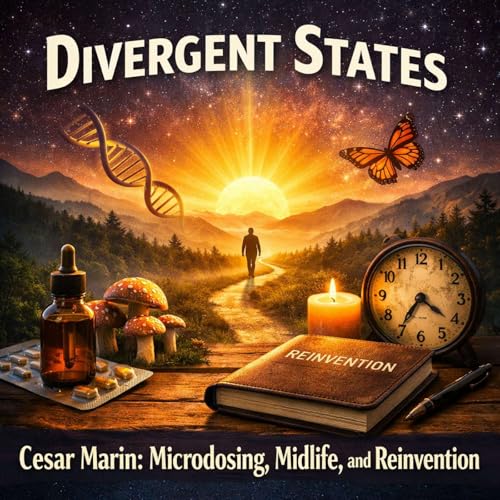
  • Cesar Marin: Microdosing, Midlife, and Reinvention
    Feb 2 2026

    What happens when a 25-year career at CNN ends — and a new life begins?

    In this episode of Divergent States, we talk with Cesar Marin, former CNN producer and founder of Microdosing Over 50, about how psychedelics helped him navigate midlife, identity loss, and personal reinvention.

    Cesar shares his journey from broadcast media to becoming an advocate for intentional microdosing later in life. We explore the difference between microdosing for healing vs optimization, how intention shapes outcomes, and why people over 50 face unique integration challenges.

    We also discuss:
    • Microdosing psilocybin vs LSD
    • Career loss and psychedelic-driven reinvention
    • Presence, connection, and integration practices
    • How media shapes psychedelic narratives
    • Why midlife may be the most powerful time for change
    • Healing vs performance framing in psychedelic use
    • Stigma, legality, and education
    • Building a mission-driven life after burnout

    This conversation is about more than substances — it’s about agency, curiosity, and what happens when you stop outsourcing your meaning.

    🎧 Extended version available on Patreon
    🎓 Zendo Project peer-support training: use code DIVERGENTS10
    🧠 For listeners interested in microdosing, midlife transitions, and psychedelic culture

    https://cultivatingwisdom.net/

    ⏱️ Chapter Markers

    00:00 – Introduction & Cesar’s background
    01:45 – 25 years at CNN and getting laid off
    04:30 – Discovering psychedelics at 55
    06:40 – Cultivating Wisdom & microdosing over 50
    10:15 – Loss, grief, and mission-driven work
    13:10 – What shifted personally
    17:45 – Early doubts and first psychedelic experience
    22:23 – Fun vs healing: why people stay
    22:41 – How media shaped his psychedelic voice
    26:13 – Bad headlines and stigma
    28:26 – Why storytelling matters
    29:18 – Midlife fear and reinvention
    32:12 – “It’s not almost over — it’s just starting”
    33:18 – Integration for older adults
    37:55 – Meditation, presence, and connection
    39:13 – Healing vs optimization
    43:45 – Microdosing LSD vs psilocybin
    46:36 – Psychedelic commercialization
    47:47 – Public episode wrap-up
    48:31 – Post-interview reflections
    50:05 – Bryan’s takeaway
    52:11 – Healing vs optimization framing
    54:17 – Outro & Patreon plug

    Send a text

    FiresideProject.org

    Download the app or text/call 62-FIRESIDE


    Zendo Project
    Our listeners get 10% off the Zendo Project SIT Program with the code DIVERGENTS10

    Disclaimer: This post contains affiliate links. If you make a purchase, I may receive a commission at no extra cost to you.

    Support the show

    Special Thanks to our Macrodosers, Super D and Mike on Patreon!


    https://linktr.ee/3L1T3Mod

    Show More Show Less
    58 mins
  • Shane Mauss: How Psychedelics Actually Change the Mind
    Jan 19 2026

    What really happens when psychedelics change someone, and why do some people come back grounded while others spiral into ego, conspiracy, or spiritual bypassing?

    In this long-form conversation, comedian and science-minded psychonaut Shane Mauss joins Divergent States for a deep dive into what psychedelics do to the human mind beneath the mystical language. Drawing on neuroscience, cognitive bias, evolutionary psychology, and lived psychedelic experience, Shane explains how substances like LSD, mushrooms, and DMT increase mental plasticity, loosen rigid categories, and open the brain to new ways of thinking — for better and for worse.

    Together, we explore why altered states can lead to creativity, healing, and insight, but also why they can just as easily fuel delusion, conspiracy thinking, and inflated ego. We talk about the placebo effect, Dunning-Kruger, belief formation, and how access to infinite information can make people feel like they know everything while understanding very little. Shane also shares candid stories from inside the psychedelic comedy world, including how Tales From the Trip was secretly launched at Comedy Central, why he’s uneasy about the current psychedelic “gold rush,” and how mainstream acceptance has changed the culture.

    This episode isn’t about chasing cosmic secrets or mystical narratives. It’s about how the mind actually works — and how psychedelics can either help us become more open, curious, and flexible, or lock us deeper into fantasy if we don’t know how to think critically about what we experience.

    If you care about psychedelics, consciousness, and staying grounded in reality while exploring extraordinary states, this conversation is for you.

    Shane's new special comes out 2/18 on ShaneMauss.com!

    Special thanks to Drip who did the music, check him out on Spotify and Soundcloud!

    00:00 — Season 2 Opening
    04:18 — From Stand-Up to Science
    07:40 — Creating Psychedelic Theater
    11:40 — Why Psychedelic Comedy Was Taboo
    14:50 — Tales From the Trip Origin Story
    19:20 — Why He Doesn’t Feel Like a Regular Comic
    23:40 — Comedy as Tension and Truth
    34:00 — George Carlin and Big-Idea Comedy
    38:20 — Psychedelics Going Mainstream
    41:00 — Skeptical Psychonauts
    45:20 — Seeing the Dark Side of the Scene
    47:45 — Psychedelics, Categorization, and the Brain
    51:30 — The Crunchy-to-Conservative Pipeline
    54:00 — Dunning-Kruger and Illusions of Knowledge
    57:10 — Why Science Is Counterintuitive
    01:02:40 — Why These Conversations Matter

    Send a text

    FiresideProject.org

    Download the app or text/call 62-FIRESIDE


    Zendo Project
    Our listeners get 10% off the Zendo Project SIT Program with the code DIVERGENTS10

    Disclaimer: This post contains affiliate links. If you make a purchase, I may receive a commission at no extra cost to you.

    Support the show

    Special Thanks to our Macrodosers, Super D and Mike on Patreon!


    https://linktr.ee/3L1T3Mod

    Show More Show Less
    1 hr and 9 mins
  • Inside Season Two: Integration, Not Escapism
    Jan 7 2026

    Season Two of Divergent States is about something simple and surprisingly rare: exploring altered states without losing touch with reality.

    In this preview episode, 3L1T3 and Bryan share two short moments from upcoming conversations that define the tone of the season ahead.

    In the first, Shane Mauss reflects on how psychedelics open people to awe—but also to certainty, conspiracies, and belief systems that can replace reality if no one pushes back. In the second, Cesar Marin explains why presence and human connection are the real work of integration, not endless chasing of peak experiences.

    Together, these moments capture what Divergent States has always tried to do: hold space for wonder without drifting into delusion, depth without losing grounding, and exploration rooted in real human connection.

    Patreon supporters get extended versions of these conversations, including sections that don’t survive algorithm-friendly edits. But this preview is here for everyone—because harm reduction, presence, and honest conversation shouldn’t be paywalled.

    Welcome to Season Two.

    Chapters

    00:00 – Welcome back & season context
    Introducing Season Two and why this year matters.

    00:28 – What Divergent States actually is
    What the show is: harm reduction, not hype or spiritual theater.

    01:05 – Shane Mauss: Awe, science, and belief systems
    The “ghost crocodile” and microscope analogy.

    04:49 – Why psychedelics create both insight and delusion
    Reflections on pattern-seeking and certainty in psychedelic spaces.

    05:20 – Cesar Marin: Presence as integration
    Connection, mushrooms, and staying grounded in real life.

    07:17 – The power of daily human connection
    Kids, texts, meditation, and showing up.

    08:55 – What Divergent States is really about
    Awe without delusion; depth without losing touch.

    09:15 – Patreon & how to support the show
    Extended cuts, deeper conversations, and why it matters.

    10:10 – Harm reduction & Zendo Project
    Why we partner with them and what the code supports.

    10:50 – Closing & Season Two welcome
    Personal sign-off and transition into the new season.

    Send a text

    FiresideProject.org

    Download the app or text/call 62-FIRESIDE


    Zendo Project
    Our listeners get 10% off the Zendo Project SIT Program with the code DIVERGENTS10

    Disclaimer: This post contains affiliate links. If you make a purchase, I may receive a commission at no extra cost to you.

    Support the show

    Special Thanks to our Macrodosers, Super D and Mike on Patreon!


    https://linktr.ee/3L1T3Mod

    Show More Show Less
    13 mins
  • Dennis McKenna: Nature, AI, and the Collapse of Separation
    Nov 21 2025

    Dennis McKenna joins 3L1T3 and Valerie Beltran to discuss the future of psychedelics, indigenous knowledge, and whether we are ready to bring these tools into mainstream culture without repeating the extractive patterns of the past. We explore the gap between good intentions and real reciprocity, what Western psychedelic enthusiasm is missing, and how community-based practice may matter more than clinical models alone.

    We also dive into the first biomedical study of ayahuasca with the UDV, how long-term members showed surprising changes in behavior and biology, and why the community structure may have played a larger role than the compound itself. Dennis talks about the work happening at the McKenna Academy, preserving Amazonian herbarium collections, digitizing ancestral plant knowledge, and the ESPD Symposia.

    This conversation calls out the cultural side of psychedelics, not just the science. If psychedelics are going to help, they must be integrated with wisdom, not just technology.

    Join our Patreon for the exclusive extended interview!

    Key Points

    • Psychedelics entered global awareness through indigenous stewardship, not Western invention
    • Reciprocity requires more than money and acknowledgment
    • The ESPD Symposia preserve ethnobotanical knowledge and make it public
    • Efforts to digitize herbarium collections in Peru before they are lost

    Chapters

    00:00 Welcome to the season finale with Valerie
    01:10 Who Dennis McKenna is and why he still matters
    04:50 What still feels unresolved after 50 years
    06:15 Co-optation, capitalism, and indigenous knowledge
    09:00 The ESPD symposia and preserving ancestral knowledge
    12:40 Biognosis and digitizing Amazonian herbarium archives
    17:00 Why preserving knowledge matters more than artifacts
    18:35 The first biomedical study of ayahuasca with the UDV
    22:45 Behavioral change, alcoholism, and community support
    24:40 Serotonin transporter findings and biological mechanisms
    27:30 Neuroplasticity and long-term structural change
    31:00 Microdosing vs macro experiences
    33:20 Default mode network and stepping outside the self
    36:20 Separation from nature and cultural disconnection
    38:30 Technology, AI, and cultural fragmentation
    42:20 What real reciprocity might look like
    46:50 Avoiding cultural appropriation and extraction
    50:00 Psychedelics entering clinical models
    52:45 Mushrooms as ideal symbiotic partners
    56:00 Future of psychedelics in 10 years
    01:00:20 Ibogaine as global brain reset
    01:04:00 Evolution, partnership, and species symbiosis
    01:06:00 Closing thoughts

    Thanks to Dyl👽Alien for the music!

    Send a text

    FiresideProject.org

    Download the app or text/call 62-FIRESIDE


    Zendo Project
    Our listeners get 10% off the Zendo Project SIT Program with the code DIVERGENTS10

    Disclaimer: This post contains affiliate links. If you make a purchase, I may receive a commission at no extra cost to you.

    Support the show

    Special Thanks to our Macrodosers, Super D and Mike on Patreon!


    https://linktr.ee/3L1T3Mod

    Show More Show Less
    1 hr and 25 mins
  • Betty Aldworth: MAPS, MDMA, and the Battle Over Psychedelic Medicine
    Nov 5 2025

    In this episode of Divergent States, 3L1T3 sits down with Betty Aldworth, the new co-president of MAPS, as she steps into shared leadership with Ismail Ali following Rick Doblin’s four-decade run.

    Betty brings decades of experience in drug policy reform, from Colorado’s 2012 cannabis legalization campaign to leading Students for Sensible Drug Policy, and now helps guide MAPS through one of the movement’s most pivotal moments: the FDA’s rejection of Lycos Therapeutics’ MDMA-assisted therapy application.

    We unpack the tension between science and advocacy, urgency and rigor, and explore what real access means for people living with PTSD. Betty offers a candid, emotionally grounded look at the FDA’s critique, the role of stigma, and how MAPS plans to keep pushing forward through education, policy, and global research initiatives.

    Later, the conversation turns to the larger movement: political support from both sides of the aisle, state-level reform models, and MAPS’ upcoming 40th anniversary in 2026.

    Key Points

    • Betty’s path from SSDP to co-president of MAPS
    • The FDA’s rejection of MDMA-assisted therapy: what it really means
    • How “positive adverse events” became a sticking point in the FDA review
    • Durability of treatment effects and the debate over long-term data
    • Balancing activism, science, and education under MAPS’ new leadership model
    • The growing divide between regulatory caution and patient urgency
    • Grassroots and state-level psychedelic reform gaining ground
    • The stigma that still shadows MDMA despite decades of data
    • Harm-reduction advice for those seeking underground healing
    • What’s ahead for MAPS’ 40th anniversary and new research directions

    Chapter Markers

    00:00 – Intro — Bryan’s stage play, today’s guest: Betty Aldworth
    02:00 – MAPS’ new leadership and legacy after Rick Doblin
    05:00 – Betty on stepping into the role and the three MAPS pillars
    08:00 – From activism to leadership — lessons from SSDP
    11:45 – Balancing research, advocacy, and education
    14:00 – FDA rejection letter — what really happened
    16:00 – “Positive adverse events” and the question of abuse potential
    22:30 – Durability of treatment and COVID-era data gaps
    26:30 – Prior MDMA experience and bias — myth or factor?
    29:20 – Politics, science, and the credibility dilemma
    32:30 – RFK Jr., AOC, and politicization of psychedelics
    35:00 – Echoes of the 1980s scheduling fight
    36:20 – What comes next — Phase III, audits, and resilience
    38:30 – MAPS’ evolving research priorities & global work
    41:00 – Normalization, decriminalization, and stigma
    43:45 – Science vs activism — carrying both forward
    48:00 – State-level reform and slow federal process
    50:30 – Cannabis rescheduling and broader reform
    52:00 – A message to people living with PTSD
    55:00 – MAPS’ 40th anniversary — what’s ahead
    57:00 – Closing reflections — stay weird, keep exploring

    Thanks to Dyl👽Alien for the music!

    Send a text

    FiresideProject.org

    Download the app or text/call 62-FIRESIDE


    Zendo Project
    Our listeners get 10% off the Zendo Project SIT Program with the code DIVERGENTS10

    Disclaimer: This post contains affiliate links. If you make a purchase, I may receive a commission at no extra cost to you.

    Support the show

    Special Thanks to our Macrodosers, Super D and Mike on Patreon!


    https://linktr.ee/3L1T3Mod

    Show More Show Less
    1 hr and 8 mins
  • David Bronner on Corporate Psychedelics, Mysticism, and the All-One Future
    Oct 22 2025

    Dr. Bronner’s Cosmic Engagement Officer David Bronner joins Divergent States for a candid, nuts-and-bolts conversation about building an “All One” company culture, pushing for psychedelic policy reform, and rewiring global supply chains to be fair, transparent, and regenerative. We trace the lineage from Rainbow Gatherings to Burning Man, from hemp activism to MAPS, and from commodity brokers to farmer-first vertical integration. Co-host therapist Valerie Beltran helps press on the tradeoffs: regulated access versus decriminalization, mission versus financing, growth versus grassroots.

    Key points

    • The “All One God Faith” DNA, salary caps (5× lowest vested wage), and why profit is a means, not the mission.
    • Why Dr. Bronner’s backed hemp early, fought DEA roadblocks, and supported MAPS, Oregon’s Measure 110, DC decrim, and church-based access models.
    • Regulated access vs. decriminalization: complementary pathways; cost, community, and safety implications.
    • Purpose-aligned financing: why many mission brands drift, and how the emerging Purpose Pledge aims to solve it.
    • Sourcing as activism: Ghana palm grown in multi-strata agroforestry; olive oil partnerships across Palestinian and Israeli producers; farmer income and soil health as first principles.
    • Regenerative Organic Certification: weaving soil health, animal welfare, and fair labor into one consumer standard.
    • Cultural lineage: Zendo/sanctuary work, AA’s Bill Wilson and LSD, Sacred Plant Alliance, and lessons from the Brotherhood of Eternal Love.
    • Pitfalls and PR landmines: navigating blame and lawsuits in a fast-shifting policy landscape.
    • Longevity over hype: why real soap beats detergents, and the quirky “punk rock soap opera” moment that proved it.
    • Practical integration: moving from unitive states to everyday choices—diet, sourcing, and local service.

    If this conversation resonated, follow the show on Spotify/Apple, leave a short review, and consider supporting the work on Patreon to keep community-driven media independent.

    Special thanks to Sandbgz for the music! Follow him on Spotify!

    00:00 – Intro & Setup
    02:00 – From Burning Man to the Mic
    04:35 – Origins & Rainbow Gathering Roots
    06:25 – The All One God Faith Legacy
    10:25 – Sourcing as Activism
    15:20 – Mission Financing & the Purpose Pledge
    17:35 – Building Roots & Staying Grounded
    22:30 – Why Risk Psychedelic Advocacy
    28:30 – Early Activism & the Hemp Wars
    33:00 – Meeting Rick Doblin at Burning Man
    37:00 – Decrim, Churches & Community Access
    39:15 – Pitfalls & Lawsuits
    40:30 – Choosing Battles & Lessons from Oregon 110
    42:45 – Integration & Regenerative Organic Agriculture
    46:45 – From Vision to Action
    51:55 – Balancing Perfection & Pragmatism
    55:45 – Longevity over Hype
    1:01:00 – Heaven on Earth & Deep Time
    1:03:45 – Brotherhood of Eternal Love & Rainbow Bridge
    1:08:30 – Closing Reflections
    1:12:00 – Outro & Patreon Call to Action

    Send a text

    FiresideProject.org

    Download the app or text/call 62-FIRESIDE


    Zendo Project
    Our listeners get 10% off the Zendo Project SIT Program with the code DIVERGENTS10

    Disclaimer: This post contains affiliate links. If you make a purchase, I may receive a commission at no extra cost to you.

    Support the show

    Special Thanks to our Macrodosers, Super D and Mike on Patreon!


    https://linktr.ee/3L1T3Mod

    Show More Show Less
    1 hr and 18 mins