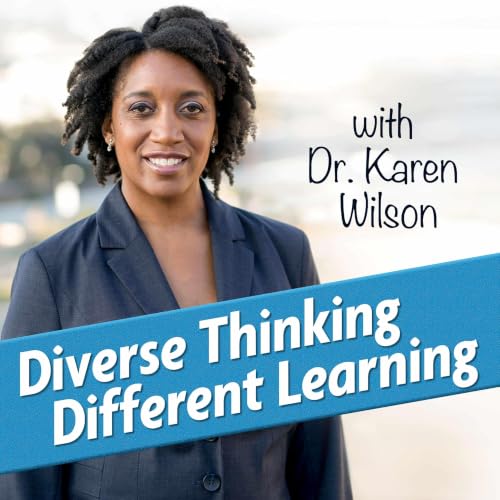
Diverse Thinking Different Learning cover art

Diverse Thinking Different Learning

Diverse Thinking Different Learning

Written by: Karen Wilson
Listen for free

About this listen

Diverse Thinking · Different Learning, a ChildNEXUS podcast, is hosted by pediatric neuropsychologist, mom of two, and ChildNEXUS founder Dr. Karen Wilson. Each week, Dr. Wilson provides support and guidance for parents raising kids with learning differences. Diverse Thinking · Different Learning features informative and inspiring interviews with top experts in their fields, and gives parents and educators the tools and takeaways they need to better understand neurodivergence, learning disabilities, and youth mental health. This podcast informs offers actionable advice to help diverse learners and children with unique needs reach their fullest potential. Parents of diverse learners or children with mental health challenges can access vetted information and connect with qualified professionals at https://www.childnexus.com/.ChildNEXUS.com Parenting Relationships
Episodes
  • Ep. 251: Sensory Processing & Regulation: How Play Rewires the Brain with Dr. Allie Ticktin, MA, OTD, OTR/L
    Jan 6 2026
    We happily welcome Dr. Allie Ticktin to Diverse Thinking Different Learning! Dr. Ticktin is dedicated to helping children and their families thrive through sensory-based play, having founded Play 2 Progress and writing Play to Progress, introducing parents to all eight senses and offering practical ways to support them at home. Blending child development science with playful learning, Dr. Ticktin focuses on building kids' confidence and supporting their growth across emotional, social, physical, and academic areas. At the core of her philosophy is the belief that empowering parents from the very beginning is the best way to set children up for lifelong success! Throughout our conversation, we explore the topic of sensory processing and sensory motor integration - often misunderstood but nevertheless foundational to how children learn, regulate, and thrive. Dr. Ticktin, an occupational therapist and author, explains that sensory processing involves more than just the five basic senses, that there are actually eight senses that children need to effectively process, including the "hidden" senses of vestibular, proprioceptive, and interoceptive! Dr. Ticktin highlights the fact that sensory issues are not simply behavioral problems but are rather neurological differences in how a child's brain processes sensory information. This can manifest in various ways, from being overly sensitive to certain textures to having trouble regulating emotions and attention. She stresses the importance of reframing these challenges as differences in sensory processing, rather than just automatically resorting to labeling them as "bad behavior." As we discuss, an especially important part of supporting children with sensory needs is teaching them to recognize and communicate their needs, and Allie discusses "body tools" - often referred to as fidget spinners or sensory toys - and how empowering children to identify and use whatever tools help them self-regulate can dramatically improve their ability to focus, learn, and interact socially. Our discussion also covers how sensory integration therapy can positively affect not just motor skills but also social-emotional functioning, with Dr. Ticktin reflecting on how she has seen children learn to self-regulate and even start advocating for their sensory needs and those of their peers. Our discussion provides you with a comprehensive overview of sensory processing, its importance in child development, and effective strategies for supporting children with sensory needs via a collaborative approach based on children's strengths! Show Notes: [2:29] - Sensory processing involves eight senses, not just tactile experiences such as messy play. [5:10] - Dr. Ticktin argues that a child's sensory system forms the unseen "roots" supporting all higher developmental skills. [7:05] - Some kids struggle to filter irrelevant sensory input, resulting in classrooms feeling overwhelming. [9:08] - Dr. Ticktin points out that many "bad behaviors" actually stem from unsatisfied sensory needs. [11:28] - Dr. Ticktin explains how "body tools" can help children self-regulate, reducing behavioral issues via sensory support. [13:30] - Sensory inputs can raise or lower excitement depending on how the child processes them. [17:38] - Misread behaviors in daily tasks might signal underlying sensory-motor challenges. [18:22] - Hear how sensory issues can appear as rough play, clumsiness, withdrawal, or shutdowns. [21:09] - Dr. Ticktin argues that self-regulation often crosses over with sensory needs. [24:49] - Young kids may tantrum from sensory overwhelm because they lack the language to explain their feelings. [25:12] - Dr. Ticktin explains how teaching kids to "empty their bucket" prevents overload, very similar to adults managing stress. [28:33] - Learn how play-based therapy strengthens sensory foundations with purposeful activities appearing as simple play. [31:54] - Excessive screen time limits ideation, rendering open-ended, unscheduled play especially important for development. [33:25] - Consistent family involvement is so important, since progress relies on using tools beyond therapy sessions. [36:14] - Dr. Ticktin encourages listeners to buy her book. Links and Related Resources: Episode 42: Understanding Sensory Processing Disorder with Courtney Duckworth-Harris, MA, OTR/L Episode 72: Prioritizing Co-Regulation and Self-Regulation in Communication with Danielle G. Kent M.S., CCC-SLP Episode 221: Would a Behavioral Aide/Shadow Help My Child? Episode 233: Body-Based Interventions for Neurodivergent Students with Megan Beardmore, PhD, NCSP Allie Ticktin - Play to Progress: Lead Your Child to Success Using the Power of Sensory Play Connect with Dr. Allie Ticktin: Play2Progress Website Phone: (323) 782-3331
    Show More Show Less
    38 mins
  • Ep. 250: Reimagining Learning: The Evolving Power of 1:1 Learning in 2025 with Jaime Porras
    Dec 16 2025
    We are happy to welcome back Jaime Porras for this episode! Jaime Porras is the District Vice President for Fusion Academy, overseeing nine campuses across Los Angeles and Santa Barbara. With more than two decades in education (including fourteen years at Fusion), he has held roles from teacher to Head of School and is passionate about fostering student-centered, relationship-driven learning environments. He holds an MA in Education with a focus on Social Justice from Antioch University Los Angeles and a BA in English from Ohio State University. A proud Buckeye and Culver City resident, Jaime enjoys sports, travel, literature, and discovering the best tacos in L.A., where he lives with his wife and daughter. Jaime joins us for this episode to discuss how the 1:1 learning model at Fusion Academy has become increasingly important in recent years as students have faced growing challenges with anxiety and depression, and disengagement. He explains that the pandemic drastically worsened many students' struggles with executive functioning and social anxiety but how, in a 1:1 setting, Fusion is able to provide a safe, supportive space where students can rebuild their confidence and reconnect with learning. By removing the pressure and comparison of a traditional classroom, students feel safer to take risks, make mistakes, and grow. Jaime highlights the importance of building a strong mentor-student relationship in which the teacher can truly understand and cater to each individual's unique needs, interests, and learning style, a personalized approach that also helps address issues around executive functioning, as Fusion teachers break down assignments into manageable steps while also explicitly modeling positive behaviors and social-emotional skills. Jaime notes that the 1:1 environment allows students the space to process feelings of failure in a healthy way without judgment from their peers. At the same time, Fusion works to build a sense of community and belonging via shared social spaces and activities, although the focus remains on creating an environment customized for each student's needs. Jaime believes that this model will only become more important in the years ahead as schools grapple with the lasting impacts of the pandemic on student mental health and engagement. Our conversation highlights how the 1:1 approach at Fusion Academy empowers students to rebuild their confidence and reconnect with their strengths even in the face of significant challenges. As the education landscape continues to evolve, this model may serve as an important blueprint for supporting the diverse needs of today's learners! Show Notes: [2:27] - Jaime describes how post-pandemic isolation worsened student anxiety and depression while boosting demand for 1:1 learning. [5:59] - 1:1 environments reduce social pressure and allow teachers to address each student's unique needs. [9:00] - Jaime stresses that individualized settings can lead to belonging, safety, and feelings of mattering. [12:08] - Learning begins with love and rapport, creating trust before taking on executive functioning challenges. [14:01] - Jaime explains how executive functioning develops with maturity, so Fusion Academy celebrates incremental progress. [17:11] - Jaime notes how 1:1 settings allow students to process failure safely and quickly recover. [19:41] - Fusion removes traditional school obstacles, focusing on individualized support without judgment. [22:37] - 1:1 learning suits kids who need safety, personalization, and emotional comfort. [23:08] - Jaime highlights Fusion's flexibility to adjust instantly for each student's needs. [25:21] - Jaime compares Fusion's structure to private lessons that separate focused learning from broader social experiences. [27:46] - Small-group environments let students more easily build real friendships and resolve conflicts. [29:48] - Jaime criticizes traditional schools for pressuring kids into activities that adults rarely pursue. [31:53] - Hear Jaime share a student's gradual growth from isolation to leadership, proving that patience and personalization can lead to confidence. [35:19] - Jaime predicts that 1:1 education will shape all schooling by highlighting growth over conformity. [38:30] - Where can Jaime be reached? Links and Related Resources: Episode 52: How a 1:1 Instruction Model Helps Students with Jaime Porras and Vailet Yarijanian Episode 154: Why Self-Efficacy and Self-Advocacy are Important for Diverse Learners with Ashley Harding Episode 189: The Private School Option for Kids with Learning Differences with Collette Bowers Zinn Episode 243: From Inclusion to Belonging: Creating Neurodiversity-Affirming Schools with Amanda Morin Connect with Jaime Porras: Fusion Academy Website
    Show More Show Less
    42 mins
  • Ep. 249: Using Technology to Support Neurodivergent Students with Joan Green
    Dec 2 2025
    For this edition of the show, we warmly welcome Joan Green! Joan Green, M.A., CCC-SLP, is a speech-language pathologist, assistive technology specialist, and founder of Innovative Speech Therapy in the Washington, DC area. For nearly 40 years, she has helped people of all ages (especially neurodiverse learners) use technology to enhance communication, learning, and independence. Passionate about accessibility and innovation, Joan also educates families and professionals on how everyday tech and AI can change our daily lives. Our conversation explores how technology, including AI-powered tools, can be used to help support neurodivergent students in learning, communicating, and thriving, with Joan explaining that her passion for this work began in the 1980s when she saw how early computer software could dramatically improve outcomes for her adult patients with neurological conditions. She then expanded her focus to helping families and students, motivated in part by her own experiences as a parent. We highlight how many accessibility features and free tools built into common devices and platforms can provide incredibly crucial support for students who struggle with reading, writing, organization, or focus, with Joan stressing the importance of tailoring solutions, whether it's adjusting text-to-speech settings or finding the proper app or extension. She cautions against oversimplifying the process, as each student's needs are unique. Our discussion also touches upon the complex role of AI and advanced technology in education. Joan sees tremendous potential for AI to personalize learning and free up teachers to focus on higher-level instruction. She also voices some concerns about overreliance on it. Her approach is to position AI as a "thought partner" that can enhance and augment human learning rather than replace it. Throughout the conversation, Joan also shares some practical tips and resources, including her free 15-minute consultations and her ongoing Tech Life Inner Circle program, which provides weekly training and collaborative problem-solving sessions. Our conversation in this episode truly highlights the power of technology to bridge gaps and amplify the voices of neurodivergent students - but only when used with intention and mindfulness! Show Notes: [2:31] - Hear how Joan began using early computer software with stroke patients and saw technology speed up recovery. [5:11] - Joan stresses the importance of beginning with free, built-in assistive tools such speech-to-text, read-aloud, and captions. [7:45] - Hear how Joan helps people choose the right reading and speech tools and offers free tech consultations. [11:17] - Joan believes that AI can aid in learning when used thoughtfully, but worries about shortcuts and privacy concerns. [13:32] - While Joan values AI as a creative learning tool, she also stresses the importance of actual understanding and critical thinking. [15:02] - AI can be a great way to personalize learning. [17:04] - Hear how Joan uses AI to personalize lessons around students' interests while still thinking critically herself. [18:55] - Joan explains how she offers collaborative one-on-one tech sessions, which identify struggles. [20:47] - Joan runs the very affordable Tech Life Inner Circle, providing weekly tutorials, recordings, and live tech brainstorming. [23:53] - Tech Possibility Academy teaches essential, easy-to-implement tools for parents, educators, and lifelong learners. [26:42] - Joan stresses technology's necessity for independence while also acknowledging its downsides. [29:39] - Where can Joan be reached? Links and Related Resources: Episode 142: How to Help Neurodivergent Kids Manage Social Media Episode 177: How Understanding the Adolescent Brain Helps Us Better Support Teens Episode 241: How to Be a 'Screen-Smart Parent with Jodi Gold, MD Connect with Joan Green, M.A., CCC-SLP: Innovative Speech Therapy Main Website Tech Life Inner Circle IST Tech Savvy Solutions Facebook Group
    Show More Show Less
    31 mins
No reviews yet