• The Watercolour Control Problem with Jessie Kanelos Weiner
    Oct 10 2025

    The Watercolour Control Problem with Jessie Kanelos Weiner

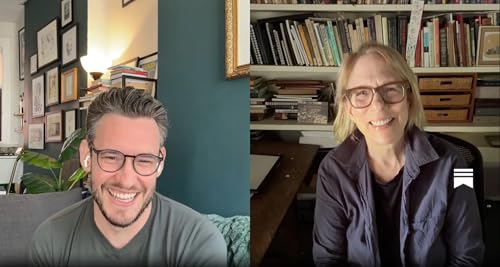
    Earlier this year, I joined Jessie Kanelos Weiner —artist, author, and watercolour wizard—for a live chat about colour, chaos, and why watercolour refuses to obey. She just released Thinking in Watercolour, which made me realise I mostly think in panic, and snacks.

    This year, for 2026, she’s launching a series: 31 Days of Watercolor! which sounds really fun.

    In our talk, Jessie asked how I approach colour, and I admitted that I approach it sparingly. I used to think “real artists” painted every shadow like da Vinci. Then I saw the da Vincis at the Met and thought, Yeah… I don’t need to do all that. These days, I use colour the way comedians use silence—strategically. A dab here, a spot there. Enough to make you look where I want you to look.

    We talked about the Philadelphia Eagles poster I illustrated—a parody of the classic New Yorker cover, except it’s a jacked football player instead of Eustace Tilly. They wanted bold colour. I gave them subtle pastels amid the team’s green hue. They said, “Brighter!” I spent two days repainting and relearned my favourite rule: colour should serve the joke, not the marketing department.

    Growing up in Perth, I had almost no access to great art—just beach paintings and dial-up internet. So I learned from cartoonists like Roz Chast, Richard Thompson, and Ronald Searle, whose trauma and humour somehow coexisted in ink. My grandfather gave me Searle’s book after surviving a POW camp, so I guess drawing as coping runs in the family.

    Jessie and I agreed: restriction is, in fact, a form of freedom. Fewer colours, fewer brushes, fewer excuses. Watercolour is chaos in liquid form, and the sooner you stop trying to control it, the more alive it becomes.

    I’m still working on that part—the unclenching. But at least now, when my washes go rogue, I can say: It’s philosophy.

    ‘til next time, your pal,

    ✏️ Thanks for reading New York Cartoons. To support more mess disguised as art, consider becoming a paid subscriber.


    This is a public episode. If you'd like to discuss this with other subscribers or get access to bonus episodes, visit www.newyorkcartoons.com/subscribe
    Show More Show Less
    34 mins
  • The Art of Drawing Worse with Tom Toro
    Oct 8 2025
    Thank you Kevin KAL Kallaugher, asher, Margreet de Heer, Dan Collins, Pat Coakley, and many others for tuning into my live video with Tom Toro (and his cat, Pumpkin!) Tom is a New Yorker cartoonist, author, and the rare person who can make me feel simultaneously inspired and completely inadequate about my cartooning skills.His new book, And to Think We Started as a Book Club, just dropped, and it’s already Andy Borowitz’s October Book Club pick. The title itself is a gag from one of his cartoons—bank robbers mid-heist, one holding a crowbar (originally a shotgun, but weapons get flagged by algorithms, apparently). It’s the kind of unwieldy-but-funny title that works because the joke sustains it.The Art of Drawing WorseOne of the best moments came when Tom shared Bob Mankoff’s advice to Paul Noth: “Draw worse.”Not as an insult, but as a direction. Noth’s early work was so detailed—cross-hatching, filigree, the whole nine—that Mankoff told him the jokes were strong enough to carry simpler art. The delivery needed to be cleaner. Tom admitted he sometimes overdoes drawings when he’s insecure about a joke, like he’s compensating. I felt seen. Very seen.“The best thing about your work is the worst thing about your work,” Mankoff once told me. “You draw too well sometimes.” I’m still not sure if it was a compliment. Probably not.Fact-Checking V*ginas & Left-Handed CatchersThe New Yorker fact-checks cartoons. Tom once got a note asking if he could make a drawing “less vaginal.” (Three lion manes forming an unfortunate composition.) “I had a baseball cartoon flagged because I’d drawn a left-handed catcher—apparently, there hasn’t been one in the majors since 1972. They let me keep it, but wanted me to know.”These notes are rare, which makes them oddly precious. “It’s nice to know there are eyes on it,” Tom said. Most of the time, cartooning is just the Roman Coliseum—thumbs up, thumbs down, see you in twelve years.AI Can’t Make Good MistakesWe talked about AI creeping into cartoon spaces, and Tom’s theory hit hard: AI can’t make good mistakes. It can mimic, reproduce, even generate six-fingered hands by accident—but it can’t make the artful mistakes that lead you somewhere unexpected. The kind that gives a drawing its heartbeat.“Maybe it’s incumbent upon artists to keep pushing ourselves to realms of discomfort,” he said, “where we just make more beautiful mistakes.”That’s the hope. That’s the work.Tom’s on tour all month—Powell’s in Portland this Friday, then Connecticut, New York, Boston. If you’re near any of those spots, go hear him talk and get your book signed. Support cartoon collections. Raise all boats.‘til next timeYour pal,Referenced in the conversation:* Tom Toro’s website* And to Think We Started as a Book Club (Tom Toro)* The Borowitz Report (Andy Borowitz)* Well, This Is Me (Asher Perlman)* The Joy of Snacking (Hillary Fitzgerald Campbell)* Understanding Comics (Scott McCloud)* Matt Inman / The Oatmeal on AI* Civics 101 Podcast* Powell’s Books, Portland* St. Nell’s Writer’s Residency (Emily Flake) This is a public episode. If you'd like to discuss this with other subscribers or get access to bonus episodes, visit www.newyorkcartoons.com/subscribe
    Show More Show Less
    58 mins
  • Asher Perlman & The Art of Eugene
    Oct 6 2025
    I went into this episode of DMA expecting the usual blend of cartooning shop talk and digital doodling. What I got was a deep dive into creative authenticity, delivered by someone who's figured out that being yourself is both the hardest and most obvious solution to every artistic problem.The Eugene EmpireAsher's Hi It's Me Again had just dropped, and our conversation naturally gravitated towards his most famous creation: Eugene. For the uninitiated, Eugene is that wide-eyed, innocent character who looks like he just materialised in the world ten minutes ago and is still figuring out the rules (and nervously figuring out how to ask the barista for the bathroom code).An unexpected moment came when Asher produced an actual cardboard cutout of Eugene—because of course he has one within arm’s reach. But the real insight was his theory about Eugene's existence: having come up through Chicago improv and sketch, Asher needed a creative collaborator for the inherently solo act of cartooning. Eugene became that collaborator, a subconscious way of recreating the writer's room dynamic on paper.When a live stream viewer requested drawings of "Eugene and his dog, who looks like Eugene," the chat collectively decided the dog should also be named Eugene. Asher immediately declared this "canon." Watching creative mythology form in real time was unexpectedly moving.The Mankoff Hair DoctrineI recounted Bob Mankoff's bizarre but apt advice about finding your artistic voice. Mankoff stumped with an analogy about hair styling: "You decide to wear your hair that way... why is your drawing not as distinct as your hairstyle?"At the time, I admitted, I was too dense to understand. But eventually it sank in: stop drawing what you think a New Yorker cartoon should look like, and start drawing like myself. Asher also sold his first cartoon a month after Ellis gave him similar advice: "Don’t draw a ‘New Yorker Cartoon’, draw an Asher Perlman cartoon that could be in the New Yorker."This feels like the kind of obvious wisdom that's only obvious after you've bashed your head against the wall for years trying to be someone else.The Comedy Economics of HackBoth Asher and I shared war stories about the delicate economy of comedy crowds. His Second City experience taught him that audiences of comedy people versus regular people laugh at completely different things. The example that stuck: during the Cubs' historically bad years, any joke that simply acknowledged their terribleness would reliably kill with regular audiences, while comedy vets groaned at the predictability.I confessed to deploying hack MC material at tourist-heavy shows, earning eye-rolls from grizzled road comics. The unspoken rules of what's permissible comedy form our intricate ecosystem—one where Ellis serves as our "encyclopedia of cartoons," helping determine what's been done before.Digital vs. Analogue RomanticismBoth of us admitted to fetishising paper and pen while acknowledging the seductive convenience of digital tools. Asher confessed to tapping his page to try to undo lines when working on paper. I noted how the digital safety net makes me more confident but less skilled—a creative paradox worth pondering.By some miracle, our technical discussion revealed practical wisdom: 80-pound paper works well with iPad light boxes, draw faces first to avoid redoing entire backgrounds, and always have a brutal filing system that you'll inevitably hate.From Hackery to SubstackeryAsher had just joined Substack a month ago, and his description of the platform was refreshingly honest: "It feels like what I wanted Instagram to be, but it never was." My strategy mirrored my cartooning breakthrough—stop trying to copy what successful newsletters do, write for your own people, and celebrate the unsubscribes.The platform discussion highlighted a broader shift away from algorithmic manipulation towards intentional consumption. As Asher put it: "I prefer things that exist outside of the algorithm now because I don't like being catered to my worst instincts."The Bell House LaunchWe wrapped with excitement about Asher's book launch at Bell House, featuring Gary Gulman, temporary Eugene tattoos, and what sounds like half the New Yorker cartooning community.Related Reading:Asher's journey from frustrated imitator to distinctive voice serves as both a cautionary tale and an inspiration—a reminder that the path to originality runs directly through the abject horror of just being yourself.Thanks to everyone who tuned in to the live stream!‘til next timeYour pal,Next week: Tuesday at 12pm, I'm chasing down Kevin “KAL” Kallagher to talk to him about his 50+ years as a working cartoonist for the Economist and —until recently— The Baltimore Sun. Add it to your calendar now! This is a public episode. If you'd like to discuss this with other subscribers or get access to bonus episodes, visit www.newyorkcartoons.com/subscribe
    Show More Show Less
    57 mins
  • Liza Donnelly on Breaking Barriers, Drawing Aliens, and Why Everything is Political (Including Pigs)
    Sep 27 2025
    Thank you Stan!, E. Sjule, Margreet de Heer, Loitt, Michael Maslin's Ink Spill, and the nearly 500 others for tuning into my live video with Liza Donnelly yesterday! Join me for my next live video in the app next Thursday, Sept 4th at 12pm EST when I speak with political cartoonist Kevin KAL Kallaugher. You can follow his new Substack here:Nearly 500 people tuned in yesterday for Drawing Me Anything #25, and honestly, I'm not sure if they came for the cartoons or just to watch me fumble with my drawing setup like a broken octopus. Either way, I had Liza Donnelly on—the first person I ever subscribed to on Substack, and a cartoonist who's been breaking barriers since before breaking barriers was trendy.From Watergate Kid to New Yorker PioneerLiza grew up in Washington D.C. during Watergate, which explains a lot about her political sensibilities. She wanted to be Herblock—the political cartoonist's political cartoonist—but felt like she couldn't find her voice in that arena."I looked at the political cartoonists that I admired, Gary Trudeau and Herblock. I just didn't feel like I could fit in. I didn't think that I had a strong enough opinion about things, which was not true, but I couldn't find my opinions, I guess. I was afraid to share them."So she turned to the New Yorker, which she initially thought was "stodgy" until she realised it was actually full of "subtle but subversive" cartoons. This led to her becoming one of the first women to regularly publish cartoons in the magazine since after the period in the 1920s. She came up alongside Roz Chast and a few others.The old system was beautifully archaic: Tuesdays for the seasoned cartoonists, Wednesdays for the "young upstarts" like Liza, Roz, Jack Ziegler, Mick Stevens, Bob Mankoff, and Sam Gross. After submissions, they'd go to lunch at places like The Quiet Man (an Irish bar) or The Century, sometimes hit a Mets game, and occasionally go down to Tin Pan Alley to shoot pool."Before we went to lunch, we would go to the other magazines, take your little envelopes of your rejects from the New Yorker, and you'd go to other places," she explained. The rejection tour included National Lampoon (where she sold her first cartoon), Good Housekeeping, Cosmopolitan—places that actually paid cartoonists, unlike today's one-shop reality.The Live Drawing RevolutionLiza's been doing live drawing on streaming since way before it was cool. She started during the 2016 State of the Union, using an iPad with Paper 53 and one of those chunky styluses that Apple doesn't make anymore (she had to stockpile them like they were cartoon gold)."I drew these quick drawings of what I was watching and put them on Twitter immediately because the app connects to Twitter. And nothing was like that yet on that platform at all, really. So it took off, and that's when my live drawing career sort of happened."This led to everything from drawing the Oscars red carpet to being the first cartoonist credentialed for that gig, to courthouse sketching during Trump trials (where electronics weren't allowed, forcing her back to paper and pen like some kind of analogue warrior).The CBS Morning Show Years and the ImplosionFor about four years, Liza worked for CBS This Morning, live drawing guests and hosts, connecting their social media with the actual broadcast. They sent her to the White House, the DNC, debates—until CBS imploded with the Les Moonves and Charlie Rose scandals."CBS imploded, you know, Les Moonves and Charlie Rose and all that sort of—CBS imploded. And I was no longer," she said, with the casual tone of someone who's watched media empires crumble before breakfast."Women Laughing" DocumentaryThe big news is Liza's documentary "Women Laughing," which is finished and premiering in New York this fall. The New Yorker will publish it on their site, and Katie Couric (who once commissioned me to draw a deliberately bad caricature of Larry David for Sardi's) is executive producer.The documentary features drawing sessions with contemporary women cartoonists at the Society of Illustrators, because, as Liza noted, "cartoonists are relaxed when they're drawing." It's a 35-minute short that traces the arc from the magazine's early women cartoonists through today, when about half the contributors identify as female or non-binary."We talked and drew at the same time because it's something that I've done with my children. And I know it's a way people are relaxed, at least cartoonists are relaxed when they're drawing," she explained.The Rejection Game and ReinventionWe talked about The New Yorker's brutal rejection rate—drawing eight to ten ideas a week, maybe selling one if you're lucky. It's almost masochistic, but as Liza pointed out, "without that rejection, the ability to tolerate rejection, you're not going to really last long in cartooning.""You and I, we have to really start reinventing ourselves because there's no... Magazines are dying, are almost dead, and there are no ...
    Show More Show Less
    1 hr
  • Adventure Sketching, Pickleball, & Bus Rides with Samantha Dion Baker
    Jul 1 2025
    I spent an hour yesterday drawing with Samantha Dion Baker —artist, author, and one the best Substackers on drawing—and came away feeling like I'd just had the best kind of therapy session. Which, as it turns out, is exactly what Sam's work is all about.Sam joined me from her studio in Dumbo, and what started as a casual chat about pickleball evolved into a masterclass on using art as a tool for presence, sense memory, and genuine human connection. It’s crazy I get to speak to people like this every week (it’s even crazier that they speak back.)The Accidental ArtistSam's artistic journey is one of those creative pivots that make you believe in second acts. She spent years as a graphic designer (same!), creating pristine designs—all clean typography and careful spacing. Then life happened: kids arrived, screens became suffocating, and she found herself reaching for a sketchbook just to remember things."I was drawing things so well or comfortable drawing things," she told me, flipping through pages of her early work. "I was just doodling like letters and arranging things. It was very designy."But here's the thing about doodling when you're not trying to be an artist: it becomes honest. Sam started documenting daily moments—not because she planned to publish them, but because drawing made her more present. The practice was meditative, almost inadvertent therapy.When she published her first collection, Draw Your Day, Amazon classified it in the art therapy section. "I didn't really think about it when I was writing it," she said, "but I was like, oh, yeah. That makes sense."The Art of Paying AttentionWhat I love about Sam's approach is how unforced it feels. She's not precious about her sketchbooks—they're repositories for whatever catches her attention, regardless of artistic merit. We talked about the tyranny of the "perfect sketchbook," those Instagram accounts full of museum-quality watercolours masquerading as casual sketches."I'm not happy with 90% of my pages”, she admitted. But that's the point. The sketchbook isn't a performance; it's a practice.Her upcoming book, Draw Your Adventures (out July 15th—pre-order it now!), explores this idea of documentation versus decoration. It's not about capturing the Sistine Chapel; it's about noticing the "Call Your Mum" mural near your son's new apartment, or the woman across from you on the bus."Sometimes it's completely unrelated," Sam explained, "but it will still bring you back if you're present and you're taking it in."The Technical Bits (For the Process Junkies)Mid-conversation, we naturally gravitated toward tools—because what are two artists without strong opinions about pencils? Sam's a devotee of Blackwing pencils and has worked with them for years (she even illustrated their iconic poster of all the limited editions). But her real secret weapon is Derwent Inktense paints."I always describe them as like a cross between acrylic wash because they dry flat and watercolour," she said, layering colours on a portrait of her friend's dog, Wayne. "They're more forgiving than watercolour." (Watch the video above to see her drawing Wayne!)I confessed my own tool obsession whilst wielding a Wren fountain pen I'd discovered the night before at a comedy show (thanks Lauren Layne and Anthony LeDonne). We compared notes on everything from mechanical pencils (neither of us likes them) to date stamps (both obsessed) to that magical Faber-Castell 14B pencil that somehow exists despite breaking all the rules of graphite grading.(This is probably where I should mention that Sam's giving away 50 copies of her book at her launch party on July 15th in Dumbo. RSVP required—don't just show up like you're crashing a wedding.)The Interrupted ArtistOne of the most honest parts of our conversation was when Sam talked about working around constant interruptions. Her artistic practice developed not in some pristine studio, but in the margins of motherhood—quick sketches between playground emergencies, continuous line drawings because she might have to stop mid-pencil stroke."I was constantly being interrupted," she said. "So my process, I've learned to work in stages."This resonated deeply. How I often wait for the "perfect" time to create—the uninterrupted afternoon, the ideal lighting, the moment when inspiration strikes like lightning? Sam's work is proof that creativity thrives on constraint, that the most meaningful art often happens in the spaces between other obligations.Adventure as a State of MindAs we wrapped up (Wayne the Cairn Terrier now immortalised in both our sketchbooks), Sam explained the philosophy behind her new book. Adventure isn't necessarily about passport stamps or mountain peaks—it's about approaching the world with the curiosity of someone who might want to draw it.When you're carrying a sketchbook, you notice differently. You see the baroque curve of a fire escape, the precise way someone holds their coffee, the particular ...
    Show More Show Less
    1 hr and 2 mins
  • The Dollar Tree Revolutionary: From Introvert Drawing Club to Global Art Movement with Beth Spencer.
    Jun 25 2025
    How Beth Spencer Started an Art Movement with a Five-Minute SketchI need to tell you about Beth Spencer —not because she asked me to (she didn't), but because watching her work on Substack these past few years has been like watching someone perfect the art of making strangers feel less alone with a pencil and a really good attitude about being terrible at things.Beth runs the Introvert Drawing Club, which might be the most honest newsletter title in the history of newsletters. No grandiose promises about unlocking your creative genius in thirty days, no affiliate links to expensive art supplies that will supposedly transform your stick figures into Sistine Chapel material. Just: "Hey, you want to draw badly together? Great. Let's be bad at this thing we love."I've been a subscriber since practically day one—her newsletter was among the first I ever signed up for when I stumbled into this Substack world with a dangerous amount of confidence in my own artistic abilities.RELATED:What Beth does shouldn't work. In a world where everyone's selling courses and productivity hacks and systems for optimising your creative output, she's over there saying, "Actually, what if we just... drew some goats? What if we were gentle with ourselves? What if we got off our phones and made terrible art with dollar store supplies and loved every minute of it?"The Badge That Broke the InternetBut here's the thing that makes Beth more than just another encouraging voice in the creative wilderness: she accidentally started a revolution with a five-minute sketch.In June 2024, Beth Spencer picked up an iPad and sketched a red hand jotting the words "Created with human intelligence." She was procrastinating on her actual work—a children's book illustration—and had been seeing "a lot of concerned chatter about AI among fellow artists on Instagram." So she figured she'd post this little badge to her website to make it clear that everything there came from, you know, an actual human being."I thought maybe two or three people would say, 'Thanks, I'll take one,' because people love free stuff, right?" Instead, what happened was this: nearly 1,200 artists, illustrators and designers have contributed their own versions of her drawing to a growing gallery of unique images. The hashtag #hibadge2024 exploded across Instagram. Fast Company featured the movement, calling it exactly what it was: a small revolution.Artists from the US, UK, Spain, Germany, Brazil, and Colombia started recreating Beth's scrappy little sketch in their own styles—watercolour, clay sculpture, minimalist doodles, bold hand lettering. Each one a tiny act of defiance against the algorithmic tide.The Accidental RevolutionaryWhat makes this story so perfectly Beth Spencer is that she never set out to be the face of artistic resistance. "I didn't intend it as anti-tech, but as pro-human," she explained in a later interview. It wasn't about burning the machines—it was about celebrating the messy, imperfect, beautifully human process of making things with your hands."No software has lived life the way you have," she wrote, which might be the most succinct argument for human creativity I've ever heard. While AI churns through datasets looking for patterns, we're out here stubbing our toes and falling in love and watching our pets do ridiculous things and somehow turning all of that into art.The badge caught fire because it crystallised something artists had been feeling but couldn't quite articulate: that there's value in the struggle, in the years of patient labour, in the way your hand shakes just slightly when you're drawing something that matters to you.Why Beth Spencer Matters (Especially to Weirdos Like Us)I started following Beth's work long before the badge went viral, back when she was just this thoughtful voice encouraging people to make bad drawings and be okay with it. What struck me wasn't just her art—though her loose, playful style has this wonderful "I'm having fun and you can too" energy—but her approach to the whole enterprise of being creative.In her Zoom drawing sessions (yes, she runs fantastic live drawing sessions), people ask what supplies she's using, and half the time the answer is something from Dollar Tree. "My favourite things are these," she'll say, holding up a 75-cent brush pen that she swears works better than the fancy $11 ones.This is revolutionary stuff, people. While the rest of us are bankrupting ourselves at art supply stores, convincing ourselves we need the right tools to make good art, Beth's over there making beautiful work with discount store markers and having an absolute blast doing it.The Goat WhispererBeth has this thing with goats. (So do I.) It started after what she calls a "crushing career blow"—a book deal that fell through after she'd already told everyone about it. (Anyone who's had a creative project implode knows this particular circle of hell.) Instead of wallowing, she found a community garden in ...
    Show More Show Less
    56 mins
  • Matt Ruby on Comedy, Mindfulness, and Why Algorithms Are Ruining Everything
    Jun 10 2025
    Yesterday, I sat down with Matt Ruby, a comedian who's somehow managed to turn drug experimentation into art, philosophical wisdom into punchlines, and crowdwork critique into a manifesto. What started as a chat about joke writing quickly devolved into an exploration of why we're all slaves to Chinese algorithms, how meditation is the antidote to everything, and why tension might just be comedy's secret weapon.Matt's an inventive comic. He once did a special called Substance where he performs the same material drunk, high, on mushrooms, and sober – not because he's reckless, but because he's genuinely curious about consciousness. His Substack, Funny How: Letters to a Young Comedian reads as if Marcus Aurelius decided to become a stand-up comic, and his latest special Bolo proves he's not just thinking about comedy deeply – he's executing it at the highest level in the trenches of NYC comedy clubs.The Worst Sin You Can Commit"I think the worst sin that you can do is to be dull," Matt told me early in our conversation. "Just don't be boring." It's a philosophy that extends beyond the stage into his entire approach to art and life. When everyone else is zigging, he’s looking for what he can break to make his comedy zag. Or zog. Or something.This isn't contrarianism for its own sake – it's strategic differentiation based on supply and demand. "If there's something that everyone else is saying, it's probably not going to be great fodder for stand-up." The result of doing the opposite is comedy that feels like watching someone dig a hole for themselves just to see if they can climb out. As Matt puts it, "Sometimes digging a hole for yourself... if you can get out of it, it's almost like a magic trick element to it."The Philosophy of Getting UncomfortableMatt's approach to tension might be the most illuminating thing about his comedy philosophy. When I mentioned how audiences sometimes seize up at the topic of a joke rather than waiting for the target, he lit up: "To me, that's a golden opportunity. Tension is opportunity."His analogy is perfect: "Tension to a comedian is what waves are to a surfer." You don't paddle away from waves – you learn to ride them. "Laughter is tension released, so if you've got them feeling tense, that's not necessarily something to run away from."This isn't just theory. Matt's 2020 special tackled cancel culture not by taking cheap shots, but by genuinely exploring the discomfort around what we can and can't say. The audience doesn't know where he's going, which creates that crucial tension that great comedy requires.The Substance Experiment: Malcolm Gladwell Meets Morgan SpurlockMatt's most audacious project remains Substance, where he performed stand-up under the influence of alcohol, weed, mushrooms, and completely sober. As his friend Gina noted, "It makes sense because you have your 10,000 hours in all of those things."The results were revelatory. Alcohol, he discovered, is "the worst possible drug there is" for performing. "I felt like I had broken a contract with the audience... as soon as the audience hears you slur, all bets are off."The drunk set was all ego: "I'm doing great, they love this." The mushroom set was complete ego loss: "This is about us, what can we do together?" One drug builds walls, the other tears them down – a perfect window into what these substances actually do to human consciousness.The Chris Rock Rule and the Death of The HangOne of the most practical pieces of advice Matt shared came from Chris Rock: "If there's anything that you've talked about three times in your life with someone else, try talking about it on stage." The logic is bulletproof – if you've brought it up three times, you clearly care about it, and that authentic investment is what audiences crave.But here's the problem: The Hang is disappearing. Matt came up in the era of Rififi, "this video store that had a bar," where comedians would stick around after shows and actually talk to each other. "After the show, everyone would just hang out and there'd be like this great hang of comedians who were on the show, newer comedians, people who just wanted to be in the scene."Now? "Everyone's just sort of in their silos. Even when you go to a comedy show, people do their spot and then they leave afterwards." The green room that used to be full of ball-busting and zinging is now just "comics huddled over their phones."This matters because Matt's best material comes from real conversations: "A lot of my favourite jokes or ideas for jokes don't come from sitting down at a laptop... It comes from having conversations with cool, interesting, smart, funny people." When a joke originates from genuine conversation, "the audience can perceive on stage... that's who you really are."Meditation, Mushrooms, & the Pursuit of PresenceMatt's been meditating since childhood – his mom had a meditation room. His joke: "The first time I ever smoked weed, I was like, wow, this smells a lot like ...
    Show More Show Less
    55 mins
  • Ann Telnaes: Talking Musk VS Trump & Freedom of Expression!
    Jun 6 2025
    Two Megalomaniacs Walk Into a Democracy: Ann Telnaes on Cartoons, Chaos, and Why We Can't Look AwayEarlier today, I got to speak with Ann Telnaes, 2025 Pulitzer Prize winner and one of the most fearless voices in political cartooning. (Also, one of my favourite people in the world.) We discussed the urgent question: “How do you document democracy's slow-motion car crash when two unhinged maniacs are fighting over the steering wheel?”New York Cartoons is a reader-supported publication. To receive new posts and support my work, consider becoming a free or paid subscriber.Ann doesn't mince words. She never has. When I described Trump and Musk as "a petulant toddler and a drug-addled lunatic lobbing bombs," she laughed and countered with her more accurate assessment: "Male adolescents who have too many toys."We're not dealing with political disagreements here. We're watching what happens when unlimited power meets unlimited ego, and spoiler alert: it's not that funny.Cartoonists: The Canaries in Democracy's Coal MineAnn has a theory that cartoonists are "the canary in the coal mine of democracies," and honestly, after our conversation, I'm starting to think we might already have one lung full of coal dust. The documentary she's featured in, Democracy Under Siege, was made before everything currently happening actually started happening, yet it predicted pretty much everything we're watching unfold.As Ann put it, there was urgency during Trump's first presidency, "but nobody noticed because he was so entertaining for the media to cover, because it got eyeballs." The cartoonists, however, "did a fairly good job showing who Trump was in the first one." We had a running start this time, but somehow we're still acting surprised that the leopard is eating faces.When Free Speech Gets ComplicatedOur conversation took a serious turn when we talked about Charlie Hebdo. Ann and I were both in the States when the 2015 murders happened, and like me, she felt that gut punch of "sadness and fear and fury." But here's where it gets interesting – and uncomfortable."At first, everybody was all... ‘Je Suis Charlie!’, Free speech! —and everybody was together," Ann recalled. "Then, all of a sudden, at least in this country, there started to be a divide." She strained friendships over defending those cartoons. So did I. "I discovered that I definitely am a free speech absolutist because I don't think you go down that path where you start talking about what you can and cannot draw or say."Her line in the sand is crystal clear: "You're just not allowed to kill people because you disagree with them." The moment someone justifies murder with "Yeah, but the cartoons…" they've lost the argument immediately.RELATED:The Kitchen Counter RevolutionHere's something that blew my mind: Ann still works at her kitchen counter. This absolute legend, who's been skewering politicians for decades, is creating her masterpieces at the same place most of us eat cereal.Her style evolved out of pure practicality. When she started, she tried to copy the McNally crosshatching approach that everyone was doing. "I realised I couldn't do those cartoons very fast. And in business, you have to work fast." So she just started doing them in her own style fast, using the brush and ink techniques from her animation background.Sometimes the best artistic breakthroughs come from just figuring out how to pay the bills.The Art of Evolving EvilOne thing that fascinates me about Ann's work is how her caricatures evolve. She doesn't just create one version of Dick Cheney and repeat it forever. "For me, a caricature is more about who a person is inside rather than how they look outside," she explained. "I wouldn't say that my Cheney looks like Cheney, but it certainly feels like Cheney."This is particularly evident in her Musk cartoons. As I told her, "Your Musk evolved as he devolved." If you did a retrospective of her Musk drawings, it would show this terrifying de-evolution from celebrated businessman to... whatever the hell this is. Her recent cartoon of Musk strung out in an alley with needles around him perfectly captured not just his downfall, but the Greek tragedy of watching it happen in real time on our collective screens.The Pat Oliphant RevelationAnn shared an incredible story about how Pat Oliphant transformed his art. In the '60s, his style was much more cartoon-y. But when he went to speak at the Corcoran School of Art, he noticed they were teaching life drawing and decided to sit in. That's when his incredible draftsmanship really developed.Ann's advice? "If you want to learn to draw, go take life drawing classes. I still take them." She goes to open sessions to draw the figure because "the best way to really understand foundation, to understand shapes and make your cartoon solid" is to master the fundamentals.It's a reminder that even legends are still learning.The Panic That Powers CreationWhat drove Ann to political cartooning? Two ...
    Show More Show Less
    36 mins