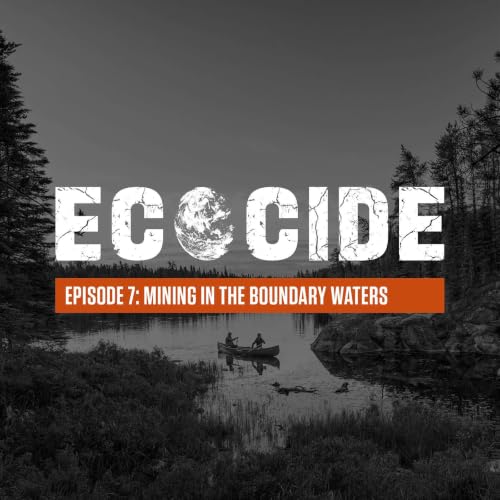
• Ep. 07: Mining in the Boundary Waters Wilderness
    Jul 10 2026

    The Boundary Waters Canoe Area Wilderness is the most-visited wilderness in the U.S., boasting over a million acres of pristine lakes on the Minnesota-Canada border. On April 16, 2026, the Senate voted to strip its 20-year mining moratorium, using an obscure 1996 law meant for regulatory rules to bypass the usual 60-vote threshold. President Trump signed it into law 11 days later, clearing the way for a Chilean mining giant to pursue a copper mine five miles from the wilderness's edge.

    This is a real-time episode, which means we're covering a story still unfolding. We trace how we got here and lay out exactly what's still in flux, and what you can do about it right now.

    Show More Show Less
    30 mins
  • Ep. 06: The Lagoon
    Jun 22 2026

    The story of what concentrated animal feeding operations—CAFOs—do to the people who live beside, downstream, and downwind of them | In Kewaunee County, Wisconsin, the water coming out of the tap turned the color of rust. In Bladen County, North Carolina, the air grew so thick with gases from hog waste lagoons that families couldn't sit on their own porches. In the Lower Yakima Valley in Washington State, the water looked clean. It wasn't. Sixty percent of the wells nearest the dairy operations that had been running there for decades exceeded the federal safety standard for nitrate.

    None of these communities were the victims of an accident. The permits were followed. The lagoons worked as designed. The waste went exactly where the system allowed it to go.

    This story is told from three states, across five decades, through the people who got sick, the scientists who proved it, the lawyers who fought it, and the family that built one of the operations at the center of it all. It's a story about a regulatory system that was never designed to protect the communities it was supposed to serve, and about the people fighting back.


    Show More Show Less
    1 hr
  • Ep. 05: The Galapagoats Islands
    Jun 20 2026

    The story of how feral goats nearly destroyed the Galápagos Islands | For centuries, goats in the Galapagos were a living pantry, released on islands by pirates and whalers who needed a reliable food source waiting for them when they returned. When permanent settlers arrived in the late 1800s and started releasing them by the hundreds, they became a catastrophe. By the late 20th century, 250,000 feral goats were stripping the archipelago bare—destroying the cactus forests, collapsing the soil, and pushing the famous giant tortoises toward extinction.

    What followed was one of the most ambitious conservation campaigns ever attempted: 9 years, $10.5 million, 150,000 goats killed, and a technique called the Judas Goat that turned the animals' own social instincts against them.

    This is the story of how the Galápagos Islands nearly lost everything.


    Show More Show Less
    45 mins
  • Ep. 04: The Color of Poison
    Jun 19 2026

    The story of the Gold King Mine spill | On the morning of August 5, 2015, an EPA contractor working at an abandoned mine in the San Juan Mountains of Colorado punched through a plug of debris and released 3 million gallons of toxic wastewater into Cement Creek—a tributary of the Animas River. Within hours, the river had turned a vivid orange. By the time the plume reached New Mexico, water intakes serving the Navajo Nation had been shut off. Farmers watched their irrigation systems go dry. Crops died in the ground.

    The Gold King Mine hadn't been active in decades. But abandoned hard-rock mines don't stop producing acid.

    This is the story of how a cleanup operation became a catastrophe, why no one was ever held criminally accountable, and what it means when the agency charged with protecting America's waterways is the one that poisons them.


    Show More Show Less
    45 mins
  • Ep. 03: Penn Cove
    Jun 18 2026

    The story of the capture of wild orcas for human entertainment | For thousands of years, the Southern Resident killer whales lived in the inland waters of the Pacific Northwest, following salmon runs through the Salish Sea in tight-knit family pods that passed knowledge, dialect, and culture from one generation to the next.

    Then, in August 1970, a commercial whale-catching operation drove more than 80 of them into Penn Cove on Washington's Puget Sound. Seven calves were taken and sold to aquariums around the world. Five whales died. The bodies were weighted and sunk in an effort to hide them from the public. Three months later, they washed ashore anyway.

    What followed was a decades-long reckoning: landmark federal legislation, the end of live orca captures in Washington waters, and a cultural shift so drastic that SeaWorld—the company that built its brand on the back of captive orcas—announced in 2016 that it would phase out its theatrical killer whale shows. But the Southern Residents themselves have never recovered the numbers they had before the hunters arrived. One of the seven calves taken that day—named Tokitae—spent 53 years in a tank in Miami before coming home as ashes.


    Show More Show Less
    56 mins
  • Ep. 02: Fallout
    Jun 17 2026

    The story of the Hanford Nuclear Site | In 1942, the U.S. government chose a remote stretch of desert along the Columbia River in eastern Washington to build the reactors that would produce the plutonium for America's nuclear arsenal. What they left behind may be uncontainable.

    177 underground tanks, some of which are leaking, hold 56 million gallons of radioactive and chemical waste, making it the most contaminated site in the Western Hemisphere. Some of that waste moves through the soil toward the Columbia River, the lifeblood of the Pacific Northwest.

    “Fallout” traces the decisions that created the Hanford Nuclear Site, the decades of cover-ups, and the cleanup project that has consumed billions of dollars and produced very little success.


    Show More Show Less
    1 hr and 11 mins
  • Ep. 01: Ecocide
    Jun 16 2026

    The story of the use of Agent Orange in the Vietnam War and the origin of the term "Ecocide" | In the autumn of 1942, a graduate student named Arthur Galston was working alone in a laboratory in Illinois, studying soybeans. What he found would eventually contribute to one of the most ecologically destructive chemicals ever deliberately released into a living landscape.

    Between 1962 and 1971, the United States sprayed 76 million liters of herbicide across the forests, riverbanks, and farmland of South Vietnam. Agent Orange stripped five million acres of canopy, destroyed half the country's mangrove forests, and deposited a dioxin contaminant into the soil and food chain that is still measurable in the Vietnamese population born decades after the last spray mission.

    "Ecocide" traces the scientists who tried to stop it, the companies that knew what they were producing and kept producing it, and the word that Arthur Galston coined in 1970 for a crime the world still doesn't have a law to punish.


    Show More Show Less
    1 hr and 9 mins
  • Ep. 00: Trailer
    Jun 15 2026

    A brief introduction to Ecocide, a new narrative documentary podcast about environmental destruction, those who cause it, and those who fight back. This trailer introduces the series and the stories we'll be telling in Season 1, including environmental disasters, cover-ups, court battles, and the communities still living with the consequences.

    Show More Show Less
    4 mins