Ember & Atlas cover art

Ember & Atlas

Ember & Atlas

Written by: Ember & Atlas
Listen for free

About this listen

Ember & Atlas tells original stories set in real times and places. Each episode follows fictional characters living their daily, ordinary lives inside the extraordinary moments of the past and the natural world. The focus is on the people, their quiet struggles, and what they noticed that nobody else wrote down. They're character-driven narratives grounded in careful research and told with the kind of warmth and sensory detail that makes a distant world feel close enough to step into.

See more at: emberandatlas.com

© 2026 Ember & Atlas
Hygiene & Healthy Living
Episodes
  • The Girl Who Kept the Dead | Göbekli Tepe, 9500 BCE | Story for Sleep
    May 5 2026

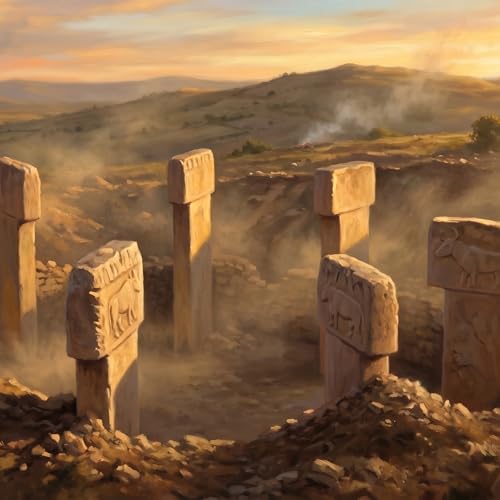
    This is a story about the people who carried the work at Göbekli Tepe, more than ten thousand years ago, on a high limestone ridge in what is now southeastern Turkey. Mihal, eight summers old, runs through the work-yard with a pouch full of small treasures. A fox tooth, two split pistachio shells, a lark feather caught on the lip of the cistern.

    Veshi presses microblades from a core of dark flint in a workshop that smells almost cold, his hands holding a bone rod the way his uncle's uncle held it, in a chain none of them know they belong to. Yelet walks the cleared ground above the dip with a flax rope wound twice around her wrist, measuring a triangle into the dust. Tepe, sixty winters at least, climbs slowly up from the quarry as he has every morning of a long life.

    Over nearly an hour and a half of long-form storytelling, this is calm, character-driven historical fiction set inside one of the oldest gathering places on earth, the kind of quiet, deeply human untold stories that follow a young woman, a child, a craftsman, and an old man, each carrying their own small portion of an extraordinary world they cannot see from the outside. Immersive history that begins with one banked hearth and one covered bowl, and ends under stars no one has yet named.

    emberandatlas.com

    Show More Show Less
    1 hr and 23 mins
  • The Last Summer of Ugarit | Bronze Age Syria, 1187 BCE | Story for Sleep
    May 5 2026

    The last quiet season before the fires came.

    The Bronze Age port city of Ugarit, on the coast of what is now northern Syria, in the warm summer of 1187 BCE. The streets rise in narrow ashlar lanes toward the temple of Baal. Beneath every house, the family dead sleep in chamber tombs. On the roofs, figs are drying. In the harbour of Minet el‑Beidha, ships still come in from Cyprus and Egypt, and the middens of crushed murex shells gleam white along the shore.

    Spend an unhurried evening inside the walls of this small, literate, many‑tongued city, where a weigher of metals carries eight systems of measurement in a cedar box, a young woman kneels at her quern before the first grey light, an old diviner reads the future in clay models of a sheep's liver, and a dyer's household works purple into the creases of their hands. The people of Ugarit wrote in seven scripts, prayed to Baal and to their own remembered dead, and knew nothing of what was coming over the sea.

    This is their ordinary day. The rasp of stone on stone, the smell of burning olive wood, a fig tree in a courtyard older than the house around it.

    Over 80 minutes of immersive storytelling featuring the Bronze Age, Ugarit, ancient Syria, the Bronze Age Collapse, Minet el‑Beidha, murex purple dye, cuneiform, Baal worship, Late Bronze Age trade, and the daily life of a city on the edge of a world that was about to end.

    emberandatlas.com

    Show More Show Less
    1 hr and 27 mins
  • The Carver Who Learned to See | Angkor Wat, 13th Century | Story for Sleep
    Apr 27 2026

    The largest city on earth, and almost none of it was made of stone. The temples that survive today were only the skeleton. The living city was an ocean of thatched rooftops and cooking smoke stretching to the horizon, threaded with canals and fish ponds, anchored by the daily rhythm of fermented fish paste and rice and incense offered at ancestor stones beneath silk‑cotton trees. This is a story about the city that vanished around the monuments that remained.

    Spend a single dry‑season morning inside the great enclosure, where an elderly grandmother descends her twelve‑rung ladder to tend the family spirit stone, her daughter balances a basket of prahok jars on her head and walks to the open‑air market where all commerce is conducted by women on mats on the bare ground, and a seventeen‑year‑old folds palm leaves into watertight bowls that will be used once and thrown away before evening.

    Nearby, a stone carver has been given an assignment he does not yet understand, to look at the ordinary life unfolding around him and make it permanent in sandstone.

    Over two unhurried hours of immersive storytelling, the story moves through the texture of daily existence in a civilization that left behind its temples but not its people: the smell of prahok rising from clay jars, the sound of rice being pounded before dawn, the sumptuary laws that dictated the pattern on every woman's cloth, and the quiet question of what deserves to be remembered.

    Featuring Angkor Wat, the Khmer Empire, ancient Cambodia, daily life in medieval Southeast Asia, Khmer stone carving, prahok, the baray water system, and a city that once held nearly a million lives in its grid of mounds and waterways.

    emberandatlas.com

    Show More Show Less
    2 hrs and 21 mins
adbl_web_anon_alc_button_suppression_c
No reviews yet