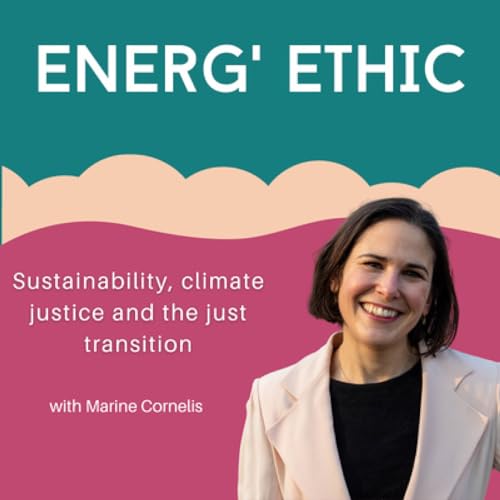
Energ’Ethic - Climate Justice and Energy Transition cover art

Energ’Ethic - Climate Justice and Energy Transition

Energ’Ethic - Climate Justice and Energy Transition

Written by: Marine Cornelis
Listen for free

About this listen

Energ’Ethic is a podcast exploring the human, institutional, and ethical dimensions of the energy transition. Hosted by Marine Cornelis, Energ’Ethic brings together policymakers, regulators, industry leaders, city practitioners, researchers, and civil society voices to examine what makes energy transitions succeed—or fail—in the real world. Beyond technology and targets, the podcast focuses on trust, power, consumer rights, digitalisation, and energy justice. Each conversation connects policy and market design with lived experience, unpacking how decisions taken in boardrooms and institutions translate into everyday realities for people and communities. Energ’Ethic is not about slogans or quick fixes. It is a space for rigorous, grounded conversations about resilience, legitimacy, and the social conditions required for lasting climate and energy strategies. Listen to Energ’Ethic to: Hear first-hand perspectives from those shaping energy and climate policy from the inside Understand how governance, regulation, and technology affect consumers and communities Explore energy and climate justice through practical, experience-based insights Energ’Ethic speaks to an engaged audience of decision-makers and practitioners working at the intersection of policy, markets, cities, and society. Organisations can partner with Energ’Ethic to support high-quality dialogue and reach a thoughtful, policy-literate audience committed to a fair and resilient energy transition. Listen, subscribe, and join the conversation. Hosted on Ausha. See ausha.co/privacy-policy for more information.Marine Cornelis Science Social Sciences
Episodes
  • Heat Pumps, Systems, and People: Why Clean Heating Needs Alignment
    Jan 27 2026

    Europe has set ambitious targets for clean heating. Heat pumps are central to that strategy. Yet deployment continues to slow, especially in multi-apartment buildings and social housing.

    In this episode, Marine Cornelis explores why.

    Joined by Vladimir Gjorgievski and Louise Meister, the conversation moves beyond technology to examine how clean heating actually works in real buildings.

    Drawing on experiences from North Macedonia and Austria, the episode looks at:

    • why heating and cooling must be planned together,

    • how sector coupling translates into comfort, resilience, and bill stability,

    • why upfront costs and risk allocation remain major barriers,

    • and how business models and coordination determine success in collective housing.

    The discussion also reflects on lessons from contexts with limited gas infrastructure, the role of energy communities and flexibility, and what alignment means for EU and national policy frameworks.

    A grounded, systems-level conversation on scaling clean heating without shifting cost and risk onto residents.


    Energ' Ethic goes out every other week.

    Keep up to date with new episodes straight from your inbox


    Reach out to Marine Cornelis via BlueSky or LinkedIn
    Music: I Need You Here - Kamarius
    Edition: Podcast Media Factory


    Support Energ'Ethic on Patreon


    © Next Energy Consumer, 2026


    Hosted on Ausha. See ausha.co/privacy-policy for more information.

    Show More Show Less
    46 mins
  • Energy Customers Do Not Need More Explanations, Sean Layerle
    Jan 13 2026

    Why does the energy sector keep trying to explain, rather than designing better?


    In this episode of Energ’Ethic, Marine Cornelis speaks with Sean Layerle, Managing Partner at Baalbek Insights, about a stubborn reflex in the energy transition: the belief that low adoption can be fixed by better explanations.


    With 14 years in Silicon Valley and experience across five continents, Sean has worked at the forefront of digital energy products, demand-side management, and behavioural science, including roles at Opower and EnerNOC. Today, he supports energy and tech companies as electrification, flexibility and distributed energy resources accelerate.


    Together, they unpack why tech-first thinking persists, how behavioural biases quietly shape energy decisions, and why collecting more data rarely leads to better customer understanding.


    The conversation moves from early lessons in demand response to today’s challenge: designing digital products that align with real human motivations, not expert assumptions.


    Energ' Ethic goes out every other week.

    Keep up to date with new episodes straight from your inbox


    Reach out to Marine Cornelis via BlueSky or LinkedIn
    Music: I Need You Here - Kamarius
    Edition: Podcast Media Factory


    Support Energ'Ethic on Patreon


    © Next Energy Consumer, 2026


    Hosted on Ausha. See ausha.co/privacy-policy for more information.

    Show More Show Less
    44 mins
  • Stitching the Energy Transition in Cities - Eduardo Blanco
    Dec 16 2025

    Cities are on the front line of the energy transition. They are also where energy poverty is most visible.


    In this episode of Energ’Ethic, Marine Cornelis talks with Dr Eduardo Blanco from Energy Cities, coordinator of the POWER UP project.


    The episode covers:

    • Social energy players and new local business models

    • Municipal leadership and public risk-taking

    • Neighbourhood-scale solutions

    • Concrete lessons from European pilot cities


    Eduardo explains why building fair energy systems looks less like engineering and more like embroidery. Slow, precise and deeply human.


    Energ' Ethic goes out every other week.

    Keep up to date with new episodes straight from your inbox


    Reach out to Marine Cornelis via BlueSky or LinkedIn
    Music: I Need You Here - Kamarius
    Edition: Podcast Media Factory


    Support Energ'Ethic on Patreon


    © Next Energy Consumer, 2025


    Hosted on Ausha. See ausha.co/privacy-policy for more information.

    Show More Show Less
    42 mins
No reviews yet