Episodes

  • Upskilling teachers: Elements of social justice-focused teaching
    Apr 19 2026

    We welcome back Dr. Anthony Johnston to speak about his new book, "Introduction to Secondary Teaching: Blending Wisdom, Research, and Social Justice.” Dr. Johnston explores teacher wisdom of practice, social justice pedagogy, evidence-based practices, and adolescent brain research. He identifies the foundation of all classroom teaching as teacher identity, teacher presence, teacher passion, and teacher stance.

    Show More Show Less
    36 mins
  • Global Conversations: Nature, Place, and Education, Salon #3
    Mar 25 2026

    We share brief presentations from the third of the “Saturday Salons” that Ethical Schools is sponsoring with three international partners. Kerry Kirk Pflugh is the executive director of the New Jersey School of Conservation. She also comes with extensive background experience at the New Jersey Department of Environmental Protection. Tom Roderick is the author most recently of Teach for Climate Justice: A Vision for Transforming Education. He was also the Founding Executive Director of Morningside Center for Teaching Social Responsibility. Deb L. Morrison is a Learning Designer and Advisor at the University of Washington and a Lead Author on the Intergovernmental Panel on Climate Change Assessment Report 7. They talk about how educators can respond to the urgent environmental crises we face. Learn more and join at globalconversations.net

    Show More Show Less
    31 mins
  • School Choice: Who Does the Choosing?
    Mar 12 2026

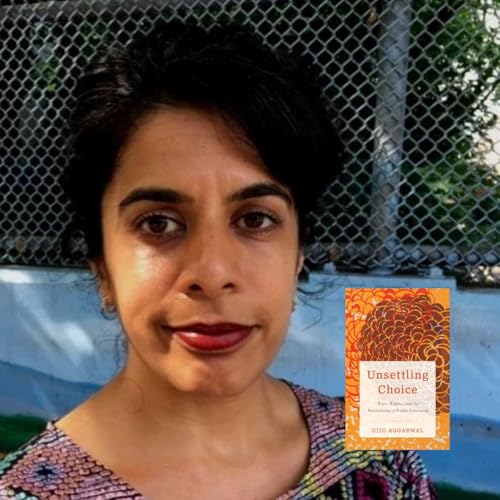
    We welcome back Dr. Ujju Aggarwal, assistant professor at The New School, to speak about her book, Unsettling Choice: Race, Rights, and the Partitioning of Public Education. In Unsettling Choice, Dr. Aggarwal focuses on the intersection of public education and gentrification. The book is based on her work with mothers at a Head Start center in NYC. We discuss the race and class discrimination the parents faced and whether exclusion is inherent in school choice programs.

    Overview

    00:00-00:56 Intros

    00:56-07:13 Working with Head Start mothers in Manhattan’s Community School District 3

    07:13-09:15 Connection between school choice and austerity

    09:15-19:17 Issues mothers faced in choosing schools for their children and their experiences

    19:17-24:06 The “post-Brown realignment” following the Brown v Board of Education Supreme Court decisions

    24:06-25:30 Parents as “consumers” rather than as “citizens”

    25:30-28:01 Can school choice exist without exclusion

    28:01-29:03 NYC Schools Chancellor Samuels and citywide integration

    29:03-32:21 Radical municipalism

    32:21- Outro

    Transcript

    Click here to listen to see the full transcript of this episode.

    References

    • Book "Unsettling Choice: Race, Rights, and the Partitioning of Public Education" by Dr. Ujju Aggarwal
    • Listen to our first interview "Ujju Aggarwal on school choice, whiteness as property, and the “right to exclude” published in 2019

    Soundtrack by Poddington Bear

    Show More Show Less
    34 mins
  • Global Conversations: Nature, Place, and Education, Salon #2
    Feb 18 2026

    We share brief presentations from the second of the “Saturday Salons” that Ethical Schools is sponsoring with three international partners. Sherry Johnson, Tribal Education Director of the Sisseton-Wahpeton-Oyate (South Dakota), Deepak Ramola, Founder of Project FUEL (India), and Charlotte Hankin of Coconut Thinking and the Green School (Bali) talk about the importance of stories in reshaping how we think about our relationship to the natural world.

    Learn more and register for the third salon on February 21 at globalconversations.net

    Show More Show Less
    52 mins
  • Trump cutbacks and policies: stripping minority student protections
    Feb 16 2026

    We speak with Derek Black, Constitutional law professor at the University of South Carolina School of Law, about the impact of Trump administration’s policies on students’ civil rights. Department of Education offices meant to ensure students are not subject to discrimination have been decimated. The Department of Justice has switched from protecting minority students' rights to focusing on so-called “discrimination" against whites and attacking transgender students. Professor Black also says the need for "circuit breakers" on executive power transcends this administration.

    Overview

    00:00-00:52 Intros

    00:52:02:21 Threats to students’ protection from discrimination

    02:21-03:53 Status of complaints to Department of Education’s Office of Civil Rights (OCR)

    03:53-05:30 Importance of access to OCR without an attorney

    05:30-10:09 OCR procedures and remedies

    10:09-13:55 Role Department of Justice is supposed to have in protecting students against discrimination; Trump Administration priorities

    13:55-17:01 How the Administration’s approach is schizophrenic

    17:01-23:10 Ethical quandaries facing district administrators

    23:10-24:43 Supplementing not supplanting: What happens when the Department of Education is no longer monitoring

    24:43-27:21 The uncertainty factor—who gets focused on

    27:21-30:36 State Departments of Education: How they fit in

    30:36-34:11 Theatrics at US Department of Education

    34:11-38:00 Problems before the Trump Administration and what would be important afterwards

    38:00-40:11 Some specifics of “circuit breakers” that could reduce executive power

    40:11- Outro

    Transcript

    Click here to see the full transcription of this episode.

    References

    Our first interview with Derek Black happened in 2021. Click here to listen to "The attack on public education: Will public schools survive?"

    Soundtrack by Poddington Bear

    Show More Show Less
    41 mins
  • Global Conversations: Nature, Place, and Education
    Jan 21 2026

    We share brief presentations from the first of the “Saturday Salons” that Ethical Schools is sponsoring with three international partners. Juan Mora of the Center for Artistry and Scholarship and Ramji Raghavan of Agastya International Foundation talk about how educators and communities can cultivate awareness of and relationship to the natural world.

    Learn more and register for the next salon at globalconversations.net

    Overview

    00:00-01:36 Introductions by Amy and Jon

    01:36-02:45 Introduction of Juan Mora by David Penberg

    02:45-12:36 Juan Mora:

    Separation of people from nature;

    What would you do if you were starting a school from zero?

    Experience in Córdoba, Argentina of basing a school on nature;

    Integrating the curriculum into nature-centered activities;

    And kids never asked, “Why are we doing this (activity)?”

    We’ve left nature out of our learning environments;

    A shift in learning that will help us understand how to teach and what to teach and where to teach differently.

    12:36-14:09 David Penberg:

    Reciprocity, centrality of relationships, “nature deficit disorder”;

    Introduction of Ramji Raghavan

    14:09-23:59 Ramji Raghavan:

    Transforming a barren wasteland of 170 acres into an ecological preserve;

    Nature-centric learning;

    Eco-walk;

    Constructing a giant figure showing herbs benefiting different parts of the body;

    Constructing a termite hill;

    Bandhu—everything is connected;

    Distributing learnings throughout India.

    23:59-25:15 David Penberg:

    How educators can create conditions for people to think the kinds of worlds that they would like to inhabit and live in, whether it’s a school, a community;

    Creative learning and what that looks like, creative being;

    Being intentional, observant and continuously in relationship to the things around you.

    25:15- Outro

    Transcript

    Click here to see the full transcription of this conversation.

    Soundtrack by Poddington Bear

    Show More Show Less
    27 mins
  • Pop culture literacies: Engaging students in critical analysis
    Jan 13 2026

    We speak with Dr. Mia Hood, author of  Pop Culture Literacies: Teaching Interpretation, Response, and Composition in a Digital World, about analyzing popular music and films along with more traditional literature. Dr. Hood talks about helping students to think about their ethical perspectives while engaging with "entertainment," and the importance of educators' resisting the temptation to impose their own “expert” interpretations in favor of modeling the process. We also discuss how teachers can resist imposing their views while teaching for democracy and social justice.

    Overview

    00:00-00:48 Intros

    00:48-02:48 Pop culture literacies

    02:42-04:22 Schools’ ethical duty to help young people navigate the world as it is

    04:22-06:23 Helping students to thin about their ethical perspectives

    06:23-11:58 Students’ responses; Intersection of pop culture literacies and schools

    11:58-15:01 Critical literacy and text analysis

    15:01-19:09 Power operating within and through texts

    19:09-21:56 Piercing the veil of “entertainment” to encourage critical analysis

    21:56-26:25 Impact of AI

    26:25-30:48 Kathy Hytten’s article, “Ethics in teaching for democracy and social justice”

    30:48-33:55 Parental pushback?

    33:55- Outro

    Transcript

    Click here to see the full transcription of this episode.

    Resources

    Book Pop Culture Literacy: Teaching Interpretation, Response, and Composition in a Digital World by Mia Hood

    Soundtrack by Poddington Bear

    Show More Show Less
    37 mins
  • Join our Global Saturday Salons!
    Jan 4 2026

    Collaborate with teachers and learners worldwide!

    LEARN MORE AND REGISTER AT GLOBALCONVERSATIONS.NET

    Along with our partner organizations – Agastya International Foundation, Center for Artistry and Scholarship, and Thinking With You – Ethical Schools is bringing together educators, youth workers, and students from around the world to discuss ethical, democratic, and regenerative education strategies. Hear exciting presentations from visionary practitioners and participate in group discussions.

    Come with your co-workers! Attend with a cohort from your school or out-of-school program to maximize the benefits for your organization and students.

    Series 1: Ethics and the Natural World Saturdays, January 10 and 31; February 21 8:30-10:00 AM EST

    Pay what you wish. Suggested donation: $25 per session, $50 for all three sessions Additional participants from your organization: $15 per session, $30 for all three sessions.

    LEARN MORE AND REGISTER AT GLOBALCONVERSATIONS.NET

    Show More Show Less
    2 mins