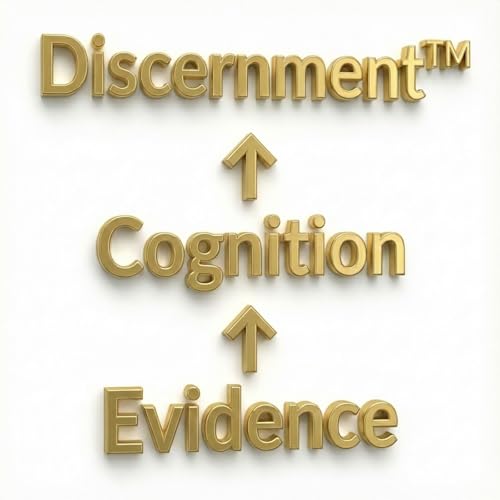
Evidence → Cognition → Discernment™️ - Your Pathway to AI Leadership cover art

Evidence → Cognition → Discernment™️ - Your Pathway to AI Leadership

Evidence → Cognition → Discernment™️ - Your Pathway to AI Leadership

Written by: Greg Twemlow
Listen for free

About this listen

XperientialAI — Pathway to AI Leadership explores how people can collaborate with AI without outsourcing judgment. The spine is a three-step method: Evidence → Cognition → Discernment — a bridge from what’s scattered to what’s chosen. Through essays, reflections, and practical examples, I show how the Context & Critique Rule™ keeps thinking visible, decisions explainable, and responsibility human.FusionBridge Podcasts are the Copyright of Greg Twemlow Economics Management Management & Leadership Self-Help Success
Episodes
  • The Voyager Protocol- A Human Handshake With Forever
    Apr 25 2026
    This article by Greg Twemlow provides a poetic and philosophical perspective on the Voyager spacecraft missions as they approach their fiftieth year in space. Written from the imagined viewpoint of the probes themselves, the text refutes the idea that the mission is ending simply because NASA must periodically deactivate instruments to conserve dwindling nuclear power. The author highlights the Golden Record as a permanent "Protocol for Humanity," ensuring that human culture and beauty will drift through the cosmos for billions of years. Even after their last signals fade in the 2030s, the vessels will continue their journey toward distant stars, serving as a testament to human audacity and faith. Ultimately, the source frames Voyager not as a tragedy of failing hardware, but as an eternal ambassador that transcends the limits of its creators. Read the article.

    About the Author - Greg Twemlow writes and teaches at the intersection of technology, education, and human judgment. He works with educators and businesses to make AI explainable and assessable in classrooms and boardrooms — to ensure AI users show their process and own their decisions. His cognition protocol, the Context & Critique Rule™, is built on a three-step process: Evidence → Cognition → Discernment — a bridge from what’s scattered to what’s chosen. Context & Critique → Accountable AI™. © 2025 Greg Twemlow. “Context & Critique → Accountable AI” and “Context & Critique Rule” are unregistered trademarks (™).
    Show More Show Less
    19 mins
  • What Deep Use of AI Taught Me
    Apr 25 2026
    The provided text explores Greg Twemlow’s evolution from an early adopter of AI to a developer of frameworks designed to protect human judgment. He argues that while AI can serve as a cognitive catalyst, its rapid fluency poses a risk of cognitive surrender, where users mistake polished output for valid reasoning. To counter this, Twemlow introduces the Context & Critique Rule, a discipline that deliberately slows down the interaction to ensure the human remains mentally present and accountable. He further defines Cognitive Capital as a vital organisational asset consisting of the collective wisdom and ethical discernment that AI cannot replicate. Central to his philosophy is the Cognition Ignition Matrix, a 3×3 model used to monitor whether technology is enhancing or eroding independent thought. Ultimately, the source asserts that the true challenge of the AI era is maintaining intellectual sovereignty amidst relentless machine speed. Read the article.

    About the Author - Greg Twemlow writes and teaches at the intersection of technology, education, and human judgment. He works with educators and businesses to make AI explainable and assessable in classrooms and boardrooms — to ensure AI users show their process and own their decisions. His cognition protocol, the Context & Critique Rule™, is built on a three-step process: Evidence → Cognition → Discernment — a bridge from what’s scattered to what’s chosen. Context & Critique → Accountable AI™. © 2025 Greg Twemlow. “Context & Critique → Accountable AI” and “Context & Critique Rule” are unregistered trademarks (™).
    Show More Show Less
    19 mins
  • Tracking Cognitive Capital for People and Organisations
    Apr 23 2026
    Greg Twemlow’s four-part framework addresses the profound disruption AI brings to society, organisations, and individuals, arguing that the core challenge of the AI era is not merely job displacement, but the preservation of human judgment, tempo, and accountability. He advocates for building "human sovereignty" to defend against AI's "turbocharged synchrony"—the machine's built-in push for speed and completion that conflicts with the slower, recursive nature of human reflection. Here is a comprehensive summary of his concepts across the societal, individual, practical, and organisational levels:


    1. The Societal Shift: Breaking the Human Compact AI is actively dismantling the traditional "human compact," the inherited, linear sequence where education reliably launched individuals into stable, lifelong careers. Because society's "industrial age" reliance on synchrony is incompatible with the deep, asynchronous nature of human thought, institutions must urgently redesign their purpose rather than acting as mere bottlenecks. Twemlow highlights education as the prime example, arguing that universities must evolve from one-time credentialing launchpads into lifelong "waypoints" or "transition commons" where people can periodically slow down, reorient, and rebuild their judgment against the overwhelming pace of machines and capital.


    2. The Individual Defence: Building a Sovereign Moat To survive this civilizational shift, professionals are warned that deep specialisation is a trap, as AI can easily replicate single, repeatable "Point-Solution" skills. Instead, individuals must construct a "Sovereign Moat"—a structural barrier that protects their professional agency and ethics from automation. This is mapped using the Cognition Ignition Matrix™ (CIM), a 3x3 geometric framework detailing nine human-centric cognitive skills. At the core of the CIM is the "Reasoner" or the "Human CPU," which serves as an ultimate firewall to audit the link between evidence and implication. Twemlow recommends building a "5-Cell Moat" to protect the Reasoner, with four satellite skills: the Questioner (inquiry), Analyser (context), Discerner (ethics), and Experimenter (real-world testing).


    3. The Practical Application: The 7-Step Architect’s Protocol To prevent "machine-drift"—the silent erosion of expertise that occurs when humans lazily outsource their critical thinking to AI—individuals must adopt a formal, daily discipline. Twemlow outlines a 7-Step Architect’s Protocol for sovereign practice:
    • Comprehend & Contemplate: Understand the necessity of human accountability and define your "Red Lines," the cognitive territories you refuse to outsource.
    • Audit & Reflect: Conduct a 30-day "Sovereign Identity Audit" based on tangible evidence of your behaviours, followed by a 9-Question Interrogation to expose subconscious bias and reliance on "machine-momentum".
    • Apply & Fortify: Use the "Context & Critique Rule™" to define constraints AI misses and actively rebuild your "mental muscle" in areas of vulnerability.
    • Proclaim: The final step, also known as the "Hang Your Art" test, requires you to visibly declare your "Ignition Signature"—proving to your organisation exactly how your human judgment uniquely governs and elevates the machine’s output.
    4. The Organisational Imperative: Protecting Cognitive Capital. At the corporate level, AI threatens an unmeasured but vital balance sheet asset: Cognitive Capital. This is the accumulated judgment, institutional wisdom, and ethical discernment of an organisation's management layer. When managers confidently use AI but fail to govern its outputs, they succumb to "Algorithmic Drift," silently hollowing out the organisation's decision-making DNA. Twemlow argues that the most critical question for leadership is not whether their company is "AI-Ready" (which merely measures tool adoption), but whether it is "Cognition-Ready". A Cognition-Ready organisation leverages AI for superior outcomes while actively measuring, protecting, and growing the sovereign human judgment that governs the technology.

    About the Author - Greg Twemlow writes and teaches at the intersection of technology, education, and human judgment. He works with educators and businesses to make AI explainable and assessable in classrooms and boardrooms — to ensure AI users show their process and own their decisions. His cognition protocol, the Context & Critique Rule™, is built on a three-step process: Evidence → Cognition → Discernment — a bridge from what’s scattered to what’s chosen. Context & Critique → Accountable AI™. © 2025 Greg Twemlow. “Context & Critique → Accountable AI” and “Context & Critique Rule” are unregistered trademarks (™).
    Show More Show Less
    41 mins
No reviews yet