Episodes

  • Misinformation or Disinformation?: Fostering digital citizenship and information literacy in students
    Jan 15 2026

    In this episode of Evidence for Education, we talk with Dr. Matt Kinservik, Professor of English at University of Delaware, about the differences between misinformation and disinformation, digital citizenship, and information literacy in students in the wake of artificial intelligence. Dr. Kinservik’s work focuses on how to foster digital citizenship in education, as well as the importance of learning and living in this new AI era.

    If you care about democratic discourse, digital citizenship, and information literacy in K-12 settings, this episode offers insight, evidence, and hope. We dive into the story behind his work and what the difference between disinformation and misinformation is. Moreover, we dive deeper into the implications of the emerging use of Artificial Intelligence (AI) that permeates our everyday lives. We also explore how we could better prepare our children by cultivating digital citizenship and AI literacy at home and at school. It’s an episode full of insight and compassion for anyone who cares about helping our students in this new digital world.

    For more information visit: https://www.udel.edu/academics/colleges/cas/units/departments/english/our-people/matthew-kinservik/

    Check out the upcoming event on Digital Citizenship & Education (1/31/2026): https://events.udel.edu/event/digital-citizenship-education-symposium

    Show More Show Less
    38 mins
  • Engineering For the Future: How to Support Educators and Students in STEAM Learning
    Oct 29 2025

    In this episode of Evidence for Education, we talk with Dr. Jenni Buckley, a Professor of Mechanical Engineering at University of Delaware, about the powerful connection between mechanical engineering, community engagement, and student learning. Dr. Buckley’s work sheds light on how a well-designed engineering curriculum can enhance student learning outcomes and create meaningful changes in our daily lives. We explore how these effects vary across academic environments, communities, and teacher experience levels.

    If you care about engineering, science education, STEAM learning, research-practice partnership, or professional development, this episode offers insight, evidence, and hope. Tune in to learn how science can be a bridge—not a barrier—and why supporting students and teachers with diverse opportunities means creating future innovators.

    For more information, please visit https://me.udel.edu/

    Show More Show Less
    32 mins
  • Equity in Every Language: How Project DELITE Supports Teachers and MLLs
    Sep 4 2025

    In this episode of Evidence for Education, we’re joined by Dr. Nigel Caplan, Dr. Adrian Pasquarella, and Jamie Janick, the team behind Project DELITE at the University of Delaware, for an urgent and inspiring conversation about the growing need to support multilingual learners (MLLs) in today’s schools. As Delaware experiences one of the fastest-growing multilingual student populations in the nation, many educators are stepping up—but they need better preparation, more support, and systemic change to do this work well.

    Our guests walk us through the design and impact of Project DELITE, a federally funded initiative providing free certification and professional development to Delaware teachers and paraprofessionals who want to better serve MLLs. We hear how this program not only strengthens instructional strategies, but also builds teacher confidence and fosters statewide communities of practice—breaking down isolation and lifting up multilingualism as a powerful classroom asset.

    We also dig into the policy side: why certification matters, how current systems often create barriers for experienced paraprofessionals, and what changes are needed to create sustainable, equitable pathways for all educators to learn how to support multilingual students.

    If you care about educational equity, teacher development, or the future of inclusive schooling, this episode offers insight, evidence, and hope. Tune in to learn how language can be a bridge—not a barrier—and why supporting multilingual learners means supporting all learners.

    For more information visit: https://sites.udel.edu/project-delite/

    Show More Show Less
    31 mins
  • Science Stands Out: How Teacher Emotions Differ Across Subjects
    May 6 2025

    Episode Description:

    In this episode of Evidence for Education, we welcome back returning guest Dr. Leigh McLean to discuss her latest research on the powerful role of teacher emotions in shaping student engagement and learning. Building on her earlier work on teacher well-being, Dr. McLean shares new insights into how teachers' emotional experiences vary across different subjects—and how these emotions ripple out to influence students.

    We explore how emotional transmission works, why younger students are especially sensitive to their teachers' feelings, and how factors like socioeconomic status can amplify or diminish these effects. A major finding we discuss is that science stands out from other disciplines: teachers’ and students’ emotions around science are often more dynamic and bidirectional than in subjects like math or reading. We reason through why that might be—and what it means for teacher preparation, classroom practice, and education policy.

    If you care about the future of teaching, teacher retention, or student engagement, this is an episode you won’t want to miss.

    Guest’s work:

    McLean, L., Janssen, J., Espinoza, P., Lindstrom Johnson, S., & Jimenez, M. (2023). Associations between teacher and student mathematics, science, and literacy anxiety in fourth grade. Journal of Educational Psychology, 115(4), 539–551. https://doi.org/10.1037/edu0000790

    McLean, L., & Jones, N. (2025). Using an observational measure of elementary teachers’ emotional expressions during mathematics and English language arts to explore associations with students’ content area emotions and engagement. Contemporary Educational Psychology, 80, 102352. https://doi.org/10.1016/j.cedpsych.2025.102352

    McLean, L., Espinoza, P., Janssen, J., Jimenez, M., & Lindstrom Johnson, S. (2024). Relationships between elementary teachers’ enjoyment and students’ engagement across content areas and among student groups. School Psychology. Advance online publication. https://doi.org/10.1037/spq0000633

    Show More Show Less
    19 mins
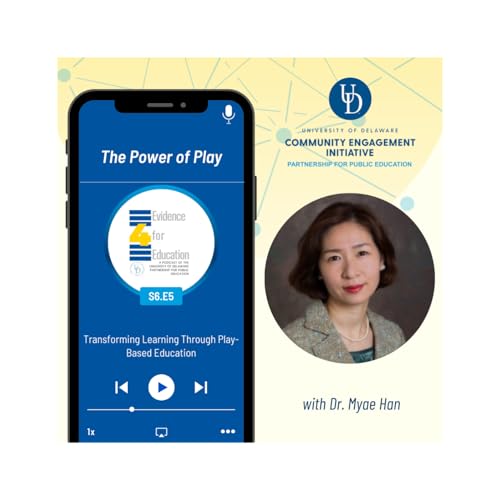
  • The Power of Play: Transforming Learning Through Play-Based Education
    Apr 8 2025

    Episode Description: In this episode of Evidence for Education, we talk with Dr. Myae Han, a professor in the Human Development and Family Sciences department at the University of Delaware, about the critical role of play-based learning in child development and education. Though often viewed as separate from academics, play is a powerful tool for fostering cognitive, social, and emotional growth. Dr. Han shares insights on how educators can effectively integrate play into the classroom, shift their perspectives through professional development, and overcome common barriers to play-based learning. We also explore the future of play in education and why it remains essential for student success

    Guest’s work:

    Han, M. (n.d.). The power of pretend play in language and literacy learning. The Genius of Play. https://thegeniusofplay.org/genius/expert-advice/articles/the-power-of-pretend-play-in-language-and-literacy-learning.aspx

    Han, M., Buell, M., Liu, D., & Pic, A. (2023). Can an intensive professional development on play change child care providers’ perspectives and practice on play? International Journal of Play, 12(2), 175–192. https://doi.org/10.1080/21594937.2023.2209239

    Han, M., Whiteside-Mansell, L., Hustedt, J. T., Drain, D., Eubanks, R., Joe, C., Lawson, I., & Pic, A. (2023). Relationships between play and learning practices among low-income families. American Journal of Play, 15(2), 136-157

    Han, M., Moore, N., Vukelich, C., & Buell, M. (2010) Does Play Make a Difference? How play intervention affects the vocabulary learning of at-risk preschoolers, American Journal of Play. 3(1), 82-105. https://www.museumofplay.org/app/uploads/2022/01/3-1-article-does-play-make-a-difference.pdf

    Hooper, A., Han, M., Buell, M., & Hallam, R. (2023). Perspectives on quality and supporting quality improvement from early childhood technical assistants working with family child care educators. Journal of Early Childhood Teacher Education, 44(4), 1024–1044. https://doi.org/10.1080/10901027.2023.2257140

    Show More Show Less
    23 mins
  • Building Financially Literate Students: Insights from the Center of Economic Education & Entrepreneurship
    Mar 5 2025

    Episode Description: In this episode of Evidence for Education, we sit down with Scott Bacon and Amy Krzyzanowski from the University of Delaware's Center for Economic Education & Entrepreneurship (CEEE) to discuss the vital role of economic education in shaping financially literate students. Scott and Amy share insights into CEEE’s impactful programs and how they prepare educators to bring economics to life in the classroom. We also dive into the implications of HB 203, a recent Delaware law affecting financial literacy in schools, and hear inspiring stories of CEEE’s influence. Finally, we explore their hopes for the future of economic education and what it means for students and communities. Whether you're an educator, policymaker, or someone passionate about financial literacy, this episode offers valuable perspectives on empowering the next generation with essential life skills.

    More Information:

    You can contact Scott Bacon and Amy Kryzanowski at the University of Delaware's Center for Economic Education & Entrepreneurship (CEEE) using the following email addresses:

    Scott Bacon: bacons@udel.edu

    Amy Krzyzanowski: akrzyz@udel.edu

    Visit CEE’s website: https://lerner.udel.edu/centers/center-for-economic-education-entrepreneurship/

    Learn more about the Partnership of Public Education: https://ppe.cehd.udel.edu/

    Show More Show Less
    22 mins
  • The Role of AI in Writing: Part 2 - Assessment and Feedback
    Feb 11 2025

    Episode Description:

    In this episode of E4E: Evidence for Education, we continue our conversation with Dr. Josh Wilson, an associate professor at the University of Delaware’s College of Education, to explore the evolving role of artificial intelligence in writing instruction. This is part two of a two-part series on AI and writing, with a focus on feedback and assessment.

    Dr. Wilson dives into how automated essay scoring and feedback tools can transform writing instruction by providing timely, consistent, and actionable feedback for students. He highlights the benefits these systems provide in fostering student growth and motivation, while also supporting teachers by simplifying feedback processes and even enhancing classroom management.

    We also examine the challenges posed by AI assessment and feedback, including issues of bias in training data, and the need for human oversight. Dr. Wilson emphasizes the importance of keeping educators “in the loop” to ensure AI systems are used effectively and ethically.

    Whether you’re a teacher, administrator, or someone interested in the intersection of education and technology, this episode provides practical insights into how AI is shaping feedback and assessment in writing education.

    This podcast is presented by the Partnership for Public Education and is hosted and produced by Kristin Chisholm.

    Guest's Work:

    Wilson, J., & Czik, A. (2016). Automated essay evaluation software in English Language Arts classrooms: Effects on teacher feedback, student motivation, and writing quality. Computers & Education, 100, 94-109.

    Shermis, M. D., & Wilson, J. (Eds.). (2024). The Routledge International Handbook of Automated Essay Evaluation. Routledge—Taylor & Francis.

    Wilson, J., Delgado, A., Palermo, C., Cruz Cordero, T., Myers, M., Potter, A., Eacker, H., Coles, J., & Zhang, S. (2024). Middle school teachers’ implementation and perceptions of automated writing evaluation. Computers and Education Open, 7, 100231. https://doi.org/10.1016/j.caeo.2024.100231

    More Information:

    Dr. Wilson’s Faculty Page: https://www.cehd.udel.edu/faculty-bio/joshua-wilson/

    Dr. Wilson’s Google Scholar : https://scholar.google.com/citations?user=Ly3EPOkAAAAJ&hl=en

    Dr. Wilson’s Email: joshwils@udel.edu

    Show More Show Less
    21 mins
  • The Role of AI in Writing: Part 1 - Writing Development
    Jan 17 2025

    Episode Description:

    In this episode of E4E: Evidence for Education, we sit down with Dr. Josh Wilson, an associate professor at the University of Delaware’s College of Education, to discuss the evolving role of artificial intelligence in writing instruction. This is part one of a two-part series where we explore AI’s impact on writing. In this episode, the focus is on writing development—how AI tools can support students in organizing their ideas, improving transcription skills, and overcoming barriers in the writing process.

    Dr. Wilson shares insights into both the opportunities and challenges AI brings to writing instruction, offering a balanced perspective on how these tools can be used effectively while addressing potential concerns. Stay tuned for part two, where we’ll dive into how AI is transforming feedback and formative assessments in education.

    Whether you’re a teacher, administrator, or simply interested in the intersection of education and technology, this episode provides valuable insights into AI’s role in fostering writing development.

    This podcast is presented by the Partnership for Public Education and is hosted and produced by Kristin Chisholm.

    Guest's Work:

    Wilson, J., & Czik, A. (2016). Automated essay evaluation software in English Language Arts classrooms: Effects on teacher feedback, student motivation, and writing quality. Computers & Education, 100, 94-109.

    Shermis, M. D., & Wilson, J. (Eds.). (2024). The Routledge International Handbook of Automated Essay Evaluation. Routledge—Taylor & Francis.

    Wilson, J., Delgado, A., Palermo, C., Cruz Cordero, T., Myers, M., Potter, A., Eacker, H., Coles, J., & Zhang, S. (2024). Middle school teachers’ implementation and perceptions of automated writing evaluation. Computers and Education Open, 7, 100231. https://doi.org/10.1016/j.caeo.2024.100231

    More Information:

    Dr. Wilson’s Faculty Page: https://www.cehd.udel.edu/faculty-bio/joshua-wilson/

    Dr. Wilson’s Google Scholar : https://scholar.google.com/citations?user=Ly3EPOkAAAAJ&hl=en

    Dr. Wilson’s Email: joshwils@udel.edu

    Show More Show Less
    24 mins