Extreme Living cover art

Extreme Living

Extreme Living

Written by: Anchal Bhaskar
Listen for free

LIMITED TIME OFFER | Get 2 Months for ₹5/month

About this listen

Extreme Living is a design inquiry into human isolation, exploring how people live, heal, and adapt in confined and extreme environments, from space stations and Antarctic labs to cancer wards and prisons. Hosted by Anchal, exploring how isolation shapes us.Anchal Bhaskar Art
Episodes
  • Living in Antarctica: Designing Polar Research Stations with Hugh Broughton
    Mar 9 2026

    What does it take to design buildings for one of the most extreme environments on Earth and where people may live in isolation for months at a time?


    In this episode of Extreme Living, I speak with architect Hugh Broughton, whose work has helped redefine how we design research stations in Antarctica. Best known for the Halley VI Research Station, Hugh’s work marked a shift from buildings designed purely for survival toward environments that consider long-term human habitability and wellbeing.


    • We explore how architecture responds when failure is not an option, what it means to design on a moving ice shelf, and how logistics, prefabrication, and environmental constraints reshape the entire design process.


    • The conversation also looks beyond engineering challenges to the human experience of confinement and isolation. From sensory deprivation to the importance of small spatial gestures like light, smell, circulation, and quiet spaces, Hugh explains how architecture can support both community and individual resilience in places where the interior effectively becomes an entire world.


    • Together, we discuss what lessons polar architecture might offer other extreme environments from space missions to other forms of long-duration isolation.


    About the guest


    Hugh Broughton is an architect whose work focuses on designing buildings for some of the most remote and environmentally demanding places on Earth. As founder of Hugh Broughton Architects, he has been involved in the design of several polar research stations, including the Halley VI Research Station in Antarctica, a project that helped redefine how architecture supports long-term human habitation in extreme environments.


    His work explores the intersection of climate, logistics, and human experience, developing buildings that must function reliably in isolation while supporting the wellbeing of the people who live and work within them.


    Learn more about Hugh’s work:

    https://www.hbarchitects.co.uk⁠


    Show More Show Less
    52 mins
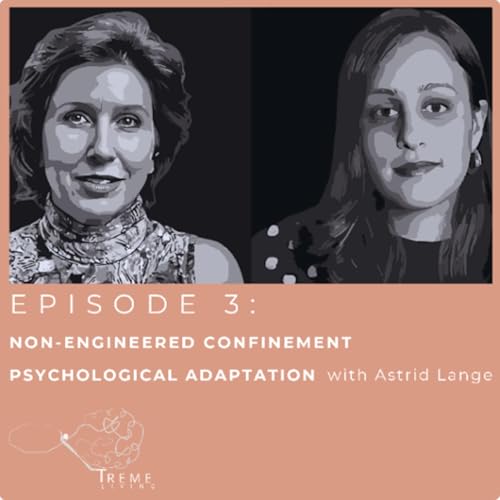
  • Non-Engineered Confinement | Psychological Adaptation with Astrid Lange
    Feb 5 2026

    What happens when confinement isn’t engineered, labeled, or even recognized as such?


    • In this episode of Extreme Living, I am joined by Astrid Lange to explore non-engineered confinement, psychological and cultural conditions that demand sustained adaptation without formal structure or support systems.


    • Drawing from Astrid’s experience living and working abroad as an English Language Fellow in Rio de Janeiro, Brazil, an assignment that had more in common with the Peace Corps than a traditional expat workplace. The conversation examines how identity, perception, and behavior shift when familiar anchors disappear. Together, we discuss cognitive overload, language as a form of confinement, and the ways people build their own coping strategies when psychological scaffolding is removed.


    Astrid Lange focuses on bilingualism, communicative arts, and collaboration in education. She has worked as a bilingual/EFL teacher and administrator across K–12 and university settings in the United States, Morocco, South Korea, Guatemala, and Brazil. She holds two master’s degrees from Texas A&M University and finished two cycles as English Language Fellow in Brazil. She is also a writer, performer, and founder of Houston’s only bilingual improvisation comedy troupe, ¡No Me Digas!.


    This episode continues Extreme Living’s investigation into how humans adapt in extreme environments, not only physical ones, but psychological as well.

    Show More Show Less
    42 mins
  • Living Underwater: Subsea Habitats with Former Aquanaut Roger Garcia From Aquarius Reef Base to DEEP
    Jan 7 2026

    Living Underwater — Subsea Habitats with Roger Garcia


    What does it actually mean to live underwater?

    • In this episode of Extreme Living, I’m joined by Roger Garcia, who has spent more than two decades working in underwater human habitation first as an aquanaut living inside subsea habitats, and later leading operations that support long-duration missions.


    Roger is the former Operations Director of the Aquarius Reef Base and a retired U.S. Navy Deep Sea Diver and Marine Corps Combat Diver. During his 23 years with the Aquarius program, he supported and supervised nearly 100 saturation missions, including scientific research projects, defense initiatives, and NASA’s NEEMO astronaut training analogs.


    Roger currently serves as Director of Habitat Operations at DEEP, where he is helping shape the next generation of subsea habitats designed for long-term human presence.


    Our conversation explores what makes underwater environments challenging beyond engineering and safety. We talk about:


    • Confinement by choice,
    • The difference between livable and habitable spaces,
    • Why the hardest moments are often the time between the work, and how comfort and human interaction become critical to long-term performance.


    We also discuss why decades of lived experience underwater represent a valuable, and often overlooked, knowledge base, how subsea habitats have shaped spaceflight training, and how companies like DEEP are re-imagining underwater habitats as places for sustained human presence.

    Show More Show Less
    44 mins
No reviews yet