• Ep. 090 - Nine Supplemental Books for Elementary and Early Intermediate Piano Students
    Dec 17 2025
    It’s my last week of teaching for the year, and I've been reflecting on the supplemental books that have been most successful with my elementary and early intermediate students this year. The new year can be a great time to start fresh: with new repertoire, new technical routines, or new creative challenges for our students.As we prepare for the Spring semester and look forward to lessons resuming in January, I want to share nine collections I’ve been using with my students this year. Some are etudes based on specific technical patterns, others are solo repertoire books. Most of these are available through Piano Safari, though they can be used alongside any method book. For reference, my elementary and early intermediate students are in Piano Safari Levels 1-3 and range from 2nd-7th grade.If you're looking to refresh your teaching materials for January or add some variety to your studio library, I hope you'll find a few gems here that spark your interest.For show notes + a full transcript, click here.Resources Mentioned*Disclosure: some of the links in this episode are affiliate links, which means if you decide to purchase through any of them, I will earn a small commission. This helps support the podcast and allows me to continue creating free content. Thank you for your support!Miniatures (Juan Cabeza)Piano Safari Level 3Through the Windowpane (Chee-Hwa Tan)A Child’s Garden of Verses (Chee-Hwa Tan)Diversions, Books 1 and 2 (Juan Cabeza)Free download: 12 Variations on Diversion 12 (Juan Cabeza)Friends at Last (Amy Glennon)Here Comes Treble (Amy Glennon)Audio recordingsPiano Safari Level 1The Kitchen Suite, Op. 26 (Charles Stier)21 Amazingly Easy Pieces (Barbara Arens)If you enjoyed this episode, please leave a review in Apple Podcasts >>Find me on Instagram: @ashleydanyewWhenever you’re ready, here are three ways we can work together:1️⃣ Need fresh teaching ideas? Schedule a quick 25-min. call and we’ll brainstorm on a topic of your choice. Build an idea bank that you can pull from in the months to come.2️⃣ Have questions about teaching or managing your music career? Book a 60-min call and get personalized advice, creative ideas & step-by-step strategies on up to 3-4 teaching/business topics.3️⃣ Develop the skills and strategies you need to plan the year, refine your teaching methods, and manage your time more effectively with a suite of online courses and professional development trainings
    Show More Show Less
    15 mins
  • 089 - The Science of Practicing: What I’m Learning from Molly Gebrian's Book
    Nov 5 2025

    One of the things I love about teaching is that we can draw on many disciplines to make our work better—art, psychology, learning theories, and even neuroscience. Recently, I’ve been reading about what brain research can tell us about practicing and how we learn, and it’s fascinating.

    Welcome back to our 2-part series on practicing.

    In part 1, we talked about the art of practicing. I shared what I’m learning from Madeline Bruser’s book, The Art of Practicing, and how I’m carrying these concepts and strategies into my practice sessions and studio.

    In this episode, part 2, we’ll explore Molly Gebrian’s book, Learn Faster, Perform Better. This book is all about the neuroscience of practicing: how we learn, process, and retain information. If you’ve been reading along with us in the Musician & Co. Book Club, you likely have some insights of your own, but I wanted to share what stood out to me and how it’s impacting my practicing and my teaching.

    For show notes + a full transcript, click here.

    Resources Mentioned

    *Disclosure: some of the links in this episode are affiliate links, which means if you decide to purchase through any of them, I will earn a small commission. This helps support the podcast and allows me to continue creating free content. Thank you for your support!

    The Art of Practicing: A Guide to Making Music From the Heart (Madeline Bruser)

    Learn Faster, Perform Better: A Musician’s Guide to the Neuroscience of Practicing (Molly Gebrian)

    Join the Musician & Co. Book Club (it’s free!)

    Sign up for the Lunch & Learn: Practicing Workshop on 11/10 (it’s free!)

    Well-Tempered Clavier, Volume 1 (J.S. Bach)

    Ep. 038 - The Secrets of Interleaved Practice: What We Can Learn From Cognitive Science

    If you enjoyed this episode, please leave a review in Apple Podcasts >>

    Find me on Instagram: @ashleydanyew

    Whenever you’re ready, here are three ways we can work together:

    1️⃣ Need fresh teaching ideas? Schedule a quick 25-min. call and we’ll brainstorm on a topic of your choice. Build an idea bank that you can pull from in the months to come.

    2️⃣ Have questions about teaching or managing your music career? Book a 60-min call and get personalized advice, creative ideas & step-by-step strategies on up to 3-4 teaching/business topics.

    3️⃣ Develop the skills and strategies you need to plan the year, refine your teaching methods, and manage your time more effectively with a suite of online courses and professional development trainings

    Show More Show Less
    17 mins
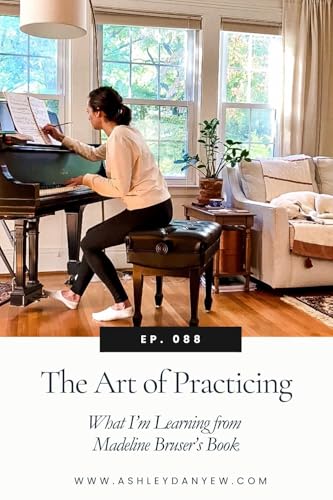
  • 088 - The Art of Practicing: What I’m Learning from Madeline Bruser’s Book
    Oct 8 2025

    This fall, I read two books about practicing: The first is Madeline Bruser’s, The Art of Practicing: A Guide to Making Music from the Heart. The second is Molly Gebrian’s 2024 release, Learn Faster, Perform Better: A Musician's Guide to the Neuroscience of Practicing.

    Art and science. Because practicing requires both.

    This is part 1 of a 2-part series about practicing and what I’m learning and applying from both books.

    In this episode, part 1, we’ll talk about the art of practicing. I’ll share what I’m learning from Madeline Bruser’s book and how I’m carrying these concepts and strategies into my practice sessions and studio.

    For show notes + a full transcript, click here.

    Resources Mentioned

    Disclosure: some of the links in this episode are affiliate links, which means if you decide to purchase through any of them, I will earn a small commission. This helps support the podcast and allows me to continue creating free content. Thank you for your support!

    The Art of Practicing: A Guide to Making Music From the Heart (Madeline Bruser)

    Learn Faster, Perform Better: A Musician’s Guide to the Neuroscience of Practicing (Molly Gebrian)

    Join the Musician & Co. Book Club (it’s free!)

    Well-Tempered Clavier, Volume 1 (J.S. Bach)

    The Perfect Wrong Note: Learning to Trust Your Musical Self (William Westney)

    Ep. 060 - How Do We Approach Mistakes in Music Teaching & Learning?

    If you enjoyed this episode, please leave a review in Apple Podcasts.

    Find me on Instagram: @ashleydanyew

    Whenever you’re ready, here are three ways we can work together:

    1️⃣ Need fresh teaching ideas? Schedule a quick 25-min. call and we’ll brainstorm on a topic of your choice. Build an idea bank that you can pull from in the months to come.

    2️⃣ Have questions about teaching or managing your music career? Book a 60-min call and get personalized advice, creative ideas & step-by-step strategies on up to 3-4 teaching/business topics.

    3️⃣ Develop the skills and strategies you need to plan the year, refine your teaching methods, and manage your time more effectively with a suite of online courses and professional development trainings.

    Show More Show Less
    16 mins
  • 087 - 9 Creative Lesson Activities You Can Do with a Broken Arm
    Sep 10 2025
    It was about this time last year when I got a panicked email from a parent: “Jack broke his left wrist this week. What does this mean for piano? He’s in a cast.”Has this ever happened to you? Some parents may assume that lessons need to be paused during this time. I mean, they can’t play with only one hand… or can they?The answer is yes, and there’s more and more one-handed repertoire available. With a broken foot, we can focus on repertoire that doesn’t use the pedal, or they can learn to pedal with their left foot for a few weeks.But more importantly, what I want to convey to parents (and students) is that playing is only one facet of musicianship. There are so many other things we do in lessons, so many other skills we’re working to develop. It reminds me of something Frances Clark once said, “Teach the student first, the music second, and the piano third.”Today, I’m sharing a list of nine lesson activities you can do with a broken arm. Some of these are specific to piano, but some are relevant no matter what instrument you teach. I hope the next time you find yourself in a situation like this, you’ll have just what you need to continue learning and making music together.For show notes + a full transcript, click here.Resources Mentioned*Disclosure: some of the links in this episode are affiliate links, which means if you decide to purchase through any of them, I will earn a small commission. This helps support the podcast and allows me to continue creating free content. Thank you for your support!Sight-Reading and Rhythm Every Day (Helen Marlais)Rhythm Keeper, Vol. 1 (Samantha Steitz & Steve Aho)Ep. 059 - 7 Ways to Practice RhythmEp. 026 - My Favorite Aural Skills Games + ActivitiesEp. 085 - Everyone Can ImproviseEp. 083 - Bernstein and Bill EvansIf you enjoyed this episode, please leave a review in Apple Podcasts >>Find me on Instagram: @ashleydanyewWhenever you’re ready, here are three ways we can work together:1️⃣ Need fresh teaching ideas? Schedule a quick 25-min. call and we’ll brainstorm on a topic of your choice. Build an idea bank that you can pull from in the months to come.2️⃣ Have questions about teaching or managing your music career? Book a 60-min call and get personalized advice, creative ideas & step-by-step strategies on up to 3-4 teaching/business topics.3️⃣ Develop the skills and strategies you need to plan the year, refine your teaching methods, and manage your time more effectively with a suite of online courses and professional development trainings
    Show More Show Less
    12 mins
  • 086 - Teaching Keyboard Skills to Students of All Ages
    Aug 20 2025
    Learning to play the piano isn’t just about learning repertoire pieces. It’s about developing a set of keyboard skills that lets you make music anywhere, with anyone, in any style. Technique, performance, and sight-reading are part of it, but so are harmonization, transposition, chord knowledge, and voice-leading. It’s more than the ability to perform what’s on the page; it’s understanding how the music is made.In this episode, I’ll share why keyboard skills matter for students of all ages and a few strategies I’m using in my studio to build them into lessons from the very first year of study.For show notes + a full transcript, click here.Resources Mentioned*Disclosure: some of the links in this episode are affiliate links, which means if you decide to purchase through any of them, I will earn a small commission. This helps support the podcast and allows me to continue creating free content. Thank you for your support!RCM Piano SyllabusPiano Safari Repertoire Book 1Diversions (Juan Cabeza)Piano Safari FriendsPiano Safari Sight-Reading CardsSight-Reading and Rhythm Every Day (Helen Marlais)Rhythm Keeper, Vol. 1 (Samantha Steitz & Steve Aho)Ep. 085 - Everyone Can ImproviseThrough the Windowpane (Chee-Hwa Tan)A Child’s Garden of Verses (Chee-Hwa Tan)Free download: 12 Variations on Diversion 12 (Juan Cabeza)Create First! Duet (Forrest Kinney)Free download: 27 Easy Chord Progressions (Tim Topham)If you enjoyed this episode, please leave a review in Apple Podcasts >>Find me on Instagram: @ashleydanyewWhenever you’re ready, here are three ways we can work together:1️⃣ Need fresh teaching ideas? Schedule a quick 25-min. call and we’ll brainstorm on a topic of your choice. Build an idea bank that you can pull from in the months to come.2️⃣ Have questions about teaching or managing your music career? Book a 60-min call and get personalized advice, creative ideas & step-by-step strategies on up to 3-4 teaching/business topics.3️⃣ Develop the skills and strategies you need to plan the year, refine your teaching methods, and manage your time more effectively with a suite of online courses and professional development trainings
    Show More Show Less
    16 mins
  • 085 - Everyone Can Improvise (+ 3 Examples From My Studio)
    Jul 23 2025
    When I was in grad school, I took an elective class on Improvisation. I remember shuffling into the 3rd-floor classroom that first day, pulling a blue chair into the semicircle like everyone else, unfolding the desk and preparing to take notes. Everyone was quiet. There was a palpable uncertainty among the group—all classical musicians by training. When had we ever been asked to improvise? No one wanted to be put on the spot.We started by talking about where to start with improvisation. “Improvisation is something we can all do,” our professor, Dr. Christopher Azzara began. “We’re born improvisers.”The challenge sometimes is trusting that creative process. Trusting that we have something interesting and musical to say.Improvisation is a skill like anything else; it can be learned and developed. Of course, there’s safety in writing it down, but learning the fundamentals of improvising and giving yourself time to experiment and practice this can be really fulfilling, especially in teaching.Today, I’m sharing a few simple ways to build improvisation into your teaching practice in meaningful ways, even if it’s new to you. You’ll learn what improvisation is and how to get started, how to find inspiration and musical ideas, and activities to do with your students in lessons. I’ll also share a few examples and recordings from my studio recently.For show notes + a full transcript, click here.Resources Mentioned*Disclosure: some of the links in this episode are affiliate links, which means if you decide to purchase through any of them, I will earn a small commission. This helps support the podcast and allows me to continue creating free content. Thank you for your support!Developing Musicianship Through Improvisation, Book 1(Azzara & Grunow)A Systematic Introduction to Improvisation on the Pianoforte(Czerny)Piano Safari Repertoire Book 1Ep. 066 - A Winter Improvisation Prompt for Elementary Piano StudentsPiano Safari Repertoire Book 2Lyric Preludes in Romantic Style(William Gillock)“Chromatic Monochrome” in Moving Pictures (Naoko Ikeda)Ep. 021 - How to Use Praise With IntentionEp. 036 - Let’s Talk About ImprovisingIf you enjoyed this episode, please leave a review in Apple Podcasts >>Find me on Instagram: @ashleydanyewWhenever you’re ready, here are three ways we can work together:1️⃣ Need fresh teaching ideas? Schedule a quick 25-min. call and we’ll brainstorm on a topic of your choice. Build an idea bank that you can pull from in the months to come.2️⃣ Have questions about teaching or managing your music career? Book a 60-min call and get personalized advice, creative ideas & step-by-step strategies on up to 3-4 teaching/business topics.3️⃣ Develop the skills and strategies you need to plan the year, refine your teaching methods, and manage your time more effectively with a suite of online courses and professional development trainings
    Show More Show Less
    20 mins
  • 084 - Recital Recap & Year-End Reflection
    Jun 18 2025
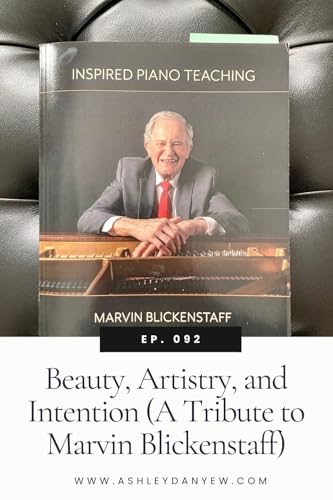
    Earlier this month, I hosted my 14th studio piano recital. There’s always so much that goes into planning and preparing for an event like this:Choosing repertoireBooking the venuePolishing memoryEmailing parentsPracticing “piano bows”Coordinating with the facilities manager and the piano tunerBorrowing percussion instruments from the music teacherScheduling duet and ensemble rehearsalsFinalizing and printing programsPlanning a receptionWe spend months learning the music and practicing performing. What happens if you play a wrong note or miss a key change? What happens if you forget the repeat or play the first ending twice?We discuss arm movement and phrase shapes, articulation, and projection, and how it feels and sounds different in the big theater vs. the classroom where we have our lessons. We listen and observe. Today, I’m sharing my own recap and reflection on this year’s recital—how it went, what I learned, what I observed, and how it’s shaping my teaching practice for the year ahead.For show notes + a full transcript, click here.Resources Mentioned*Disclosure: some of the links in this episode are affiliate links, which means if you decide to purchase through any of them, I will earn a small commission. This helps support the podcast and allows me to continue creating free content. Thank you for your support!Ep. 070 - The 3-Month Recital PlanEp. 064 - How I Plan a Year of Student RepertoireCircus Sonatinas (Chee-Hwa Tan)Through the Windowpane and A Child’s Garden of Verses(Chee-Hwa Tan)The Simpsons ThemeCelebrated Lyrical Solos, Book 1 and Celebrated Virtuosic Solos, Book 5(Robert Vandall)Inspired Piano Teaching (Marvin Blickenstaff)Piano Safari Repertoire Level 2“Criss Cross” (Florence Price)Musikal HuskyEp. 081 - Celebrating Women in Music: An Inside Look at Our Studio InformancesEp. 077 - A New Approach to Teaching Group ClassesEp. 071 - 3 Things I Learned From Hosting a Musical InformanceIf you enjoyed this episode, please leave a review in Apple Podcasts >>Find me on Instagram: @ashleydanyewWhenever you’re ready, here are three ways we can work together:1️⃣ Need fresh teaching ideas? Schedule a quick 25-min. call and we’ll brainstorm on a topic of your choice. Build an idea bank that you can pull from in the months to come.2️⃣ Have questions about teaching or managing your music career? Book a 60-min call and get personalized advice, creative ideas & step-by-step strategies on up to 3-4 teaching/business topics.3️⃣ Develop the skills and strategies you need to plan the year, refine your teaching methods, and manage your time more effectively with a suite of online courses and professional development trainings
    Show More Show Less
    17 mins
  • 083 - Bernstein & Bill Evans: Inside My Recent Intermediate Studio Class
    May 14 2025

    It starts simply. Two blocked jazz chords with I-V in the bass. And then the vocalist comes in:

    “Twenty-four hours can go so fast. You look around, the day has passed…”

    This is Leonard Bernstein’s song “Some Other Time” with lyrics by Betty Comden and Adolph Green, written for the 1944 musical, On the Town. It’s about three sailors on 24-hour leave in New York City who meet three women before leaving for war. Four characters perform this song (in the stage version), hoping to catch up some other time, but knowing they may never see each other again.

    I first heard this song a few weeks ago on Bill McGlaughlin’s weeknight radio show, Exploring Music. We’ve been listening to this show for over 16 years—we have it on while we cook and eat dinner.

    A few weeks ago, he did a series called “Dona Nobis Pacem (Grant Us Peace).” Nestled in the middle of the Wednesday night program, he paired Bernstein’s “Some Other Time” with jazz pianist Bill Evans’ improvised solo piano recording, “Peace Piece.”

    I was captivated.

    I got up from the dinner table and went to the piano to find the two chords by ear, playing along gently with the recording.

    Today, I’m taking you behind the scenes of these two pieces of music—exploring how they’re made, what they have in common, and how hearing them played back to back inspired a listening and improvisation project in my intermediate-level studio class last month.

    For show notes + a full transcript, click here.

    Resources Mentioned

    “Some Other Time” (Bernstein)

    Exploring Music with Bill McGlaughlin

    “Peace Piece” (Bill Evans)

    The Profound Impact of Peace Piece – Bill Evans Time Remembered Documentary Film

    “Flamenco Sketches” (Miles Davis)

    “It’s Been a Long, Long Time” (Harry James)

    “Put on Your Sunday Clothes” (Wall-E)

    “It Only Takes a Moment” (Wall-E)

    Ep. 042 - What Does It Mean to Be a Teacher-Facilitator?

    Get a free 15-minute consult with me

    If you enjoyed this episode, please leave a review in Apple Podcasts >>

    Find me on Instagram: @ashleydanyew

    Whenever you’re ready, here are three ways we can work together:

    1️⃣ Need fresh teaching ideas? Schedule a quick 25-min. call and we’ll brainstorm on a topic of your choice. Build an idea bank that you can pull from in the months to come.

    2️⃣ Have questions about teaching or managing your music career? Book a 60-min call and get personalized advice, creative ideas & step-by-step strategies on up to 3-4 teaching/business topics.

    3️⃣ Develop the skills and strategies you need to plan the year, refine your teaching methods, and manage your time more effectively with a suite of online courses and professional development trainings

    Show More Show Less
    18 mins