Finding Market Gaps: Business & Product Ideas cover art

Finding Market Gaps: Business & Product Ideas

Finding Market Gaps: Business & Product Ideas

Written by: AutoPod.co
Listen for free

About this listen

Deep research turned into audio articles on untapped market gaps and the business and product ideas that could fill them. Each episode dives into a specific gap in a real industry — analyzing the opportunity, the demand, and how it could be turned into a viable business or product. Whether you're an entrepreneur looking for your next move or an investor scanning for opportunities, we do the research so you can focus on taking action. New episodes published regularly — subscribe and never miss a market gap worth exploring.

© 2026 AutoPod.co
Economics Leadership Management Management & Leadership
Episodes
  • Synthetic Data Marketplaces: Trust, Quality, and Certification Gaps
    May 9 2026

    Read the full article: Synthetic Data Marketplaces: Trust, Quality, and Certification Gaps

    Discover more at Market Gap Business and Product Ideas

    Excerpt:

    Synthetic Data Marketplaces: Trust, Quality, and Certification Gaps

    The synthetic data market is booming but still immature, and many buyers remain wary. Firms are investing heavily – one analysis projects the global synthetic data market to grow from a few hundred million dollars in 2024 to well over \$1 billion by 2025 (quickmarketpitch.com) – buoyed by demand for AI training and privacy-safe data. Synthetic datasets, which “mimic real-world data while breaking direct links to sensitive information” (innodata.com), promise dramatic cost reduction and privacy benefits. They are increasingly used in AI model training, advanced analytics, and testing across industries (particularly healthcare, finance, and automotive) (quickmarketpitch.com). Yet alongside this growth, buyers often distrust synthetic data: they worry about data quality (will models trained on it be accurate?), representativeness (are rare cases or subpopulations captured?), and legal safety (could it still violate privacy or IP laws?).

    ... Continue reading

    Show More Show Less
    17 mins
  • Construction and AEC: AI for Bid Estimation and Safety Compliance
    May 2 2026

    Read the full article: Construction and AEC: AI for Bid Estimation and Safety Compliance

    Discover more at Market Gap Business and Product Ideas

    Excerpt:

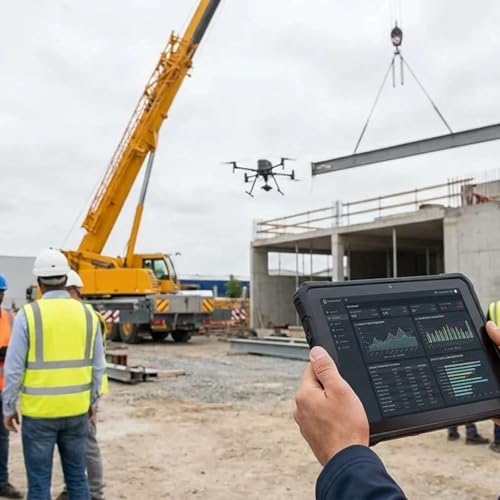
    Introduction Construction projects suffer from costly inefficiencies in both bid estimation and site safety. Manual takeoffs and paperwork leave estimators bogged down in spreadsheets and drawing markups rather than high-value planning (www.planmetry.com). Safety managers rely on periodic inspections and reactive reporting, even though construction remains one of the nation’s most dangerous industries (arxiv.org). By contrast, artificial intelligence (AI) and computer vision offer the promise of automating tedious tasks, catching hazards in real time, and surfacing hidden risks (www.mckinsey.com) (www.mckinsey.com). This article outlines a vision for end-to-end AI in construction: from extracting material quantities on plans, to predicting site hazards, to enforcing regulatory compliance – all integrated with tools like Procore, Autodesk Construction Cloud, and back-office ERP systems. We also discuss mobile-first interfaces for foremen, estimate costs and ROI, and address data ownership and liability concerns.

    Bid Estimation Challenges Bid estimation in construction is painfully manual. Estimators often spend the majority of their time on routine takeoff work – opening CAD/PDF drawings, calibrating scales, measuring lengths and areas, and counting symbols (www.planmetry.com). Industry surveys indicate that an estimator may waste 60–80% of their day on tasks like data entry and reformatting (www.bidicontracting.com). For example, one analysis notes: “Every hour your estimator spends manually counting doors and windows is an hour they’re not reviewing scope or optimizing pricing” (www.bidicontracting.com).

    ... Continue reading

    Show More Show Less
    23 mins
  • AI for Emerging Markets: Offline-First Models and Low-Cost Devices
    Apr 28 2026

    Read the full article: AI for Emerging Markets: Offline-First Models and Low-Cost Devices

    Discover more at Market Gap Business and Product Ideas

    Excerpt:

    Introduction

    Artificial intelligence (AI) offers huge promise for development, but digital divides in emerging markets pose real obstacles. In many low-income regions, internet connections are slow, coverage is patchy, and electricity is unreliable. For example, GSMA finds that in Sub-Saharan Africa only about 27% of people use mobile internet and a 60% “usage gap” remains – millions live within coverage but cannot go online due to high device, data or skill barriers (www.gsma.com). Africanews reports that roughly 900 million Africans still lack any internet access, and a similar number lack electricity (www.africanews.com). Meanwhile internet data in some countries costs over 5% of a monthly income (evolutionafricamagazine.com). In this context, cloud-based AI (like large chatbots) is simply out of reach for most.

    ... Continue reading

    Show More Show Less
    23 mins
adbl_web_anon_alc_button_suppression_c
No reviews yet