• The Climate of Our Moral Character | Energy, Capital, and Human Well-Being
    Feb 16 2026

    Climate, Energy, Morality, and How We Thrive as a Species on a Finite Planet

    We tell ourselves stories to help us cope with existence, but too often we bend our stories to fit a misguided, destructive, and utterly unsustainable worldview.

    In this revised audio version of a 2019 article I published in Medium, we begin with a tight shot on Venezuela and the Trump administration’s recent military action and claim to its oil. From there, we slowly pan back and consider the moral grounding of a civilization convinced of its “God-given” right to extract, destroy, and dominate, if it means there is more energy to burn.

    We can find a better way to live, one based on our fundamental, biological morality.

    Resources:

    1. The Climate of Our Moral Character on Medium
    2. Deliver Us From Evil: How Biology, Not Religion, Made Humans Moral
    3. Greta Thunberg UN Speech Transcript
    4. Politico: Energy secretary plans visit to Venezuela — but says Trump isn’t focused on its oil riches
    5. CNBC: What Big Oil Executives Told Trump About Investing in Venezuela
    6. Top 10 Countries with the Largest Confirmed Oil Reserves
    7. Earthbound Podcast Home
    8. GlobalWarmingisReal.com

    Show More Show Less
    10 mins
  • Climate and Peace | Lessons of Minneapolis
    Feb 11 2026

    This bonus episode features a short reading from my Thinking Out Loud section of my newsletter.

    Is empathy a strength or a weakness? How do we respond to forces that hide behind masks and seek to coerce, intimidate, and terrorize? In the midst of the chaos, how do we make sense of living in a warming world?

    There are lessons we can learn from the citizens of Minneapolis as they resist the masked men and their grasp at power, and from their efforts to maintain an unjust world, exemplifying the power of community, compassion, and empathy. These are the qualities that will lead us into a thriving future.

    As Bad Bunny says, love is stronger than hate.

    Sign up for my newsletter for more!

    Show More Show Less
    4 mins
  • Bill McKibben: Here Comes the Sun and How Renewables Can Power the Future
    Jan 28 2026

    What if the sun, the same star that’s powered life on Earth for billions of years, could finally free us from the fossil fuel stranglehold that’s choking our future?

    That’s the question at the heart of this episode’s conversation with legendary climate activist and author Bill McKibben. In his latest book, Here Comes the Sun, McKibben delivers a message that's equal parts urgent and unexpectedly hopeful: after decades of fighting uphill against Big Oil, the economics of energy have fundamentally shifted, despite the rhetoric from vested interests and their bought-and-paid-for politicians.

    In 2024, more than 90% of new electricity generation globally came from renewable sources. Solar and wind aren’t “alternative" energy anymore, say McKibben, they are the future, and they're already cheaper, cleaner, and increasingly more accessible than fossil fuels. But the window to capitalize on this epochal shift is narrow, and the fossil fuel industry knows it, which is why they’ve purchased political power to protect their dying business model.

    McKibben doesn’t sugarcoat the climate crisis—he knows too much about the science for that. We've already locked in significant warming, and we won't stop short of 2 degrees Celsius. But he argues passionately that we're in a race to shave off every tenth of a degree we can, because each one represents 100 million people pushed out of livable climate zones.

    My conversation with McKibben explores practical, real-world solutions that are scalable right now: heat pumps, induction cooktops, electric vehicles, and even balcony solar panels that renters can plug directly into their walls. From California’s grid running on over 100% renewable energy during peak hours to China’s EV revolution eating the world’s lunch while America’s political leaders serve it up on a silver platter, McKibben paints a picture of a world in transition.

    This isn’t a conversation about distant doom or abstract policy—it’s about the tangible, human-scale changes we can make right now, and the massive structural shifts already underway that prove rapid transformation is possible. McKibben’s clear-eyed honesty about where we are, combined with his grounded optimism (though he says he isn’t an optimist) about what we can still do, offers a roadmap illuminated by the sun itself. The question isn’t whether the technology exists to save ourselves. It does. The question is whether we’ll choose to use it before it's too late. If you've ever felt paralyzed by the scale of the climate crisis, this episode will remind you that, even as we have backed ourselves into a corner, we have a brightly lit, if narrow, path out.

    Takeaways:

    1. Bill McKibben highlights the shift in energy economics where renewable sources are now cheaper than fossil fuels, marking a pivotal moment for climate action.
    2. The podcast emphasizes our deep connection to the sun, both biologically and emotionally, making renewable energy not just feasible but a natural choice for humanity.
    3. McKibben’s journey through climate activism illustrates how grassroots movements can reshape global agreements like the Paris Accord, showcasing the power of collective action.
    4. The conversation underscores that transitioning to solar and wind energy is not merely an alternative but the primary path forward for sustainable
    Show More Show Less
    33 mins
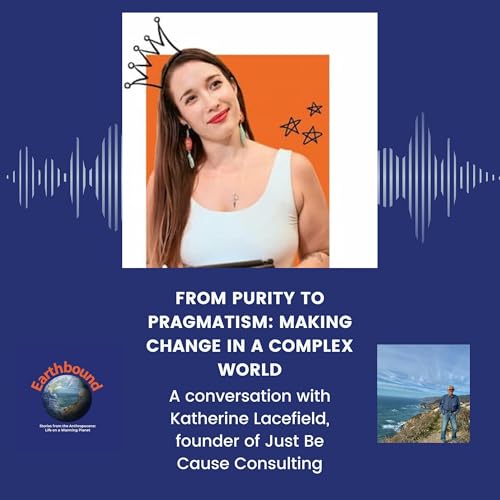
  • Katherine Lacefield: From Purity to Pragmatism
    Jan 10 2026

    In a world of either-or thinking, where you’re expected to choose between hugging trees or hugging flags, Katherine Lacefield offers a refreshing alternative. The founder of Just Be Cause Consulting and host of the Just Be Cause Podcast joins us to dismantle the false binaries that plague environmental and animal rights movements. With candor and hard-won wisdom, she shares her journey from "crazy vegan" activism to a more nuanced understanding of how we create lasting change. Katherine reminds us that perfection isn’t the goal—connection is. Whether it’s a well-meaning mother buying the wrong cheese or an environmentalist grilling a steak, shaming people for imperfection only pushes potential allies away. The real work, she argues, lies in meeting people where they are and recognizing that caring about animals doesn’t mean you don’t care about people, and vice versa.

    Katherine’s extensive experience in nonprofit fundraising and philanthropy reveals a sector struggling with siloed thinking and resource distribution problems masquerading as resource scarcity. She challenges the philanthropic status quo, questioning why massive endowments sit in perpetuity while urgent environmental crises demand action now. Her vision for the future involves wealth transfer that empowers nonprofits to focus on impact rather than endless grant applications, and a cultural shift away from ego-driven legacy projects toward collaborative, intersectional problem-solving. From her travels across continents to her work with organizations bridging human and animal welfare, Katherine has witnessed firsthand how interconnected our challenges truly are—and how collaboration, not competition, offers our best path forward.

    This conversation tackles the uncomfortable truths about consumption, privilege, and the paralyzing fear of not doing enough. Katherine doesn’t offer easy answers because there aren’t any. Instead, she provides something more valuable: permission to be imperfect, encouragement to contribute according to your unique passions and bandwidth, and a framework for understanding that we don't have a resource problem—we have a distribution problem. In a time when despair and division seem to dominate the discourse, Katherine’s message is one of pragmatic hope rooted in gratitude, awareness, and the recognition that every authentic effort, no matter how small, matters.

    Takeaways

    1. In this episode, we explored the false dichotomy between environmental stewardship and human well-being.
    2. Kathryn Lacefield reminds us that pursuing purity in activism can alienate potential allies, leading to a counterproductive cycle of division.
    3. We discussed how viewing whatever motivates us as isolated issues neglects the deep connections among justice, environmental stewardship, and human well-being.
    4. The conversation highlighted the importance of empathy and collaboration in tackling climate challenges, reminding us that progress requires collective effort.

    Resources

    1. Just Because Consulting
    Show More Show Less
    51 mins
  • Blood and Cigarettes: The Christmas Truce of 1914-Finding Peace on Common Ground
    Dec 23 2025

    With this bonus holiday episode, I revisit a short article I originally wrote for a now-defunct website and republished on Medium back in 2022. Blood and Cigarettes takes us back to Christmas Eve and the trenches of World War I, and how redemption can be found in the unlikeliest of places.

    Ever since I heard the story of the Christmas Truce of 1914, it has intrigued me. The poignant tale of the 1914 Christmas Truce serves as a powerful reminder of our shared humanity, even amidst the chaos of war. This was not a truce fiercely negotiated by generals miles from the front, but an impromptu laying down of arms by the battered grunts in the trenches. The collective power of the human spirit reached across the barren no man’s land, transforming it into common ground.

    Standing shoulder-to-shoulder with their erstwhile enemies, they offered each other cigarettes, sang Christmas carols, and played football. The next day, they could return to war. Tonight was a different story.

    I keep coming back to this story at this time of year (especially this year) because it starkly illustrates the power of storytelling and mythmaking. Myth is not falsehood. We navigate the long night of winter, the dark solstice, with a tapestry of stories and myths patched together through the weaver of time. One thread that weaves its way through them all is our shared humanity. Try as one ideology or another would reject any common association with the other, it is there, a single fiber that binds us together even as we crouch in our trenches of imagined division.

    Can we not find inspiration in this tale, questioning our own narratives and the divisions they create? I challenge myself and you, dear listener, to seek common ground, to understand that we all inhabit this planet together, and to embrace our shared humanity.

    A New Name for Season Two

    As we conclude season one of the podcast, we are transitioning to our new name, Earthbound.

    We have many more great interviews and thought-provoking episodes in store for the new season.

    Thank you for listening.

    Takeaways:

    1. The 1914 Christmas truce during World War I exemplified humanity's capacity for empathy amidst conflict.
    2. Myths and narratives shape our lives, influencing our values, purpose, and ultimately our actions.
    3. In a poignant moment, soldiers from opposing sides united in the spirit of Christmas, transcending their enmity.
    4. The human condition is a constant struggle between our better angels and darker impulses, especially in times of strife.
    5. This holiday season, we are reminded of our potential to be a light in the darkness, just as those soldiers were.
    6. The fleeting peace of the Christmas truce highlights the importance of finding common ground in divisive times.

    Resources:

    The Story of the 1914 Christmas Truce

    Show More Show Less
    5 mins
  • Joshua Harrison: Art, Science, and Reconnecting with Our Roots in a Modern World
    Dec 13 2025
    What Would The Ocean Say If You Could Ask It A Question?

    Exploring the intersection of art, science, and environmental activism, this episode features thought provoking conversation with Joshua Harrison, director of the Center for the Study of the Force Majeure based at the University of California, Santa Cruz.

    The art-science environmental research collaborative challenges us to rethink our relationship with the planet and provoke us into thinking beyond the status quo and our long-held assumption about how the world works and our relationship to it. Harrison's work lives at the edges: the intersection of disciplines, the boundaries between land and water, and the uncomfortable space between what we know and what we choose to ignore. Through immersive installations like the Sensorium for the World Ocean and community-based fire ecology projects with indigenous partners, Harrison is pioneering new ways to help us feel—not just understand—our impact on the world that sustains us.

    Harrison unpacks why our modern disconnection from nature isn't just a philosophical problem, but a practical crisis with deadly consequences. From the urban heat island effect claiming thousands of lives to overgrown forests fueling catastrophic wildfires, he reveals how abandoning circularity, community, and indigenous wisdom has left us vulnerable to the very "acts of God" his center studies.

    Yet Harrison refuses to leave us in despair.

    He traces the history of American innovation and destruction—from victory gardens to planned obsolescence, from universal education to the current brain drain—while pointing to concrete solutions: greening cities to match pre-colonial temperatures, recovering cultural burning practices, and building appreciating assets rather than extracting depreciating ones. The conversation explores how California's fire management thinking has shifted dramatically in just five years, proving that rapid change is possible when we're willing to learn.

    You Are Not Alone, And You Don't Have To Be Perfect

    That's Harrison's message for anyone feeling overwhelmed by the scale of environmental crisis.

    He illustrates how mapping local resilience projects, connecting young people to place-based action, and finding the intersection of what you love, what you're good at, and what needs fixing offers a practical antidote to paralysis.

    As Gary Snyder reminds us: “Find your place in the world, dig in, and take responsibility from there.”

    Resources:

    • Center for the Study of the Force Majeure
    • Leaf Island
    • Joshua Harrison on LinkedIn

    Show More Show Less
    1 hr and 22 mins
  • Black (Cyber) Monday: How the Sausage is Made in an Instantaneous, Digital World
    Nov 30 2025
    How I Felt Ridiculous When I Ordered Same-Day Delivery

    In this short bonus episode, I briefly examine the complexities of modern consumerism and the often-overlooked hidden costs of our convenience-driven shopping habits. As we rush into another holiday shopping season, I revisit a 2018 article that explored the darker side of online shopping convenience, particularly during events like Cyber Monday.

    The rapid evolution of retail and escalating consumer expectations, from the demand for same-day delivery to the profound human cost on logistics and fulfillment workers, present a stark reality.

    We’ll hear poignant accounts from industry workers, revealing the grim conditions that often go unnoticed as we click “buy now." As consumers, our knowledge and awareness empower us to make conscious decisions about what, where, and how we shop.

    Takeaways:

    • The rapid convenience of online shopping has hidden costs, both financial and ethical, that we need to acknowledge.
    • Witnessing the human toll behind instantaneous deliveries can change our perspective on what convenience really costs us.
    • As consumers, we have the power to reshape expectations and demand better working conditions for retail workers.
    • The dark side of e-commerce reveals uncomfortable truths about logistics and labor that are often overlooked.
    • With increased awareness, we can make informed decisions about our consumption habits and their broader impacts.

    Resources:

    • New York Times: The Daily Podcast: The Human Toll of Instant Delivery
    • The Nation: Amazon’s Prime Sweatshop Is Nothing to Celebrate
    • Original article in Medium
    • GlobalWarmingIsReal.com


    Show More Show Less
    8 mins
  • Sustainability Isn't a Dirty Word: A Conversation With Sustainable Business Expert Lee Stewart
    Nov 22 2025

    The 1970s “Crying Indian” campaign, as it came to be known, with its poignant imagery and simple message about littering, has left an indelible mark on American culture.

    Yet, as we unpack the history and implications of this campaign, we discover that not all was as it appeared.

    It served as a brilliant marketing tactic by corporations to shift the onus of pollution onto individuals, effectively masking the real environmental damage caused by corporate practices. The origins of the Keep America Beautiful campaign reveal how it was strategically designed to deflect attention from industry-generated pollution and place the blame squarely on consumers.

    The campaign highlights the pernicious nature of greenwashing and its evolution into the modern business landscape, where companies often prioritize image over genuine environmental responsibility. Our guest, Lee Stewart, is the author of How to Build Sustainability Into Your Business Strategy: A Practical No-Nonsense Guide for Business Leaders.

    His work and book provide insight into how businesses can navigate this complex terrain. He emphasizes the need to shift from superficial sustainability claims to authentic action.

    Drawing from his extensive experience across various industries, Lee outlines practical steps for integrating sustainability into business operations. He advocates for a triple bottom line approach, where profit, people, and planet are equally prioritized, and urges business leaders to engage their teams in meaningful conversations about sustainability.

    Takeaways:

    • The iconic Crying Indian ad, while effective in reducing litter, also shifted blame onto individuals, diverting attention from corporate pollution.
    • Cody Iron Eyes, the face of the ad, wasn’t actually Native American, raising questions about authenticity in environmental messaging.
    • Authentic sustainability efforts must focus on systemic change rather than merely reducing individual litter, or they risk becoming greenwashing.
    • Lee Stewart advocates for actionable sustainability strategies that genuinely engage businesses to create long-term environmental benefits.
    • A robust sustainability strategy involves understanding the business’s impact, engaging employees, and aligning with customer expectations for a competitive edge.
    • The call for transparency in sustainability practices is growing, with frameworks, like Lee Stewart’s Triple C framework, requiring companies to disclose their carbon emissions and environmental impacts.

    Resources:

    • Lee Stewart Book, Bio, Media, and Press
    • Cody Iron Eyes and Keep America Beautiful
    • Global Warming is Real

    Show More Show Less
    43 mins