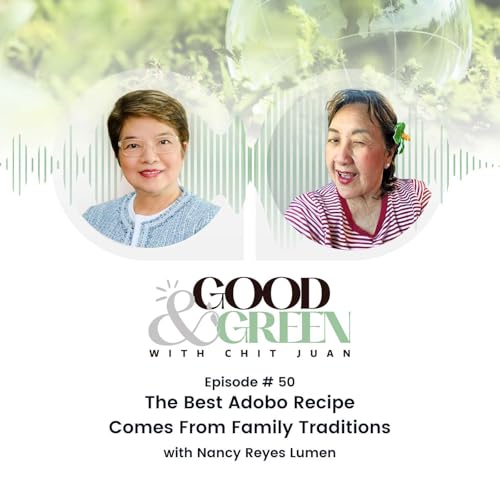
Good and Green cover art

Good and Green

Good and Green

Written by: Pacita Juan
Listen for free

About this listen

The Good and Green Podcast, hosted by sustainability advocate Chit Juan, was created for the purpose of helping social entrepreneurs overcome challenges and grow impactful ventures that drive meaningful change. Each week, we share the tools, strategies, and stories that empower changemakers to build businesses with purpose. Whether you're launching your dream social enterprise or looking for fresh inspiration, this podcast is your go-to space for practical insights and uplifting conversations. Let's create a brighter, more sustainable future together!


© 2026 Good and Green
Art Cooking Economics Food & Wine Leadership Management & Leadership Social Sciences
Episodes
  • Episode 50: The Best Adobo Recipe Comes From Family Traditions with Nancy Reyes Lumen
    May 4 2026

    Filipino food is deeply rooted in family, tradition, and everyday life. In this episode of Good and Green, Chit Juan sits down with food advocate and author Nancy Reyes-Lumen, also known as the “Adobo Queen,” to explore why adobo continues to be one of the most powerful symbols of Filipino identity. As part of a multigenerational food family, Nancy shares how recipes are passed down, adapted, and preserved over time. From sourcing ingredients directly from local producers to practicing zero-waste habits long before they became trends, this conversation highlights how our food traditions are shaped by history, culture, and survival. Nancy also reminds us that there is no single “correct” version of adobo and that the beauty of Filipino food lies in its diversity and personal stories.


    GUEST BIO:

    Nancy Reyes-Lumen is a Filipino food advocate, researcher, writer, and culinary ambassador best known as the author of the best-selling The Adobo Book. A passionate champion of Filipino cuisine, she is widely recognized as the self-proclaimed “Adobo Queen” for her mission to elevate adobo as a signature Filipino dish for global audiences. She has also written several other cookbooks, co-hosts the Adobo Connections segment of Our Awesome Planet, and teaches Filipino and Asian cooking classes as a chef instructor for Cozymeal USA. Based in Houston, Texas, Nancy continues to promote Filipino food heritage both in the Philippines and abroad.


    WHAT YOU’LL LEARN:

    • Why adobo is considered a strong symbol of Filipino identity and culture.
    • The role of family traditions in shaping and preserving Filipino recipes.
    • Why there is no single “correct” version of adobo.
    • How sourcing from local producers and artisans was practiced even in earlier generations.
    • Traditional Filipino practices such as fermentation and zero-waste cooking.


    QUOTES:

    • I'm just a good collector of adobo recipes and stories. —Nancy Reyes Lumen
    • The 4th and 5th generations are bringing in new taste, new ways, new techniques, but we still want to instill some of our Lola's ways. —Nancy Reyes Lumen
    • One of the healthy ways of having food is fermentation. —Nancy Reyes Lumen
    • You can standardize adobo for a global recipe, only if you use branded. Branded vinegar, branded soy sauce, branded everything. —Nancy Reyes Lumen
    • Alisin na natin ang "lang". —Nancy Reyes Lumen


    LINKS or RESOURCES MENTIONED:

    Connect with Nancy Reyes Lumen:

    • Nancy Reyes Lumen on Instagram
    • Nancy Reyes Lumen on Facebook
    • The Adobo Book by Nancy Reyes Lumen and Reynaldo Gamboa Alejandro


    Listen, rate, and subscribe!

    • Subscribe to the Good and Green Podcast on Apple Podcasts and Spotify
    • Follow Chit Juan on Instagram and Facebook, and LinkedIn
    • Subscribe to EchoNews on LinkedIn.

    Purchase Brew: Cafe, Coffee. Kape at Echostore.ph.

    For more information about Brew: Cafe, Coffee, Kape, visit the Food Writers Association of the Philippine Facebook Group.

    Show More Show Less
    28 mins
  • Episode 49: The Big Reasons Filipino Food Research Matters Today with Ige Ramos
    Apr 20 2026

    As Good and Green continues its celebration of Filipino Food Month, this second special episode goes deeper into the stories behind what we eat. Chit Juan sits down with independent food scholar and book designer Ige Ramos to explore how decades of fieldwork, writing, and cultural research shaped his understanding of Filipino foodways. Their conversation touches on ethical food writing, the value of traveling and listening deeply, how data can help shape better food policies, and why Filipino food should never be boxed into one “correct” definition. This episode is a thoughtful reminder that preserving our food heritage starts with curiosity, respect, and a willingness to look beyond the plate.


    GUEST BIO:

    Ige Ramos is an independent food scholar and book designer. For more than three decades, he dedicated his life to studying Filipino foodways, founding a practical knowledge laboratory and a platform for publishing and conducting independent research on edible design, food studies, and comparative gastronomy. His books examine how geography, technology, ingredients, and demographic shifts influence Filipino cuisine, taste, and flavor. He created gastronomy and cultural diplomacy training modules for the Departments of Foreign Affairs and Tourism, as well as reviewed food-related laws and public policies. He also created the framework for the Iloilo UNESCO Creative City for Gastronomy.


    WHAT YOU’LL LEARN:

    • How Ige’s journey from museum work and book design led him into Filipino food scholarship
    • Why Filipino food must be studied through culture, history, anthropology, and fieldwork
    • The ethics of food writing, from asking permission to protecting communities and sources
    • How food research can go beyond storytelling and help shape policy and systems change
    • Why Filipino food cannot be reduced to one “authentic” version


    QUOTES:

    • We always look at things in a broader perspective, in a broader sense that the Philippines did not exist in a vacuum. —Ige Ramos
    • Influences are not one way. It's two-way or multiple ways. What you bring in, it goes out. —Ige Ramos
    • There's a fine line between promotions and review criticism. —Ige Ramos
    • Hunger is real. There are certain food preferences available because of convenience, of need, of hunger. —Ige Ramos
    • Data is data is data. —Ige Ramos
    • Eat Filipino food not for the history because we don't know what is authentic. Eat Filipino food not for the culture because we're not exotic enough. Eat Filipino food because what you know about it is wrong. —Ige Ramos


    LINKS or RESOURCES MENTIONED:

    Connect with Ige Ramos:

    • Ige Ramos on Instagram
    • Ige Ramos on Facebook
    • Book: Lasa ng Republika 2: Bukambibig by Ige Ramos


    Listen, rate, and subscribe!

    • Subscribe to the Good and Green Podcast on Apple Podcasts and Spotify
    • Follow Chit Juan on Instagram and Facebook, and LinkedIn
    • Subscribe to

    Purchase Brew: Cafe, Coffee. Kape at Echostore.ph.

    For more information about Brew: Cafe, Coffee, Kape, visit the Food Writers Association of the Philippine Facebook Group.

    Show More Show Less
    30 mins
  • Episode 48: This Is What Makes Filipino Food Truly Filipino with Felice Sta. Maria
    Apr 6 2026

    Filipino food tells the story of who we are, and there’s no better time to reflect on that than during Filipino Food Month. In this episode of Good and Green, Chit Juan sits down with cultural heritage worker and food historian Felice Prudente Sta. Maria to explore the roots of Filipino cuisine, from pre-colonial ingredients and food traditions to the ways colonial influences were transformed into something distinctly our own. Their conversation delves into what authenticity truly means in Filipino cuisine, why our culinary identity has long been shaped by adaptation, and how supporting local and artisanal food today can help preserve the richness of our food heritage for generations to come.


    GUEST BIO:

    Felice Prudente Sta. Maria has been a cultural heritage worker for over 50 years and is a pioneering food historian known for studying the Philippine colonial era through written historical records. Her latest books, When Mangoes and Olives Met at the Philippine Table (National Historical Commission of the Philippines, 2025) and What Recipes Don’t Tell (Ateneo Press, 2025), offer rich insights into the evolution of Filipino food and culinary identity.


    WHAT YOU’LL LEARN:

    • Felice’s journey into food history
    • The roots of pre-colonial Filipino food
    • The truth about “authentic” Filipino cuisine
    • How Filipino food evolved through adaptation
    • Simple ways to sustain Filipino food heritage


    QUOTES:

    • If you see the list of pre-colonial foods, there's quite a lot we are still eating. That is important. —Felice Sta. Maria
    • The precolonial element of Filipino cuisine is still alive. —Felice Sta. Maria
    • Present day food culture is what is contemporary, and that contemporary food is a combination. —Felice Sta. Maria
    • Contemporary Filipino food is an extremely fine example of our innovation. —Felice Sta. Maria
    • We're at a very critical point in our food heritage sustainability. —Felice Sta. Maria
    • We must keep eating Filipino and support each other in our research and in our branding of what is the best of Filipino food. —Felice Sta. Maria


    LINKS or RESOURCES MENTIONED:

    Connect with Felice Sta. Maria

    • Book: When Mangoes and Olives Met at the Philippine Table by Felice Prudente Sta. Maria - https://nhcp-bookstore.beesuite.ph/product/when-mangoes-olives-met-at-the-philippine-table/
    • Book: What Recipes Don’t Tell by Felice Prudente Sta. Maria - https://unipress.ateneo.edu/product/what-recipes-don’t-tell-philippine-food-history-fifty-words
    • Felice Sta. Maria on Instagram - https://instagram.com/felicepstamaria
    • Felice Sta. Maria on Facebook - https://www.facebook.com/felice.p.maria/


    Listen, rate, and subscribe!

    • Subscribe to the Good and Green Podcast on Apple Podcasts and Spotify
    • Follow Chit Juan on Instagram and Facebook, and LinkedIn
    • Subscribe to

    Purchase Brew: Cafe, Coffee. Kape at Echostore.ph.

    For more information about Brew: Cafe, Coffee, Kape, visit the Food Writers Association of the Philippine Facebook Group.

    Show More Show Less
    34 mins
adbl_web_anon_alc_button_suppression_c
No reviews yet