Episodes

  • Why so few patients access palliative care, and how Empassion is addressing that | Robin Heffernan (Empassion)
    Apr 22 2026

    Hospice and palliative care remain widely misunderstood and underused, leading many seriously ill patients in their final year of life to endure unmanaged symptoms, little advance care planning, and avoidable ER visits and hospitalizations.

    Empassion CEO, Robin Heffernan, explains supportive care, distinguishing palliative care (any stage) from hospice (typically the last six months), and describes Empassion's model: contracting with payers so care is free to patients, curating a nationwide network of in-home providers, and using technology to coordinate care across teams in 45 states.

    The conversation covers large quality variation across 5,000+ hospice agencies, Empassion Assured as a near-real-time CMS-metrics resource to identify good vs bad actors, and why hospice fraud persists given fast access and payment rules.

    Robin also discusses hospice being carved out of Medicare Advantage, why carving it in could improve oversight, and lessons from prior CMS efforts.

    For more from Health Tech Nerds, subscribe to our weekly newsletters: https://www.healthtechnerds.com/subscribe

    Show More Show Less
    29 mins
  • From building an alternative health plan to powering them: what Yuzu learned and why they pivoted | Russell Pekala & Will Gillach
    Apr 21 2026

    Russell co-founded Yuzu as a health plan before pivoting to become the infrastructure layer powering alternative health plans.

    He walks through what the team learned building a plan from scratch: that technology alone doesn't differentiate, that the employers most in need aren't startups but cost-pressured blue-collar businesses, and that the real opportunity was in powering the plans already winning on price rather than competing with them.

    The conversation covers how alternative health plans are beating traditional major health plans through reference-based pricing, direct primary care, and navigated cash pay, and why those plans needed an all-in-one TPA and platform to operationalize it.


    Russell also discusses the $35M raise and the growing employer appetite for alternatives as healthcare costs continue to rise.


    For more from Health Tech Nerds, subscribe to our weekly newsletters: https://www.healthtechnerds.com/subscribe

    Show More Show Less
    18 mins
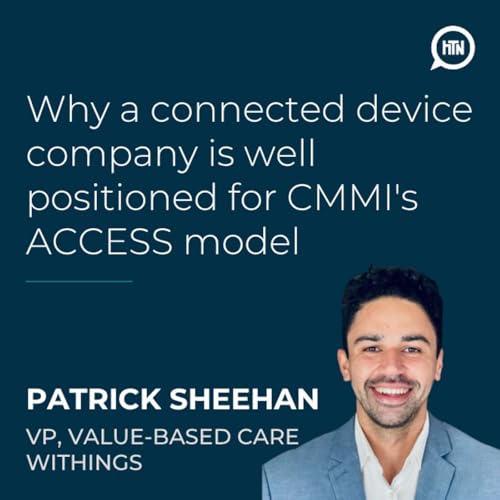
  • Why a connected device company is well positioned for CMMI's ACCESS model | Patrick Sheehan (Withings)
    Apr 21 2026

    Patrick Sheehan, VP of Value-Based Care at Withings, walks through why a connected device company sees the CMMI ACCESS opportunity differently than pure digital health players. For Withings, the device is the core cost structure, which changes the rate math entirely. Plus, their existing relationships with ACOs and health systems give them a coordination foundation that most ACCESS applicants are still figuring out.

    The conversation covers how Withings became a Medicare Part B provider, what they've built on top of their connected device offering to participate in ACCESS, and why Patrick believes the program only works if participants coordinate care back to PCPs and ACOs rather than going at it alone.

    Patrick also discusses patient choice as the most transformational design element of ACCESS, the fragmentation risk that comes with it, and how Withings is thinking about patient awareness and outreach as the program launches in July.


    For more from Health Tech Nerds, subscribe to our weekly newsletters: https://www.healthtechnerds.com/subscribe

    Show More Show Less
    16 mins
  • From AI scribing to clinical intelligence: how Abridge is expanding its role across the clinical encounter | Shiv Rao
    Apr 21 2026

    Shiv Rao, CEO and Co-Founder of Abridge, walks through how the company is expanding beyond AI scribing following new partnerships with JAMA and NEJM. He frames the expansion around a pre-visit, during-visit, and post-visit product framework, using the context captured across the full clinical encounter to surface relevant evidence and close workflow gaps at the right moment.

    The conversation covers how Abridge thinks about clinical intelligence as a reframe of clinical decision support. The old category was defined by rule-based alerts and popup fatigue. The new approach is contextual, surfacing cues grounded in medical literature without interrupting the clinical encounter. Shiv walks through a concrete cardiology example of how this works in practice.

    He also discusses go-to-market strategy, why Abridge started with large health systems and IDNs, and how being embedded at that level creates the opportunity to collapse adjacent workflows like CDI and prior authorization rather than layering AI on top of them.

    The conversation closes with where Shiv thinks AI impact shows up in healthcare, and why the gap between what clinicians feel and what the data shows is one of the most important problems the industry needs to solve.


    For more from Health Tech Nerds, subscribe to our weekly newsletters: https://www.healthtechnerds.com/subscribe

    Show More Show Less
    16 mins
  • Maternity care unbundling: why the global payment bundle is ending and what it means for innovation, costs, and access | Neel Shah (Maven Clinic)
    Apr 21 2026

    Neel Shah, Chief Medical Officer at Maven Clinic, breaks down one of the most consequential and underreported changes in healthcare payment: the end of the global maternity care bundle. For roughly 40 years, pregnancy and childbirth were paid for as a single bundled payment. Starting January 2027, care will be paid for through individual CPT codes.

    Neel walks through why the bundle is ending. Team-based care has made the original model increasingly difficult to administer, and the bundle was stifling innovation by failing to account for 40 years of technological change in maternity care. The unbundling is designed to be budget neutral, but budget neutral means some providers win and some lose, and the implications for rural practices and lower-risk pregnancies are real.

    The conversation also covers what employers and brokers should expect, why purchasers whose populations skew higher risk could see cost increases of up to 10%, and why Neel thinks this is a "slow burn" story that the industry is only beginning to process.


    For more from Health Tech Nerds, subscribe to our weekly newsletters: https://www.healthtechnerds.com/subscribe

    Show More Show Less
    17 mins
  • The Grand Roundup: Digital vs consumer health participation in ACCESS, maternity care unbundling, Abridge and clinical intelligence, Yuzu's pivot to power alternative plans, peptide market, price transparency, AI-driven risk adjustment funding, and more
    Apr 20 2026

    Kevin and Martin open with the CMMI ACCESS participant list. Roughly 150 applicants, but many original interested parties opted out presumably over rates, raising real questions about whether digital health can build a sustainable model at current payment levels. They also cover the FDA's peptide deregulation signals, and a price transparency study showing providers raised prices post-implementation, proving transparency alone doesn't fix the problem.

    Neel Shah, Chief Medical Officer at Maven Clinic, breaks down the end of a 40-year global maternity payment bundle, what's driving the change, how it creates room for innovation in team-based care, and the cost and access implications for vulnerable populations.


    Russell Pekala and Will Gillach from Yuzu walk through what the team learned building an alternative health plan from scratch and why they pivoted to become the TPA infrastructure powering them, covering how alternative plans are winning on price through reference-based pricing, direct primary care, and navigated cash pay.


    Shiv Rao, CEO and Co-Founder of Abridge, discusses the company's expansion beyond AI scribing into clinical intelligence, anchored by a pre-visit, during-visit, and post-visit product framework and new evidence partnerships with JAMA and the NEJM.


    Patrick, VP of Value-Based Care at Withings, closes with why a connected device company may be better positioned for CMMI ACCESS than pure digital health players, and how Withings is thinking about care coordination back to ACOs and PCPs as the program launches.


    Kevin and Martin close with risk adjustment AI funding. Keebler Health raised $16M and Joyful Health raised $22M, and both signal where AI is driving productivity in healthcare today.


    For more from Health Tech Nerds, subscribe to our weekly newsletters: https://www.healthtechnerds.com/subscribe

    Show More Show Less
    1 hr and 49 mins
  • Inside alternative plan design: the mechanics and behavior change driving employer cost savings | Craig Allen & Nancy Wang (Sidecar Health)
    Apr 17 2026

    Sidecar Health's approach is different from traditional health plans: set a fair price for every service and drug, give members that budget upfront, and let them keep a portion of the savings if they come in under it or pay the difference if they go over.

    Nancy Wang and Craig Allen, who lead strategy and actuarial at Sidecar, walk through how that model works, from the actuarial complexity of pricing every service and drug to the member education and behavior change required to make it work at the employer level.

    The conversation covers why mid-market employers facing 40-80% rate increases are increasingly open to alternative plan designs, what 20% medical cost savings through consumerism looks like in underwriting, and why the Trump administration's proposed no-network ACA rule is less disruptive than critics suggest, given Sidecar operates as a fully ACA-compliant plan today without a traditional network.


    They also touch on where the consumerism model could apply beyond the employer market, the shift in employer appetite from absorbing increases to demanding something different, and why the category of "alternative plan design" may not stay alternative for long.


    For more from Health Tech Nerds, subscribe to our weekly newsletters: https://www.healthtechnerds.com/subscribe

    Show More Show Less
    23 mins
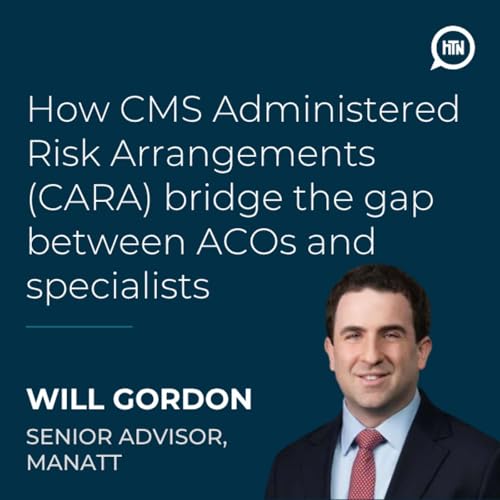
  • How CMS Administered Risk Arrangements (CARA) bridge the gap between ACOs and specialists | Will Gordon (Manatt Health)
    Apr 14 2026

    Will Gordon, senior advisor at Manatt Health and former CMMI Chief Informatics Officer, explains CARA (a voluntary component of the ACO REACH/LEAD model starting in 2027) and why it matters for value-based care in specialties.

    He outlines three converging themes: episode-based bundles—especially surgical/orthopedic—have shown savings (often from post-acute care); ACOs have struggled to operationalize bundles due to contracting, attribution, and reconciliation complexity; and specialists have largely remained outside value-based care.

    CARA aims to bridge these gaps by letting ACOs and specialists set up CMS-facilitated episode-based risk arrangements via a web-based portal, using predefined episodes or a customizable “max flex” option, while specialists continue billing fee-for-service and CMS performs retrospective reconciliation against target prices.

    The discussion also covers operational platform constraints, market-driven episode design, and the flow of funds in retrospective bundles.

    For more from Health Tech Nerds, subscribe to our weekly newsletters: https://www.healthtechnerds.com/subscribe

    Show More Show Less
    16 mins