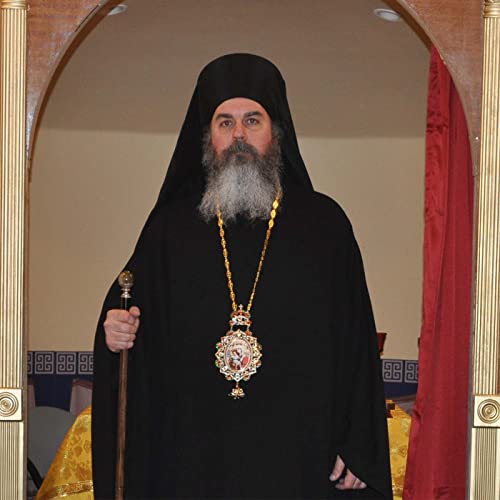
Hill Country Homilies cover art

Hill Country Homilies

Hill Country Homilies

Written by: Abp. Irineos
Listen for free

About this listen

Holy Annunciation Orthodox Church in Liberty Hill, Texas, located at the edge of the Texas Hill Country, brings you the weekly homilies from our clergy. Suited for Orthodox faithful and inquirers alike, join us for this weekly teaching on the Holy Scriptures and great saints of the Church.Copyright Abp. Irineos Spirituality
Episodes
  • No Parable: Works that Judge Us
    Feb 16 2026

    In this powerful sermon on Matthew 25, Abp. Irineos emphasizes a startling reality: Christ's description of the Last Judgment is not a parable but a direct account of how all nations will be judged. The Archbishop explains that while other teachings required parables to convey difficult truths, Christ spoke plainly about judgment. He outlines the stark criteria by which humanity will be separated into sheep and goats—feeding the hungry, giving drink to the thirsty, welcoming strangers, clothing the naked, and visiting the sick and imprisoned—actions done unto "the least of these" that Christ counts as done unto Himself. Challenging the "faith alone" doctrine, Abp. Irineos argues that while no deed merits salvation on its own, our works inevitably reveal our faith, echoing James's teaching that "faith without works is dead". Perhaps most movingly, he distinguishes between God's eternal intentions: the Kingdom was prepared for humanity "from the foundation of the world," while the fires of judgment were prepared only "for the devil and his angels"—a place where the condemned cast themselves through their own negligence, hard-heartedness and lack of love. The Archbishop's message is both sobering and hopeful: God asks us to see Christ in every person we encounter and to love our neighbor not abstractly, but through concrete acts of mercy.
    Show More Show Less
    19 mins
  • While You Were Yet Far Off: The Prodigal's Journey Home
    Feb 9 2026
    In today's homily, Abp. Irineos explores the Parable of the Prodigal Son, revealing how modern believers enter "the far country" not through physical distance but through spiritual separation from God. The message emphasizes that sin creates a separation "not one of separation of place, but by separation in point of virtue," and that we enter this spiritual exile through digital distractions, consumerism, and neglecting prayer. The homily offers profound hope by highlighting the father's unconditional love—running to meet his son "while he was yet a great way off"—demonstrating that God doesn't wait for perfect repentance but rushes toward us with healing love. Additionally, the teaching addresses the danger of becoming like the older brother, who represents religious pride and serves God while resenting others, reminding Orthodox Christians to celebrate every soul that returns to God rather than judge them. As believers prepare for Great Lent, this message calls them to recognize their own spiritual wandering, trust in God's limitless forgiveness, and embrace both humility in personal struggle and joy in others' repentance.
    Show More Show Less
    14 mins
  • Humility Over Pride: The Foundation of Orthodox Life
    Feb 7 2026
    In this homily, Abp. Irineos conveys that the Parable of the Publican and the Pharisee, read on the First Sunday of the Triodion, establishes the essential foundation for authentic Orthodox Christian living by contrasting pride with humility. The homily teaches that external religious practices—fasting, tithing, and meticulous observance—cannot justify us if they stem from pride, as exemplified by the Pharisee who exalted himself above others. In contrast, the despised tax collector's humble, contrite prayer—"God be merciful to me a sinner"—demonstrates the proper approach to God that leads to justification. As the faithful prepare for Great Lent, the Archbishop warns against allowing ascetical practices to become sources of pride or boasting, emphasizing that humility must ground all spiritual endeavors. The core message is clear: true confession and prayer require humility, contrition, and recognition of our complete dependence on God's mercy, not our own worthiness, for only through such childlike trust can we receive justification as a gift from God.
    Show More Show Less
    11 mins
No reviews yet