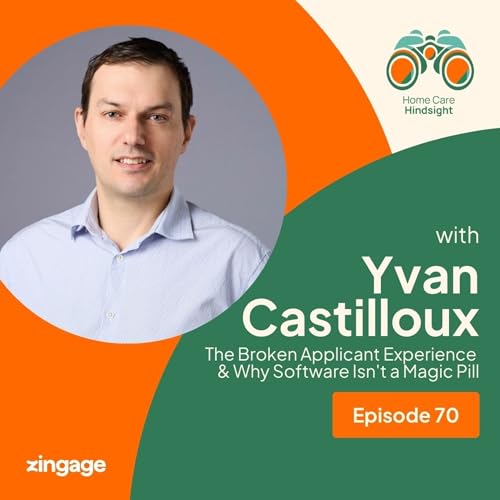
Home Care Hindsight cover art

Home Care Hindsight

Home Care Hindsight

Written by: David Knack
Listen for free

About this listen

Welcome to Home Care Hindsight, where we dive deep into the lessons learned and strategies developed by home care providers to build a resilient and dedicated workforce. Powered by Zingage, this podcast is your go-to resource for insights on retaining caregivers, reducing turnover, and optimizing your operations. Join us as we share real stories, expert advice, and practical tips that help you keep your caregivers happy and your business thriving.© David Knack 2024 Economics Hygiene & Healthy Living Management Management & Leadership
Episodes
  • Home Care Hindsight Book Club #1 - The Coaching Habit
    Feb 17 2026

    In this special solo episode and inaugural "book club" format, David Knack shares his journey from problem-solver to coach as his team at Zingage grows from one person to six. Facing the transition from customer-facing sales to internal leadership, David opens up about his struggle with being the "smartest guy in the room" and how The Coaching Habit by Michael Bungay Stanier transformed his approach.

    David walks through the seven essential questions that replaced his advice-giving habit with curiosity-driven leadership. He reveals why rhetorical questions disguised as coaching actually create the same dependency problems as direct advice, how silence became his most powerful tool, and why ending every one-on-one with "what was most useful for you?" unlocks strategic thinking in his team. This episode delivers practical frameworks for home care leaders navigating the shift from doing the work to leading the people who do the work.

    Lesson Takeaways:

    1. Stay Curious Just a Little Bit Longer: Resist the urge to jump into problem-solving mode. Ask one more question than feels comfortable, then embrace the silence. This builds team capacity and reduces your role as the "hit by a bus" problem.

    2. Kill Your Rhetorical Questions: Replace "have you tried..." with "what's the real challenge here for you?" to transform fake coaching into real development. Rhetorical questions are just advice with a question mark at the end.

    3. Make Help Requests Bounded: Ask "how can I help?" to get specific, limited requests instead of taking on five new tasks. This maximizes team ownership while minimizing what lands on your plate as a leader.

    4. End with Action and Reflection: Close every one-on-one with "what was most useful for you?" and "what's one action you'll take this week?" This builds strategic thinking habits and ensures conversations translate to results.

    5. Understand What They Really Want: Ask "what do you want?" to uncover intrinsic motivation. This creates alignment between personal priorities and role expectations, preventing burnout and boosting performance across your team.

    Timestamps:

    00:00 - Introduction: A new book club format for Home Care Hindsight

    03:13 - The shift from revenue-generating time to internal leadership

    06:09 - Creating cycles of dependence and the "hit by a bus" problem

    09:35 - The seven questions that transform your leadership approach

    12:24 - What's the real challenge here for you? Understanding the heart of issues

    15:01 - What do you want? Emily Isbell's story about promoting caregivers

    18:55 - If you're saying yes to this, what are you saying no to?

    21:09 - Practical applications: End every one-on-one with reflection and action

    Quotes:

    David Knack: "There's an immediate dopamine hit that comes with having somebody bring you a problem and making that problem go away pretty quickly. But it's more work on my plate and creates this cycle of dependence."

    David Knack: "Often I find myself saying, what if we [insert solution], or have you tried [insert solution]. I'm creating the same problem, but it's just kind of wrapped in a slightly different dressing."

    David Knack: "Advice is overrated. Curiosity is underrated. As soon as I feel like I've understood the situation enough, I give advice. That's not the best way to help my team grow and be really effective."

    Resources:

    1. The Coaching Habit by Michael Bungay Stanier: https://www.amazon.com/Coaching-Habit-Less-Change-Forever/dp/0978440749

    2. Connect with David Knack on LinkedIn: https://www.linkedin.com/in/david-knack/

    3. Powered by Zingage: https://zingage.com

    4. Watch this episode on Zingage's YouTube: https://www.youtube.com/@Zingage

    Show More Show Less
    23 mins
  • The Broken Applicant Experience & Why Software Isn't a Magic Pill — Yvan Castilloux
    Feb 3 2026
    Yvan Castilloux, Co-founder and CEO of Augusta.care joins host David Knack to discuss the fundamental challenges of recruiting in home care. Starting his journey in 2022, Yvan shares how discovering the "broken" applicant experience where half of potentially good candidates are confused and disengaged. This phenomenon motivated him to build solutions. He argues that solving home care's staffing problem requires aligning people, process, and technology, and debunks the myth of software as a "magic pill." The conversation dives into the critical need for sales and recruiting alignment, the surprising burnout rate among back-office staff (recruiters and schedulers), and why geographic and demographic focus is a superpower for agencies. Yvan also reflects on his biggest career mistake of reacting to every customer request instead of asking the right questions to build a unified solution, a lesson he now applies to help agencies hone their focus. Lesson Takeaways: 1. Fix the Broken Applicant Experience: Up to half of applicants are confused by generic job posts and agency messaging. Providing clear, specific information about the agency and the client match early in the process is key to engaging quality candidates. 2. Align Sales and Recruiting Strategically: Recruiting starts when sales begins. Agencies must align where they find clients with where they can successfully recruit caregivers, or risk constant fulfillment stress and recruiter burnout. 3. Embrace Focus as a Superpower: Trying to be everything to everyone dilutes effectiveness. Successful agencies consciously focus on a specific geography, client type (e.g., private pay), or caregiver demographic (e.g., students) and build their marketing and operations around it. 4. Software is a Tool, Not a Silver Bullet: Technology and AI enable automation but cannot replace the human-centric processes of home care. Success requires linking software to aligned internal operations. 5. Cross-Functional Insight Reduces Burnout: High turnover in back-office roles like scheduling is often due to burnout from inefficient, siloed processes. Enabling collaboration and data sharing between recruiters, schedulers, and sales creates a more sustainable and effective workflow. Timestamps: 00:00 – Introduction to the home care staffing challenge 01:10 – Welcome to Home Care Hindsight by Zingage 02:15 – The biggest surprise: How broken the applicant experience is 03:00 – Why caregivers are confused and how to fix it 04:10 – The importance of caregiver-client matching ("like dating") 09:10 – Reassessing strategy when you can't recruit in a sales area 10:10 – Yvan's Big Mistake: Reacting to customers instead of focusing 11:25 – A lesson from tech: Building too many tracking features 13:15 – Asking "why" to build unified solutions (The Ferrari vs. Cadillac example) 14:45 – Overrated in Home Care: Software as a magic pill 15:25 – Technology requires aligned people and processes to work 18:45 – The importance of implementation and onboarding for tech 18:55 – A Small Mistake to Quit: Lack of strategic focus 23:25 – Moving from a turnover metric to optimizing the employee journey 24:45 – The surprising problem of back-office (recruiter/scheduler) turnover 25:30 – Burnout from misalignment and inefficient processes 26:15 – Empowering collaboration between recruiters and schedulers 28:40 – A Recent Win: Evolving from a point solution to a core staffing partner 29:05 – Closing advice: Implement one change that can help your business Quotes: Yvan Castilloux: "Solving a problem in home care is both people and technology. Link both together and you'll find a solution." Yvan Castilloux: "AI is helping us do more automation, but it's not a magic pill. Like everybody says, AI will replace workers and so on. It's not gonna happen anytime soon." Yvan Castilloux: "If you're a home care agency, a caregiver is like a product… you want to build the right product for the audience you're targeting, but you also want the sales team to understand where the product fits the best." David Knack: "There are no silver bullets for this industry… it's something that's really complicated." Resources: 1. Connect with Yvan Castilloux LinkedIn: https://www.linkedin.com/in/yvancastilloux/ 2. Learn more about Augusta.care: https://www.augusta.care/ 3. Connect with David Knack on LinkedIn: https://www.linkedin.com/in/david-knack/ 4. Powered by Zingage: https://zingage.com 5. Watch this episode on Zingage's YouTube: https://www.youtube.com/@Zingage
    Show More Show Less
    31 mins
  • I Let Likability Blind Me to Competence (How I Fixed My Hiring Process) — Adam Sall
    Jan 27 2026

    Adam Sall, President and Co-founder of Advantage Pointe Home Care, joins host David Knack to discuss how his agency transitioned from traditional private duty care to becoming a vital partner for value-based healthcare entities. Drawing from his background on Wall Street, Adam explains the mechanics of risk-sharing models like MSOs and ACOs and how home care can save these organizations millions by preventing unnecessary 911 calls and hospitalizations.

    Adam opens up about his biggest mistake; being a "terrible interviewer" who let personal likability cloud his judgment and how he empowered an expert HR team to prioritize competence over "shooting the breeze." The conversation also explores Adam's philosophy on "sacrificing margin" to pay caregivers more, the implementation of a company-wide revenue share plan, and the critical art of having a real human conversation with staff rather than treating them like widgets.

    Lesson Takeaways:

    1. Know Your Blind Spots in Hiring: Being a "people person" can lead to poor hiring decisions based on likability rather than skill. Trust specialized HR teams to use methodical processes to ensure the right fit.
    2. Bridge the "Post-Acute" Gap: Value-based entities (MSOs/ACOs) often lack a mechanism to intervene in the home. Home care provides the "functional block" that prevents $18,000 hospitalizations for as little as $144 in triage care.
    3. Align Incentives Through Revenue Sharing: Implementing a revenue share for the entire organization, from receptionists to operations, ensures everyone is invested in the quality of the "match" between caregiver and client.
    4. Sacrifice Margin for Quality: Protecting margins at the expense of caregiver pay is a common industry blind spot. Charging more to pay caregivers better attracts higher-quality talent and supports retention.
    5. Move from "Speaking At" to "Conversing With": Simply reading a list of patient requirements to a caregiver isn't a conversation. True engagement involves checking in on their day and vetting their specific comfort level with tasks like colostomy bag care or heavy transfers.

    Timestamps:

    00:00 – Welcome to Home Care Hindsight by Zingage
    01:25 – Introduction to Adam Sall and Advantage Pointe Home Care
    01:54 – From Wall Street to Healthcare: The personal story behind the agency
    03:32 – Transitioning into value-based care and care navigation
    04:46 – Remedial Healthcare: Explaining ACOs vs. MSOs and risk-sharing
    07:23 – The pitch: Using data to prove the value of home care to MSOs
    08:49 – Real-world example: A $144 intervention vs. an $18,000 hospital bill
    10:02 – Adam's Big Mistake: Being a "terrible interviewer"
    11:58 – Building a methodical hiring process and stepping back from the final say
    14:54 – Underrated practice: Sacrificing margin to attract better caregivers
    17:24 – Creating a revenue share plan for the entire administrative team
    21:14 – A common small mistake: Speaking at caregivers instead of having a conversation
    25:03 – Personal values: How Adam's father influenced his leadership style
    26:43 – A recent win: Scaling value-based success into Georgia, Texas, and Nevada
    27:50 – Closing advice for healthcare leaders: Focus on the home

    Quotes:

    Adam Sall: "Skill and competence has to trump just me liking you as a person."
    Adam Sall: "You have to be willing to sacrifice margin to attract and retain a higher quality caregiver."
    Adam Sall: "If you don't know about what's happening post-acute... you're gonna get your clock cleaned by people who do have an in-home strategy."
    David Knack: "Home care is a very simple solution to a really complicated set of problems."

    Resources:

    1. Connect with Adam Sall on LinkedIn: https://www.linkedin.com/in/adam-sall-01461856/
    2. Learn more about Advantage Pointe Home Care: https://www.advantagepointehomecare.com/
    3. Connect with David Knack on LinkedIn: https://www.linkedin.com/in/david-knack/
    4. Powered by Zingage: https://zingage.com
    5. Watch this episode on Zingage's YouTube: https://www.youtube.com/@Zingage

    Show More Show Less
    32 mins
No reviews yet